

Geoffrey Hinton won the 2024 Nobel Prize in Physics just a few days ago for his studies on neural networks—one of the foundational technologies of artificial intelligence. But the key technology behind modern generative AI is, in the digital timeline, quite old. Hinton studied and worked on the backpropagation algorithm for training deep neural networks in the 1980s. However, the history of AI began many years earlier, and neural networks were already being discussed in 1943. For many years afterward, AI disappeared from the public eye, remaining confined to specialized circles. According to many, this so-called “AI winter” refers to periods of reduced interest, funding, and progress in artificial intelligence. After all, innovation is almost never linear.
Why generative AI has exploded
So why, in the digital present, did ChatGPT 3.5—a generative AI—enter the market in November 2022, triggering an explosion of AI in our community? And by “community,” the author means every community on the planet. But are we sure that all communities are so deeply immersed in the AIsphere, or perhaps—luckily for them—still embedded in the biosphere or maybe the noosphere?
Over the last 20 years, if you think about it, there hasn’t been any technological leap that brought AI to where it is today. Of course, there’s the power of chips crunching calculations and the vast quantity of data, but little else. There haven’t been major advances in how we conceptualize AI, what it could be, or how it could be.
AI is a matter of power
The current wave of AI was not sparked by a technological breakthrough or a new narrative about what AI could be. What made it what it is today are money and power: the power of enormous amounts of data in the hands of a few large corporations and their ability to build powerful computers to process that data for their own profit.
AI = Corporate Intelligence
What’s being built is not really artificial intelligence but corporate intelligence—a type of intelligence conceived by certain companies. It is these companies that have convinced us that AI beats humans at chess, at Go, and that talk about an AI superior to human intelligence, so much so that it threatens humanity’s very survival. Nobel laureate Hinton is one of them.
This concept of corporate intelligence, where AI “wins” and beats humans, is a troubling one. As if intelligence were merely a competition. These are narrow narratives—and on the other hand, humans themselves are narrow in defining intelligence and recognizing forms of intelligence different from our own.
Other intelligences exist
Other forms of intelligence have always existed on Earth, many predating humans. Often, they are intelligences of relationships and reciprocity. Intelligence is not just a mental process that takes place in the brain or in the black boxes of neural networks. It is something embodied, involving the entire body; it is also relational. It develops through the relationship the body has with the external world and depends on the environment and how we relate to it. Intelligence manifests in encounters and interactions with other intelligences—beings, other bodies, with the Earth, animals, and nature.
And there are still other intelligences. Plants communicate through chemical signals. Fungi and their mycorrhizal networks create vast underground systems to exchange nutrients and information, while the soil itself hosts complex ecosystems with their own forms of “collective intelligence.” These intelligences operate on temporal and spatial scales very different from our own, but they are equally sophisticated within their evolutionary context. Meanwhile, AI remains unknowable for now: the black boxes, where algorithms make decisions and rule everything, pose a great risk—but they could instead be a great opportunity if they became part of a kind of collective enterprise in which everyone feels involved. A place for dialogue between human intelligence, animals, and plants, where data is a collective property.
A place where we can come together in search of mutually acceptable principles. A vision of artificial intelligence (AI) not as a threat to humanity, but as an opportunity to better understand non-human intelligences and rethink our place in the world. Instead of trying to create machines that mimic human intelligence, it is time to explore AI models that are non-binary, decentralized, and unconscious, inspired by the organization and functioning of ecosystems
Collective properties
Defining personal data as collective goods is one of the solutions to be pursued in order to rebalance power within the AI ecosystem. It’s worth remembering that collective properties originated around the beginning of the 9th century when a (Sardinian) community began to recognize the value of managing a resource—usually a natural one like forests, pastures, water, or fishing—in a shared way for the benefit of all members.
The strength and power of collective ownership lie in its ability to promote deliberative management, ensuring long-term sustainability of resources, providing economic and social resilience, preventing overuse and degradation of resources, encouraging innovation and knowledge sharing to support equity and social justice, and strengthening the sense of community and belonging among members.
The challenge, then, is to determine the similarities and characteristics of digital data considered as common goods compared to traditional commons, because often the use, governance, and sustainability of these can be problematic due to individual behaviors that generate social imbalances—such as competition for use or overexploitation of the resource. This is why we must seek a cultural, political, and legislative path that defines a method for bringing people’s digital data back within the framework of collective property.
Toward a Cosmological AI
In the 1940s, the “Phillips Machine” or “Moniac” was invented—you can see it in the photo. An ingenious device created by New Zealander William Phillips that simulates the functioning of a national economy through the flow of water. It’s a computer—a great example of an analog device used to model complex economic processes. The MONIAC uses the movement of water to simulate money flowing through an economy. The tanks represent different economic sectors like investment, consumption, and taxes, while the flows between them show how money circulates. And it was transparent.
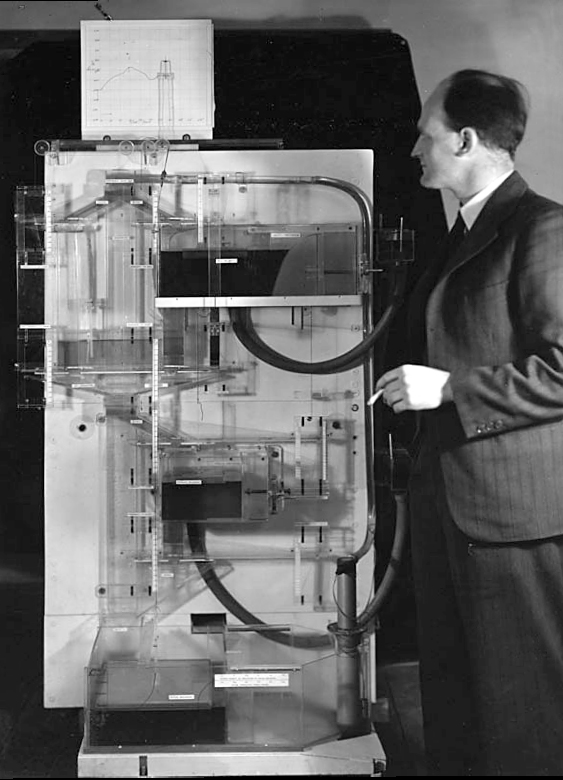
Digital technology and AI are not universal phenomena that develop according to fixed laws—they must be transparent both in the decisions they make and in the power behind those who develop them. They must result from the interaction between cosmologies—meaning not only the scientific understanding of the cosmos but also the cultural, philosophical, and metaphysical beliefs that inform a civilization’s relationship with the universe.
AI and digital technologies are also a great opportunity for the Earth’s ecosystem, agriculture, and food systems. Rural Hack has always told these stories—and if you want to know more, Alex Giordano, a friend and the creator and curator of the pages you’re reading, has written an important book on the topic. The food system can be the outpost in building a new method; but to become that, it must begin to question itself and develop models and policies for a cosmological AI—a form of artificial intelligence no longer focused solely on efficiency and control, as it is today, but instead oriented toward a harmonious and mutually beneficial relationship between humans, technology, nature, animals, and communities. Starting from the connection with the world of ancestors and concern for future generations.