

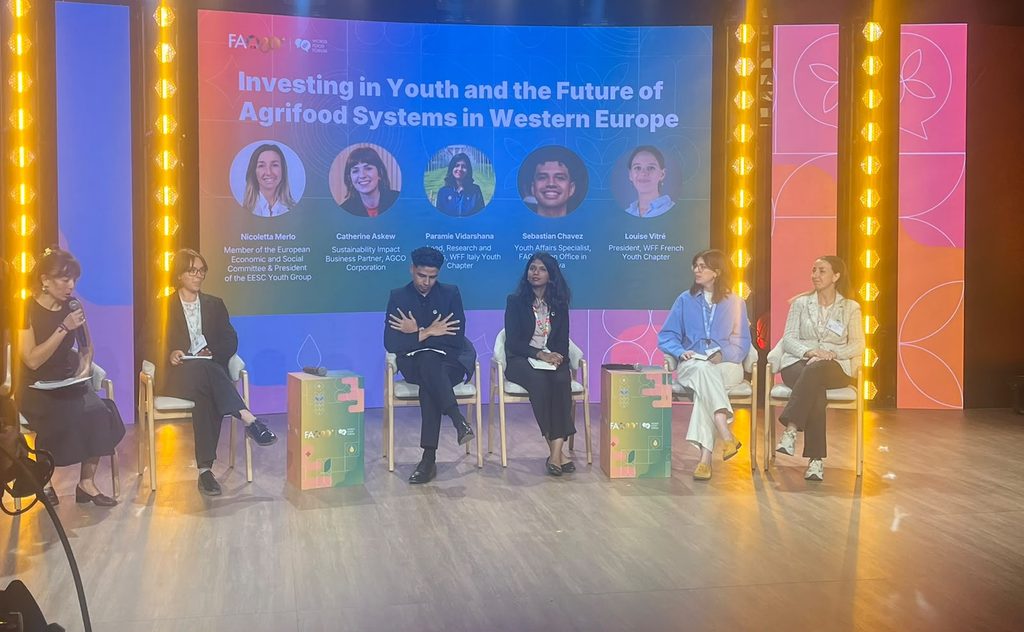
Today, 14 October, our researcher Paramie Vidarshana, Research and Analysis Lead at the World Food Forum Italy Chapter, presented the work we are developing together with the Italian Chapter at the World Food Forum, currently taking place at FAO headquarters. Speaking at the global event, held in Rome from 8 to 16 October, she described a collaboration through which young researchers are examining Italy’s role in global agrifood systems and exploring how its international relationships could evolve in the years ahead.
Paramie Vidarshana speaking at the World Food Forum, FAO headquarters, 14 October 2026.
“For us at WFF Italy Chapter, making global recommendations useful means connecting them with real-world conditions: what already exists, what is missing, and most importantly, what we can realistically take forward,” Paramie explained. This approach also raises a question about what meaningful youth participation involves. Engaging young researchers means making room for their analyses, giving them responsibility for developing proposals, and recognising their ability to contribute to decisions.
From the Farnesina to FAO
This approach took shape through the First Global Foresight Dialogue with Young Generations on the Future of Agrifood Diplomacy, promoted by Nicola Caputo, Advisor to the Minister of Foreign Affairs and International Cooperation on Agrifood Exports and Internationalisation and on European and International Sector Policies, and organised by Rural Hack together with the World Food Forum Italy Chapter.
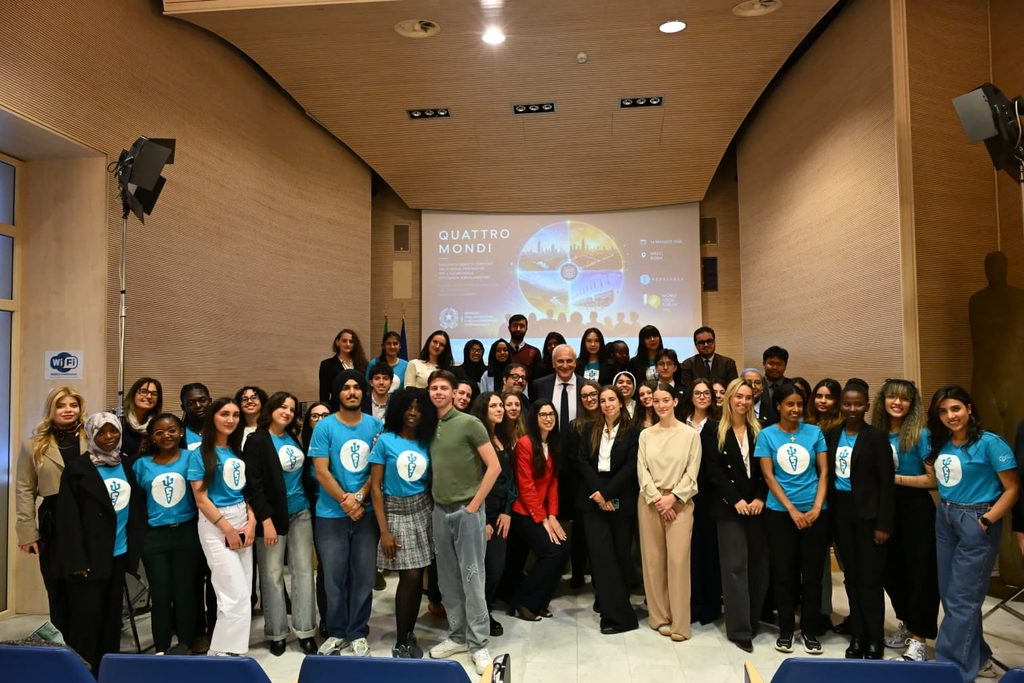
Held on 14 May at the Farnesina, the headquarters of Italy’s Ministry of Foreign Affairs and International Cooperation, the dialogue recognised young scholars as leading voices with expertise on the future. Their knowledge is grounded in research and in the experience of living in different contexts, understanding the changes taking place in their countries, and having to live longer with the consequences of decisions made today.
Foresight, understood as a participatory process of strategic anticipation, provided a way to gather young people’s visions, expectations, and contributions on the future of diplomatic relations shaped by agrifood systems. The guiding report, developed by the Rural Hack task force under Professor Alex Giordano’s scientific direction, proposed a view of Italy’s agrifood sector as an infrastructure for foreign policy. From this perspective, exports form part of a broader web of relationships encompassing scientific cooperation, innovation, knowledge exchange, soft power, and international governance.
The research identified four clusters for examining Italy’s position in global agrifood geopolitics. Mature, high-value economies; dynamic emerging economies; economies in transition facing structural vulnerabilities; and major global geopolitical actors provide a shared framework for exploring different conditions and opportunities. Drawing on this framework, young researchers examined existing partnerships, their history, and the needs of different national contexts, developing proposals for future relations with Italy.
Forty young contributors to the future of agrifood diplomacy
As Paramie observed, “proposing an idea is only the beginning. The harder question to answer is: given the institutions, relationships, and needs already present, what would make that idea workable?” Young researchers contributed throughout the research process, from developing country analyses to initial checking and revision, undertaken by a selected group with scientific guidance. Participation takes substance through the opportunity to produce evidence, critically examine proposals, and help shape the discussion.
The guiding report and the international dialogue led to “Four Worlds, One System. Italy in Global Agrifood Geopolitics”, a volume bringing together contributions from 40 young people. Their analyses pose a question to Italy, its institutions, and its agrifood stakeholders. What relationships should Italy build with their countries, what knowledge should be shared, and what forms of cooperation could shape the future of food diplomacy?
In her intervention, Paramie also highlighted the Empowerment Kit developed by the Chapter’s Gender Equality and Rural Women’s Empowerment Working Group. Through financial literacy, leadership, and advocacy tools, Italian examples, and classroom and workshop exercises, the Kit helps young people develop the skills they need to participate. The partnership between Rural Hack and the Italy Chapter connects these dimensions, bringing research, education, and practical opportunities to develop proposals into the same process.
The forthcoming presentation of Four Worlds, One System
The volume will soon be presented at FAO headquarters at an event to which Maurizio Martina, FAO Deputy Director-General, will be invited. Nicola Caputo, Noran Khalil, President of the World Food Forum Italy Chapter, Professor Alex Giordano, Scientific Director of Rural Hack, and all the young contributors to the volume will take part.
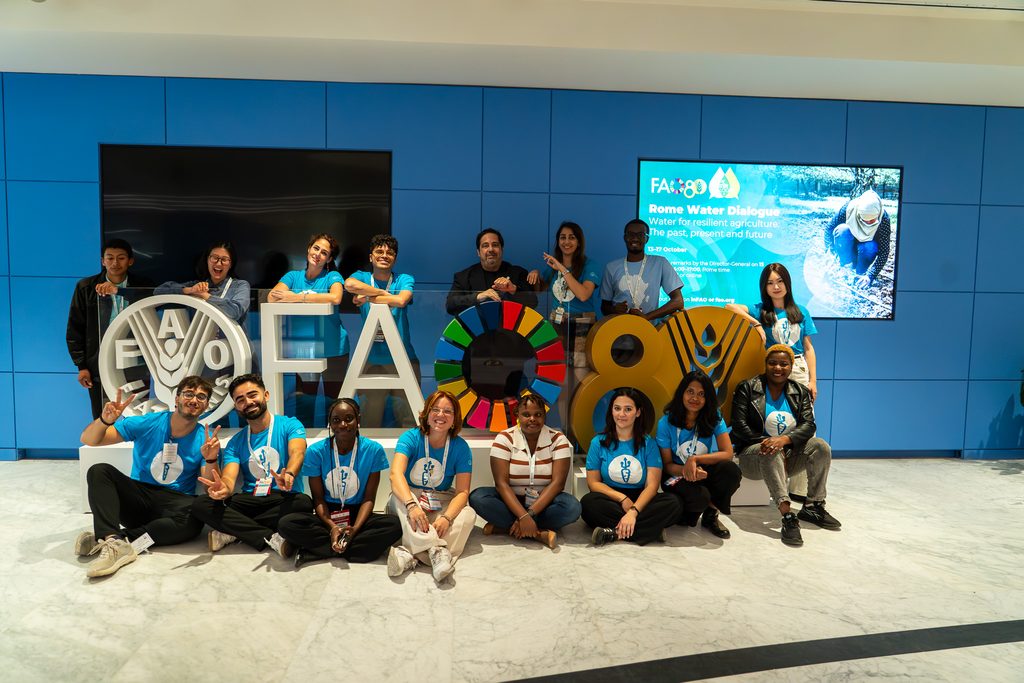
The presentation will provide a further opportunity to bring their analyses into dialogue with institutions and sustain a process that today, through Paramie’s voice, was shared at the World Food Forum.