

Women, Local Knowledge, and Fair Market Access, Read Through a Territorial Food-Systems Len
What does it mean for a small food enterprise, led by a woman in a sub-Saharan African context, to access the market, and which market? This article explores the intersection of female entrepreneurship, local food knowledge, territorial supply chains and digital infrastructure in sub-Saharan Africa, and questions the idea that export and international scaling are the only measures of success. Reading African women-led food enterprises as transformative niches, spaces of social, cultural and economic innovation operating at the margins of dominant, extractive food systems, it examines the structural asymmetries that shape market participation: rigid certifications, fragmented logistics, information gaps and financial exclusion. Drawing on documented cases across Burkina Faso, Mali, Senegal, Niger and Kenya, from cooperative shea processing to fonio supply chains and mobile money, it asks how open digital tools, community-owned infrastructure and territorial knowledge can help preserve local value and build fairer, more durable forms of market access.
Aïssatou spends three days preparing a batch of thiébou yapp, a slow-cooked rice and lamb dish whose recipe has travelled through her family for generations. She sells it at her local market in Senegal, earning enough to keep her children in school while quietly dreaming of expanding. Her horizon is not export for its own sake, nor a brand deal with a Western distributor. What she wants is harder to name in the language of conventional market metrics: recognition, fair exchange, and room to grow without being swallowed by the infrastructure of the global food economy.
Her story stands for the experience of millions of female food entrepreneurs across the continent, and it sits at the centre of a conversation the global food economy is only beginning to take seriously. What does it actually mean for a small business, led by a woman working inside systemic asymmetries, to access a market? And what kind of market are we talking about: one that is extractive and indifferent to geography and inherited knowledge, or one built on mutual resilience?
This article is not a business manual. It does not promise that digital tools will close every infrastructural gap, or that women’s entrepreneurship is a silver bullet for food-system transformation. It tries instead to sit with a genuinely difficult question: how can African women entrepreneurs turn local knowledge, traditional products, artisanal skills and territorial supply chains into lasting, equitable market access without being crushed by the very regulatory and market systems that claim to include them?
To think through this, the article reads the evidence through a territorial food-systems lens, close to the FoodSystem 5.0 framework (Giordano, 2023). Rather than treating food, technology, communities and territories as production variables to optimise, this lens reads them as a living web of relationships, one that can be exploited or nurtured. Seen this way, African women-led food enterprises are not a development afterthought: they are transformative niches, spaces of localised experimentation generating real social, cultural and economic innovation from the margins.
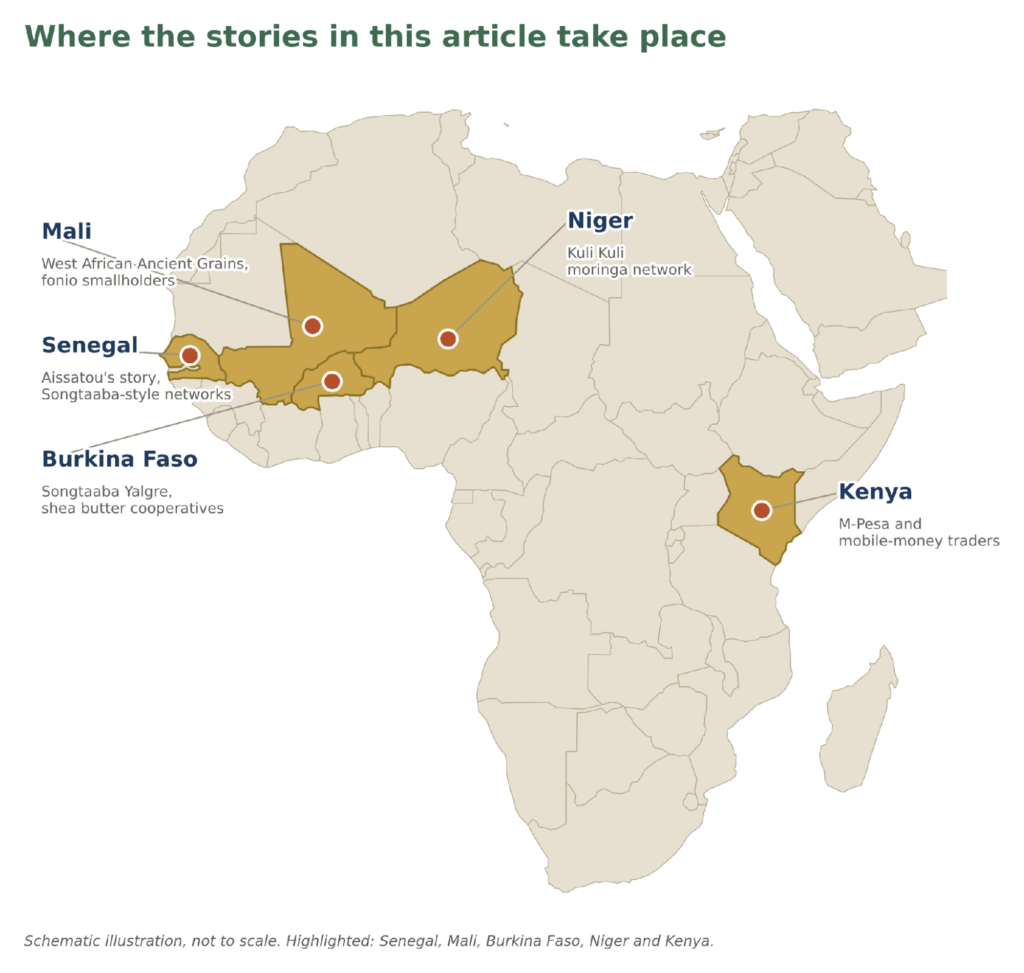
Figure 1. Where the stories in this article take place. Schematic illustration, not to scale. Source: original illustration produced by the author for this article.
What Internationalization Really Means at Ground Level
What Internationalization Really Means at Ground Level
When researchers and policymakers discuss African women entrepreneurs and internationalisation, they often picture a linear path: local production, formal export certification, entry into high-value global markets. The implicit model is about scaling up: moving from a home kitchen to a factory, from a market stall to a supermarket shelf in Europe or North America. That path is real and important for a minority, but it describes only a small fraction of the women engaged in food production and trade across the continent.
For most producers, the geography of ambition sits on a different scale entirely. The Ethiopian grain trader moving regional varieties through informal networks, the Ghanaian shea butter processor shipping bulk volumes to Côte d’Ivoire, the Moroccan argan oil cooperative whose most lucrative market is urban Morocco itself: these are not failed exporters. They are entrepreneurs navigating a form of market access that is relational and embedded in their own territories. The distance between production and consumption may be small in kilometres, but the institutional, informational and logistical obstacles in between remain considerable.
UNCTAD’s 2021 Economic Development in Africa Report documents this reality: informal cross-border trade represents a large share of total intra-African commerce, and women make up the majority of informal cross-border traders in West and East Africa. The African Continental Free Trade Area (AfCFTA), in force since 2021, could formalise and expand these regional flows, but only if its implementation accounts for the barriers that disproportionately exclude women from formal trade channels.
What blocks access is rarely a lack of ambition or product quality. More consistently, it is a set of structural asymmetries: uneven access to real-time market information, certification and packaging requirements designed for large industrial producers, financial exclusion, transport costs that consume profit margins, and an absence of intermediate infrastructure (cold chains, storage, testing labs, legal support) that wealthier economies take for granted. World Bank research shows that women-led enterprises across sub-Saharan Africa face financing gaps significantly larger than those faced by male-led businesses, compounded by weaker collateral positions and thinner institutional networks (World Bank, 2019).
Read through a territorial lens, women entrepreneurs are not passive beneficiaries of inclusion policies but active builders of local food ecosystems. The task is not to fit them into existing, unequal value chains, but to redesign those chains through collective intelligence, shared infrastructure and other ways of creating value, ones that let communities keep more of what they generate.
This is where the asymmetry becomes concrete. Extractive global value chains capture value at the level of territory and knowledge (where the raw material, the recipe, the ecological know-how and the labour originate) and concentrate it downstream, in branding, distribution and platform ownership (Gereffi, Humphrey & Sturgeon, 2005).For African women food entrepreneurs, this is a daily reality: the difference between three euros for a kilogram of raw shea nuts and forty euros for the finished cosmetic product on a Parisian shelf. A joint study by the FAO and the Global Shea Alliance, covering eight countries that together account for 99 percent of shea exports, found that women collectors and processors typically capture between 5 and 15 percent of the final retail value of shea-based products sold in Western markets (Bockel et al., 2020).).
That percentage translates into concrete, modest sums. The same study puts a collector’s gross annual income from shea at around USD 75, with value added per day of her labour at roughly USD 1.9. She sells an 85-kilogram bag of kernels for about USD 24, close to USD 0.28 per kilo, while the same chain exports shea butter at USD 1,000 per tonne and stearin at USD 4,000 per tonne. Across the eight countries studied, 2.4 million women work as shea collectors, out of 16 million involved in shea-related activities overall.
One figure from the same study speaks directly to the case this article makes for collective infrastructure: women who sell through group aggregation, as in the Songtaaba case discussed below, earn 30 to 50 percent more than the village price (Bockel et al., 2020). A nuance in the report is worth engaging with rather than setting aside: the report itself notes that shea in the region generates a value added of some USD 203 million, “mostly captured at the local production level by women collectors and local processors” (Bockel et al., 2020). That framing is accurate, and it does not weaken the argument made here: it sharpens it. A chain can look reasonably equitable once its local share is summed across 2.4 million collectors, and still leave any single one of those women with USD 75 a year to show for it.
The distance between three euros and forty euros is not a market accident. It is where the chain is designed to break in her favour, or not.
Figure 2 sketches, in illustrative terms, what this asymmetry looks like when set against a producer-controlled alternative, the kind of cooperative model examined later in this article.
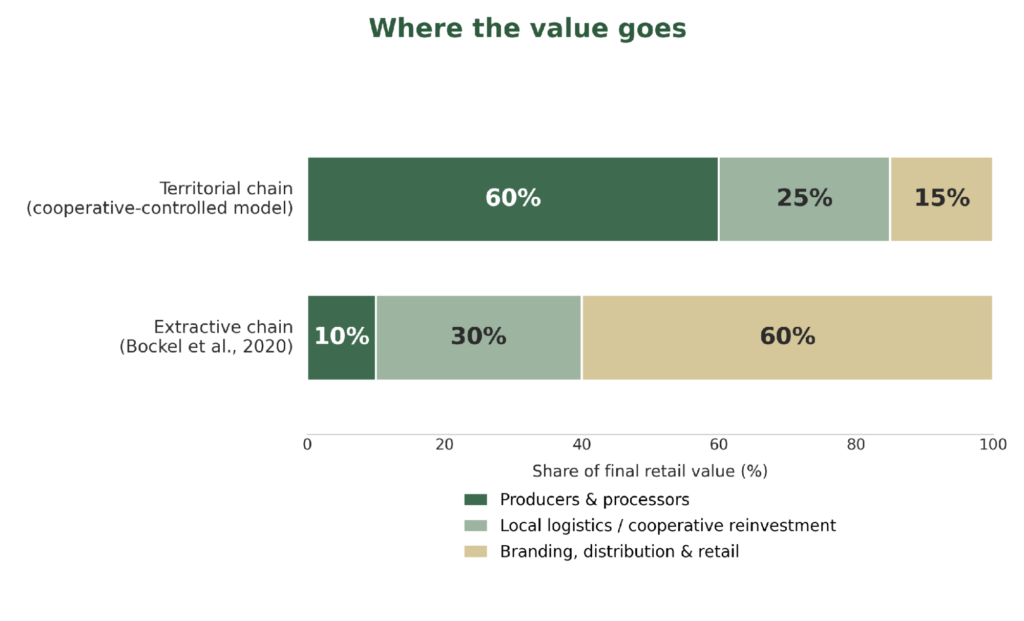
Figure 2. Illustrative comparison of value distribution in an extractive shea value chain (based on the pattern described inBockel et al., 2020) against a producer-controlled territorial model. Figures for the territorial model are illustrative rather than measured. Source: original illustration produced by the author for this article, based on Bockel et al. (2020).
The Infrastructure of Exclusion
There is a particular cruelty to the obstacles female food entrepreneurs face, because many are framed in the neutral language of consumer safety and standards compliance. Food safety rules, export certifications, traceability requirements and brand-identity systems exist, in principle, to protect consumers and ensure fair competition. In practice, they often concentrate market access in the hands of actors who can afford the legal, logistical and technical resources compliance requires.
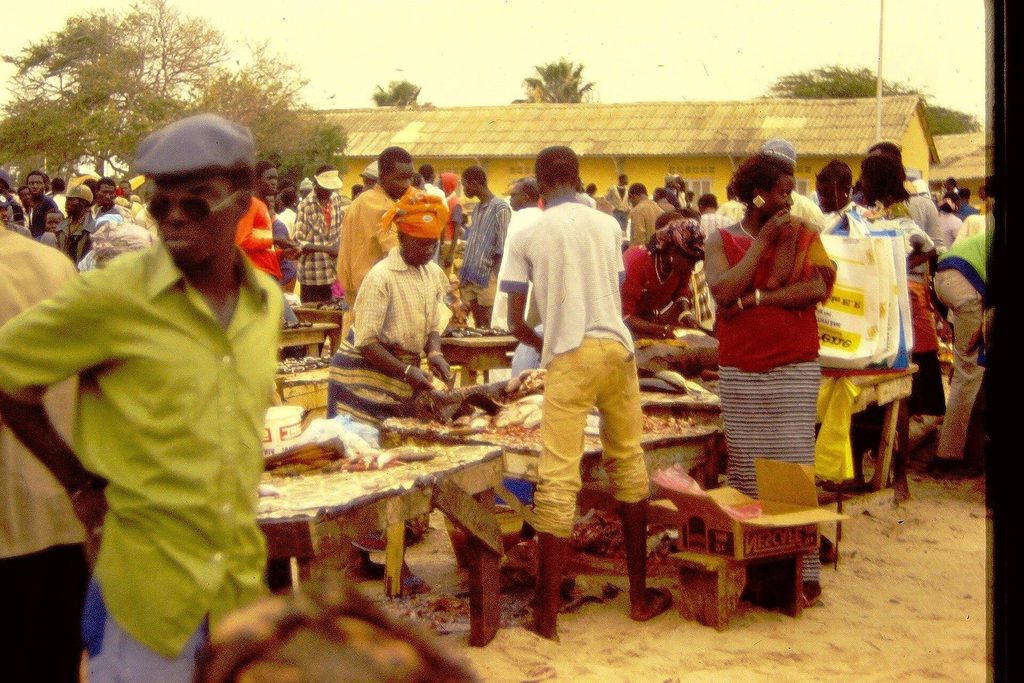
Fish vendors at the Soumbédioune market, Dakar, Senegal.
Consider certification. To sell into European or North American markets, small producers must satisfy a cascade of requirements: EU food safety rules, country-specific phytosanitary inspections, labelling compliance in the destination market’s language, often with fair-trade or organic certification layered on top. Fouilleux and Loconto (2017), studying voluntary certification in the global organic sector, show how accreditation and standard-setting are dominated by Global North institutions, leaving Global South producers dependent on frameworks they did not design. For a women’s cooperative in rural Burkina Faso producing fermented locust beans (a traditional product of real nutritional, ecological and cultural value), this means navigating a certification maze built around industrial-scale processing.
This is roughly where Aïssatou’s own ambitions stall. She has heard about EU labelling rules and organic certification from a cousin who tried and gave up; the cost of testing alone would take months of her market earnings. The logic of the rule is reasonable (food safety matters), but its design assumes a scale of operation she does not have and is not sure she wants.
The same logic applies to logistics. Transport across much of sub-Saharan Africa remains fragmented and expensive, particularly for perishable goods; cold-chain infrastructure is scarce outside major cities; port procedures are slow and costly. Producers who manage to get their goods to a shipping port often find that freight, insurance, customs and broker fees consume the margins that made the business viable in the first place. Production ends up structurally cut off from the markets closest to it, in principle if not in kilometres.
Then there is information asymmetry. Knowing which regional market to target, how consumer preferences are shifting, how to price competitively, which certification opens which door: this is knowledge that large trading companies guard as competitive advantage. For women-led microenterprises without formal business support, the gap is disabling. Baumüller (2018), reviewing the literature on mobile-enabled services for smallholder farmers, notes that digital information services help only when embedded in broader physical support systems and adapted to local literacy and connectivity.
A territorial reading of this problem introduces the idea of data and knowledge commons: market information, quality standards and supply-chain data as shared, open infrastructure rather than proprietary intelligence held by intermediaries. This is a political question as much as a technical one: it asks who owns the information that governs market access, and whether that can be arranged differently.
The Value of What You Already Know
One of the more quietly radical ideas in this territorial reading is that local knowledge is not a deficiency to correct, but an asset to protect and build on. This cuts against decades of development thinking that treated traditional food practices as obstacles to modernisation: inefficient, incompatible with international markets.
African women’s food knowledge (encoded in fermentation practices, seed selection, soil management, preparation techniques, flavour combinations refined over generations) is a form of ecological and cultural intelligence that industrial food systems rarely replicate. The global wellness and natural-foods market, worth hundreds of billions of dollars (Global Wellness Institute, 2023), is built in large part on the commercialisation of exactly this knowledge: turmeric, moringa, baobab, fonio, shea, black seed, fermented sauces and ancient grains, understood for centuries before becoming premium items on Global North supermarket shelves.
The problem is that the women who hold this knowledge rarely benefit proportionally from its commercialisation. The pattern is well documented: a traditional product is identified by a foreign enterprise, tested in outside labs, standardised, repackaged with a Western brand story, and sold at a premium while producers receive a small fraction of the retail price and no recognition of the knowledge behind it. Daviron and Ponte (2005), in their study of global coffee value chains, describe this as the paradox at the heart of commodity markets: the regions producing the most distinctive, high-quality goods often capture the least value.
This is where knowledge sovereignty matters, not as an abstract idea, but as a practical question of who controls the definitions, standards and cultural narrative of a product. A food product entering global commerce on its producers’ own terms, with its name, history and context intact, is a different economic thing from one entering as an anonymous raw ingredient to be renamed by a northern distributor.
The Songtaaba Yalgré Association in Burkina Faso is a documented example. Founded in the 1990s by Marcelline Ouédraogo with 30 women, the cooperative grew to train and organise more than 2,000 women in processing and marketing shea-based products. It built its own French-language sales platform as early as 2004, selling directly to buyers in Europe, Canada and the US. It obtained Ecocert organic certification and used GPS mapping of shea trees and harvest fields to build independent traceability, commanding premium prices while keeping producer control over the supply chain. This is not a story of external rescue. It is collective intelligence, applied deliberately, to route around extractive intermediaries.
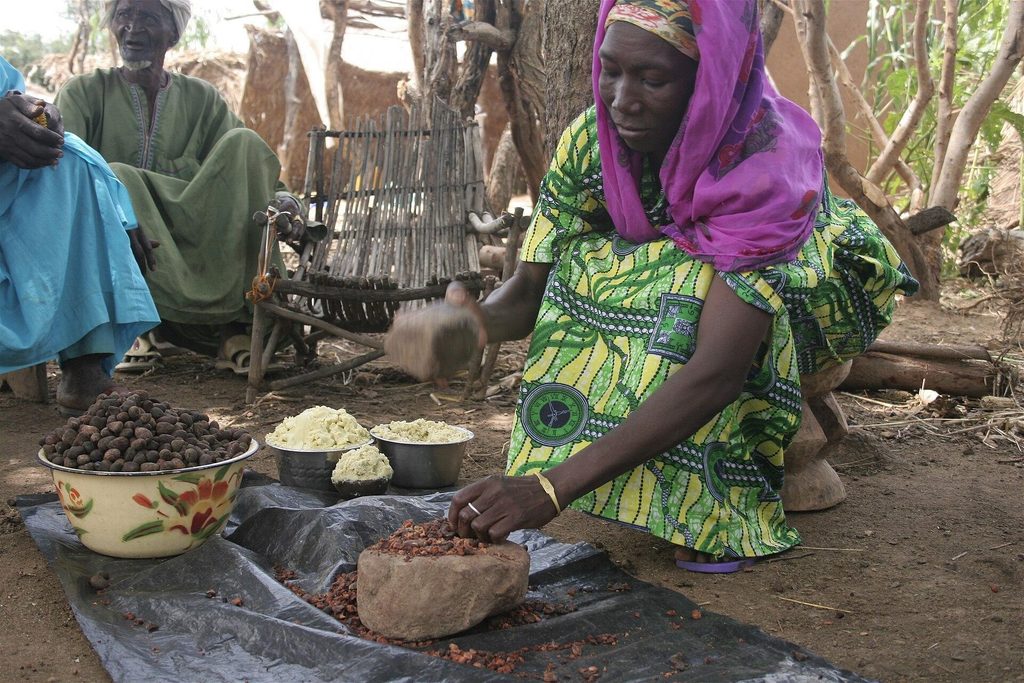
A woman crushes roasted shea kernels on a stone, with bowls of nuts and finished shea butter beside her, Burkina Faso.
If Aïssatou ever hears of Songtaaba, it will likely be through word of mouth rather than a development programme, which is itself part of the problem this article returns to later: good models exist, but knowledge about them travels unevenly.
Technology as Infrastructure, Not Magic
No conversation about African women entrepreneurs and market access can avoid digital tools. Mobile payments, social commerce, e-commerce platforms and digital traceability have become central to development policy and entrepreneurship narratives over the past decade, for good reason: there are real, data-backed examples of change.
The most studied case is M-Pesa in Kenya. Launched by Safaricom in 2007, it now serves over 40 million active users and processes more than a billion transactions a month. A landmark study by Suri (MIT) and Jack (Georgetown), published in Science in 2016, estimated that M-Pesa lifted roughly 194,000 Kenyan households out of extreme poverty, with the largest effects concentrated among female-headed households, for whom secure digital savings and payments enabled more resilient income management. By 2023, some 21 billion transactions a year, worth KShs 35.9 trillion, were moving through the M-Pesa platform (Safaricom, 2023). For market traders, food vendors and small processors, this means less cash-handling risk and a wider secure commercial reach.
Yolélé Foods, the social enterprise co-founded by chef Pierre Thiam and entrepreneur Philip Teverow in 2017, shows both the possibilities and the conditions needed for market access to become transformative. Yolélé has built a US market for fonio, a climate-resilient West African grain grown mostly by women smallholders across Mali and Senegal, now reaching over 2,000 stores including Whole Foods and Target. Through a partnership with West African Ancient Grains (WAAG) in Mali, supported by a $1.98 million co-investment from USAID’s Prosper Africa initiative, the enterprise is building post-harvest processing infrastructure aimed at raising smallholder cash income by an estimated 85 percent (Yolélé, 2022). The model works because it goes beyond distribution: it pairs market-building with supply-chain reinvestment, local processing and a brand narrative that keeps producers visible.

Harvested fonio piled in the field, Mali.
Kuli Kuli Foods, founded by Lisa Curtis after her Peace Corps service in Niger, has sourced moringa from women-owned cooperatives and family farms across West Africa since 2011. By 2020 it was sourcing from over 2,400 farmers in 13 countries, with African women as the largest group of primary producers, generating over $5.2 million in direct income while supporting the planting of more than 24.6 million moringa trees (Kuli Kuli, 2019). These numbers matter less as commercial metrics than as evidence of what a different kind of internationalisation looks like: producers as recognised partners rather than anonymous suppliers.
But there is a risk in letting the best corporate examples stand in for a shift that has not yet happened broadly. Mobile internet penetration across sub-Saharan Africa, though growing, remains below fifty percent in many rural areas (GSMA, 2023). Smartphones are often shared, intermittently charged, dependent on unreliable power grids. As Baumüller (2018) notes, the benefits of digital agricultural services depend heavily on literacy, connectivity and the presence of physical support systems alongside them. Access to a digital channel is not the same as access to a market. A woman who lists her products on a global e-commerce platform without understanding its fee structure, shipping rules or search algorithm can end up worse off than before.
This is, in practice, where Aïssatou is now: she has a smartphone and a WhatsApp group of regular customers, which already functions as a modest kind of informal commerce infrastructure. What she does not have is the next layer: a shared cold box at the market, a testing lab three cooperatives could split the cost of, a way to know what a fair export price for her dish’s ingredients would even look like. The tool she has works. The system around it does not yet exist.
What Support Really Looks Like
“Empowerment” appears in nearly every development report on women and food systems in Africa, so often that it risks becoming a gesture rather than a commitment. Asked directly, what do female food entrepreneurs actually say they need? The research is fairly consistent.
First, finance adapted to informal and semi-formal enterprises: not standard microloans with high interest and short repayment windows, but patient capital, revolving group credit and blended finance able to absorb early-stage risk. Kabeer (2012), studying women’s economic empowerment across developing economies, finds that lasting gains in market access come not from isolated financial products but from combinations of capital access, organisational support and peer networks.
Second, shared physical infrastructure: cold storage, packaging facilities, testing labs, certified processing equipment. These assets are too costly for an individual micro-entrepreneur, but collectively available through shared hubs they change what a local product’s shelf life and market readiness can be.
Third, access to networks: horizontal peer networks sharing real-time market intelligence, and vertical networks connecting producers to buyers, regulators, food scientists and research institutions.
The Songtaaba Yalgré Association shows all three at once. Supported by ICCO Cooperation’s STARS programme (2017–2021), backed by the Mastercard Foundation across 210,000 smallholders in Ethiopia, Rwanda, Senegal and Burkina Faso, the cooperative diversified its product line, established new commercial partnerships (including with the Danish buyer AAK) and stabilised its finances. This was not a one-off intervention but a sustained, multi-year engagement combining technical assistance, market linkage and integration into formal networks. The shea union UGF/CDN, supported by the same programme, brought together over 6,000 female members under a similar model.
Read through a territorial lens, local communities, innovation hubs, universities, cooperatives and public institutions are not optional add-ons to entrepreneurship: they are its foundation. This reframing matters: it moves the responsibility for market access away from individual women, away from the exhausting language of “hustle,” and onto the collective structures that either enable or undermine their economic agency.
Imagining Internationalization Otherwise
The title of this article, “Not Only Export”, is a deliberate provocation. Exporting is not inherently bad, and international markets are not automatically extractive. Trans-Saharan and maritime trade has been part of African economic life for centuries, and the aspiration to reach distant consumers with finished products is legitimate. The real question is not whether cross-border trade should happen, but on what terms, on whose conditions, and with what consequences for the territories the trade originates from.
A territorial reading proposes territorial supply chains as an alternative to extractive global commodity chains: arrangements where value is created, distributed and reinvested within a defined geographic and cultural context, where cultivator, processor, transporter, retailer and consumer share a web of relationships that fosters accountability. Internationalisation here does not mean extracting a raw product to be refined and monetised elsewhere: it means extending a territory’s identity and claim to value outward, without cutting the product loose from its roots.
The cases discussed here (Songtaaba in Burkina Faso, Yolélé and WAAG across Mali and Senegal, Kuli Kuli’s cooperative network) are each specific and cannot simply be copied elsewhere. But together they show a consistent pattern: the enterprises that achieve fair, durable market access combine internal organisational strength, a clear territorial identity, external network support, and a refusal to give up control of their product’s story. What these enterprises need from partners is not inspiration but infrastructure: public policy that treats traditional food knowledge as a common good worth protecting, financial systems that make patient capital available in informal contexts, and an AfCFTA implementation that builds real pathways for small cross-border producers rather than simply cutting tariffs for large exporters.
Figure 3 traces this as a sequence rather than a checklist, because in practice one layer of support only holds if the one beneath it is already in place.
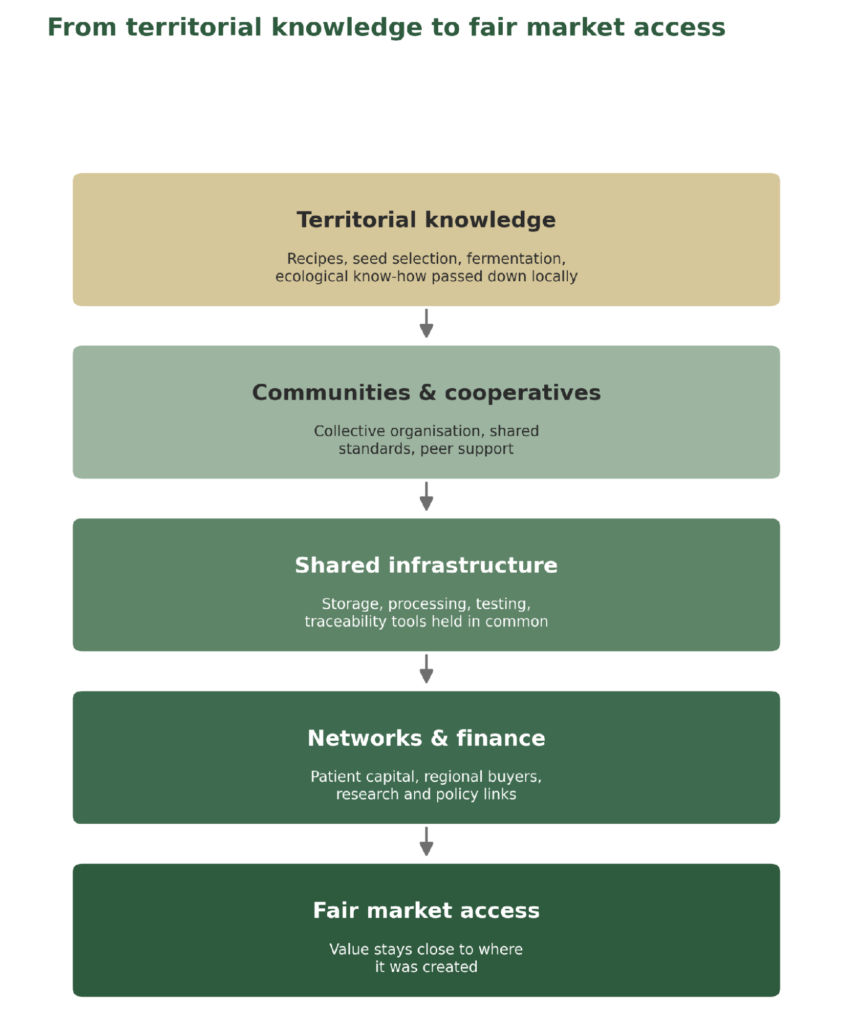
Figure 3. From territorial knowledge to fair market access: the support recurring across the cases discussed in this article builds in sequence, each layer resting on the one before it. Source: original illustration produced by the author for this article.
A territorial lens also helps explain the limits of the M-Pesa story used earlier. Mobile money has lifted many female-headed households out of poverty by widening financial inclusion, but its current form has real constraints: critics point to withdrawal fees on small transactions reaching up to 10 percent, a cost that falls hardest on the poorest traders (Donovan, 2012). That is what happens when a technology built as shared infrastructure is monetised by corporate actors and drifts back toward the extractive pattern it was meant to interrupt, unless community governance holds it in place.
A tool does not become access on its own. It becomes access when the system around it lets her keep what she earns.
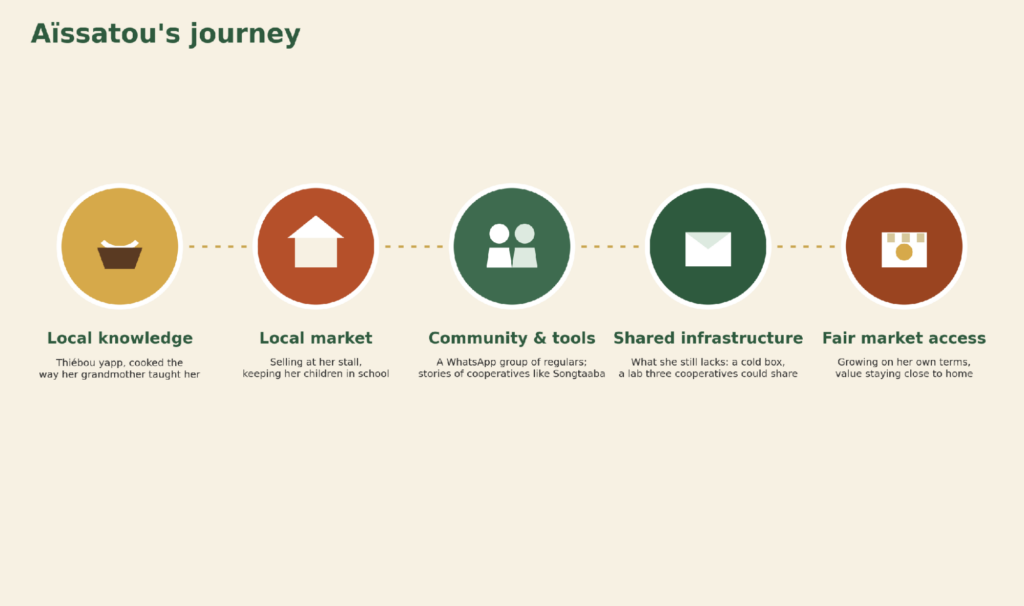
Figure 4. Aïssatou’s journey, from the knowledge she already holds to the fair market access she is still building toward. Source: original illustration produced by the author for this article.
Not Waiting to Be Discovered
There is a familiar, reductive way of telling the story of African women and food systems: as passive victims of structural inequality, rescued occasionally by an NGO programme or a viral moment. This article has tried to tell a different story, one that does not deny the obstacles but starts from the knowledge, resilience and strategic intelligence these entrepreneurs already have.
The question of fair market access for African women food entrepreneurs is not, in the end, a question of ambition, product quality or technology adoption. It is a question of political economy: who invests in infrastructure, who sets the standards that govern market entry, who captures the value that territorial knowledge generates, and who has the power to change any of this.
A territorial food-systems lens, developed in a European context, gains real depth when read against African women’s food entrepreneurship. Its critique of extractive value chains names a reality producers navigate daily. Its insistence on local communities, territories and knowledge commons as the foundation of a sustainable food system is borne out by every cooperative, processing hub and collective that has reached the market on its own terms.
Aïssatou is still at her stall, still cooking thiébou yapp the way her grandmother taught her. She is not waiting to be discovered. What would change her horizon is not a single grant or a viral post, but the ordinary, unglamorous things this article keeps returning to: a shared cold box, a fair price for what she already knows how to make, a network that tells her which door to knock on next. The global food economy does not need to save her. It needs to stop standing in her way, and start building the infrastructure that lets her, and the millions of women like her, grow entirely on their own terms.
By Sahar Manouchehri