

Thanks to a project that optimizes and automates the detection of damage caused by the brown marmorated stink bug on pears, Enrico Giovanella (University of Modena and Reggio Emilia) was awarded first prize in the agricultural category of the inaugural AgriFood Future Award.
The award was presented on May 9th in Salerno, during Agrifood Future Research—a deep-dive event held alongside the national AgriFood Future initiative, promoted by Unioncamere in collaboration with the Chamber of Commerce of Salerno. In just two editions, AgriFood Future has become one of Italy’s most prominent events on the future of agrifood systems.
Directed by Professor Alex Giordano, the 2024 and 2025 editions of AgriFood Future hosted meetings among businesses, institutions, and trade associations to foster dialogue between technology, communities, and food production—based on the FoodSystem 5.0 approach. The goal: ensuring that it’s not innovation that drives our future, but that technological solutions support sustainable development—environmentally, socially, and economically.
The AgriFood Future Award aimed to go one step further by recognizing research efforts that help close the gap between academic output and the real-world needs of the agrifood sector. The focus is on concrete studies that address problems and propose actionable solutions for industry players.
The Award-Winning Study
Giovanella’s work, titled:
“Visualization of Damage on Pears Caused by Halyomorpha halys Using Multivariate Analysis of Near-Infrared Hyperspectral Images”
was selected as the best in the agronomy category. The study significantly contributes to the detection of damage on pears caused by stink bug punctures—damage that is not visible to the naked eye—with the aim of improving post-harvest sorting systems.
Problems Addressed – Proposed Solutions – Target Users
| Problems | Proposed Solutions | Target Companies |
|---|---|---|
| Difficulty in early detection of stink bug damage. | Use of near-infrared hyperspectral imaging to detect invisible damage. | Fruit storage and distribution cooperatives and companies. |
| Economic loss from selling damaged pears or removing them from the market. | Image analysis algorithm to classify healthy vs. damaged pears. | Fruit processing industries. |
| Lack of automated tools for post-harvest fruit sorting. | Creation of a dataset to improve automated classification and pear sorting. | Producers of post-harvest quality control technologies. |
Context and Impact of the Brown Marmorated Stink Bug
The Halyomorpha halys, commonly known as the brown marmorated stink bug, is an invasive species that has caused significant damage to orchards, vegetable gardens, and ornamental plants worldwide. In Italy—Europe’s top pear producer—the pest has been especially destructive, particularly in Emilia-Romagna, with crop loss in some areas exceeding 50%.
Types of Damage and the Need for Sorting Technologies
Stink bug damage includes externally visible deformities, as well as internal necrosis and corky tissue that are invisible to the naked eye, often only noticeable when the fruit is cut open. That’s why there is a pressing need for non-invasive post-harvest sorting solutions.
An Innovative Approach: Near-Infrared Hyperspectral Imaging
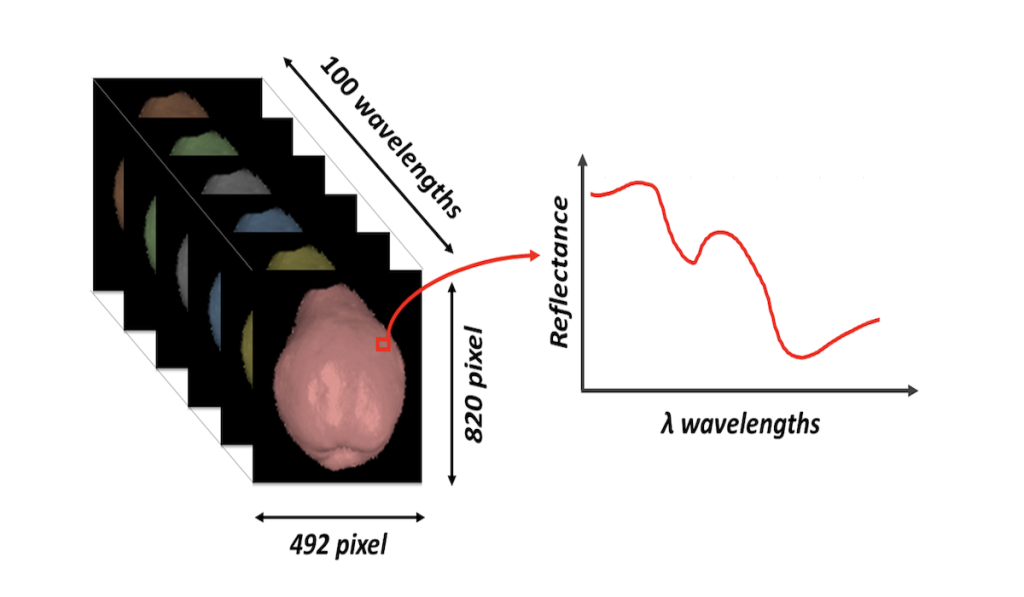
The thesis, developed as part of the HALY.ID European project, focused on using hyperspectral imaging in the near-infrared range (1156–1674 nm) on Williams variety pears. After harvesting (August 2022 and 2023), the pears were photographed across multiple sessions over a six-week cold storage period, generating a total of 1,964 images.
Multivariate Analysis: From PCA to IPLS-DA
Initial analysis using Principal Component Analysis (PCA) did not yield sufficient discrimination due to irregular shapes and weak contours of the punctures. To improve results, the team implemented a combined approach: hyperspectral imaging + interval Partial Least Squares Discriminant Analysis (IPLS-DA). This method enabled the automatic selection of pixels correlated with stink bug damage.
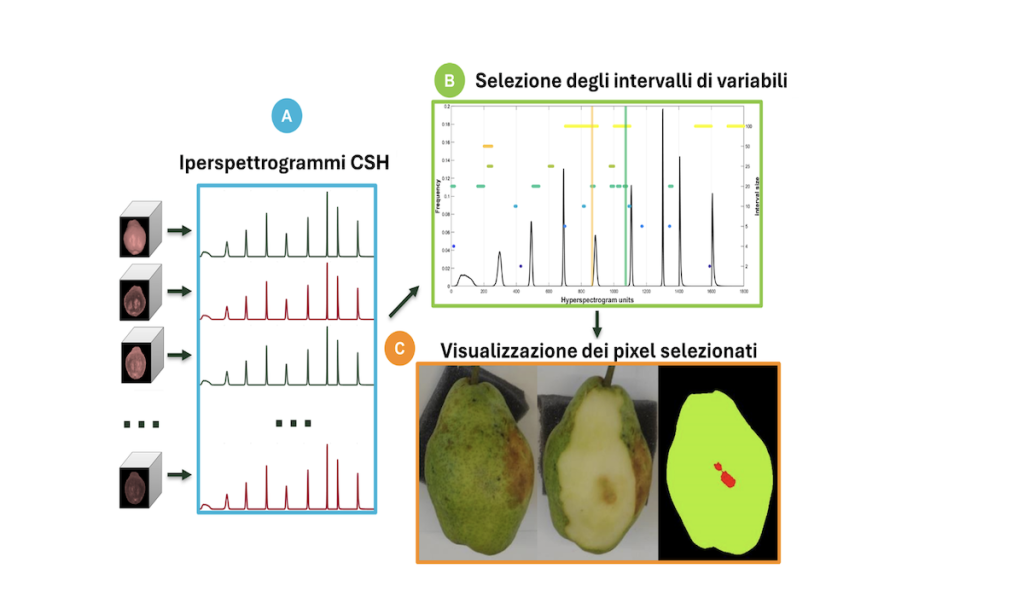
A: dimensionality reduction using hyperspectrograms;
B: application of Ipls-DA to select variables correlated with the punctures;
C: selected pixels (in red) visualized in the original image domain
(Source: Enrico Giovanella)
Quantitative Results
- 2022: 54 images analyzed — 33 punctures correctly detected (61%)
- 2023: 298 images analyzed — 240 punctures correctly identified (81%)
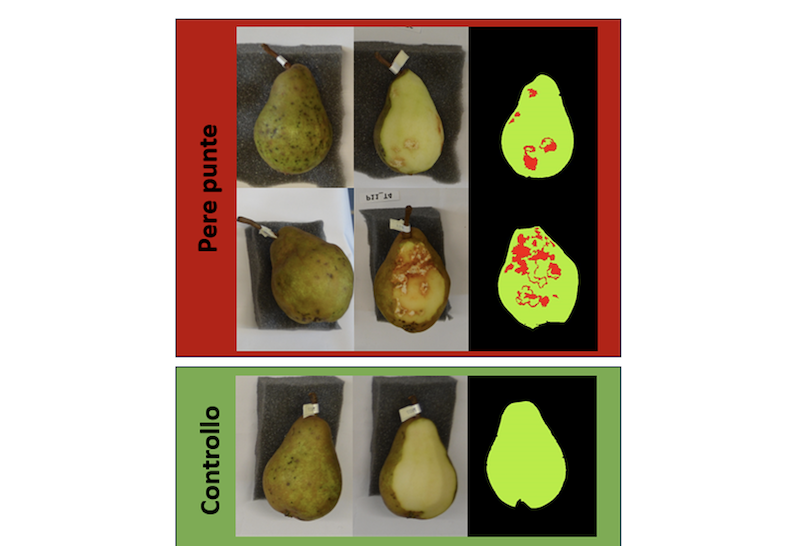
The technique also demonstrated robustness: it could detect similar types of damage even when not caused by the stink bug, and crucially, did not confuse other issues (like mold) with bug-related damage.
Application Outlook and Future Development
This study lays a solid foundation for pixel-level classification systems, thanks to the ability to build separate spectral datasets for healthy and damaged areas. Future use of multispectral imaging (with fewer wavelengths) could make the technology faster, more cost-effective, and easier to integrate into industrial sorting processes.