

There is an Italy that grows in the soil. But there is also an Italy that sinks into the earth. An Italy where tomatoes are worth less than the jars they come in, where harvesting is entrusted to invisible hands, and where the land is still a battlefield—not metaphorically, but in the precise sense of domination, extortion, and the systematic disappearance of rights. And yet, we live in the age of artificial intelligence.
We can recognize a face from low-resolution pixels, translate Armenian dialects in real-time, generate contracts, compose symphonies, write poetry, and automate finance.
But when it comes to uncovering a labor boss, tracing suspicious flows of EU funds, or simply distinguishing a real farm from one owned by a ghost company, suddenly, everything becomes complicated. The data either doesn’t exist, can’t be used, or is too “sensitive.”
The Role of AI in Combating Agro-Mafias
The truth is, AI could do much to fight agro-mafias. But it doesn’t. It isn’t allowed to. It’s not in anyone’s interest. Agro-mafias are not just criminal folklore; they are parallel infrastructures of economy and power. They operate where the state is weak or has delegated authority.
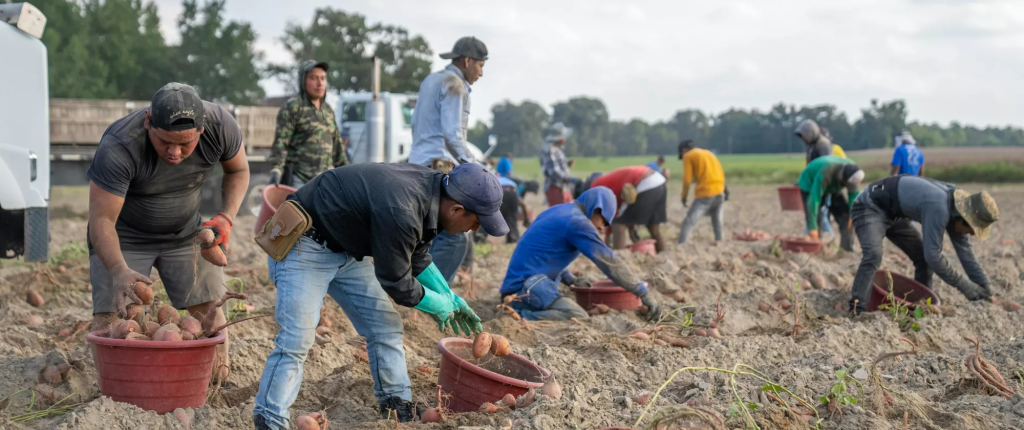
They control cooperatives, storage, transport, and distribution centers. They distort agricultural markets, manipulate tenders, drain CAP funds, set prices, and exploit laborers as human software. The margins are high because inspections are few. And when there are inspections, they are blind, slow, and disconnected.
AI could track supply chains, integrating blockchain and artificial intelligence to monitor every step of an agricultural product, from farm to shelf. If there’s an anomaly, the algorithm would detect it. But it requires all actors to cooperate. AI could flag suspicious behavior by cross-referencing production volumes, economic flows, weather forecasts, and price trends.
For instance, if a cooperative reports tons of tomatoes affected by hail, the system can trigger an alert—but only if it has access to the data—the real, uncomfortable data. AI could monitor territories with drones equipped with computer vision, detecting illegal crops, waste dumps, or arson. But the most at-risk territories are often those where drones “can’t see” due to bureaucratic reasons or where they fly but don’t report anything.
The Ethical Dilemma of AI in Agriculture
AI could detect criminal threats and language, analyzing texts, posts, and contracts with NLP tools to intercept patterns of intimidation. But then we enter an ethical dilemma: who monitors the monitors? And who decides what constitutes a threat when it moves in silences, allusions, and local jargon?
AI could provide tools for the small players, offering automated contract assistance to help producers defend themselves from unfair practices. But often, there is a lack of digital skills, trust, and access to infrastructure.
The problem is not technological. It’s political, economic, and cultural. Agro-mafias infiltrate the gaps in governance. AI could close these gaps, but it requires access to data, independent governance, and community oversight. What is needed is a territorial AI model, developed with and for communities.
A laboratory where AI is not a tool of surveillance, but of empowerment: returning power to the small, the marginalized, and the honest. A model that integrates public data, collective intelligence, and open technologies. One that can say: this supply chain is clean, this cooperative is transparent, and here, rights are respected. And it should do so with evidence, not just storytelling.
Interrupting Resilient Criminal Networks with Data Analysis: A Case Study
In a rural area of Southern Italy, an experimental project has been proposed where artificial intelligence is used to counter distortions in agro-food supply chains linked to mafia practices.

The initiative, promoted by a local network of research entities, transparent agricultural cooperatives, and civic associations, integrated heterogeneous data sources: PAC data, satellite maps, logistics flows, and anonymous reports gathered via digital portals. An automatic anomaly detection system compares production data with average market prices, climatic, and geographical parameters.
The model identifies suspicious inconsistencies, such as declared volumes not matching agricultural land area, repeated transports to unregistered warehouses, or opaque corporate networks. In simulated cases, such anomalies generate alerts that can be transmitted to the competent authorities.
Citizen Science and Participatory Platforms
The key element of this hypothesis is the participatory dimension: an open-source platform allows citizens to anonymously contribute to civic observation of the territory. It’s citizen science applied to economic legality, based on cooperation between local knowledge and digital tools. This hypothetical project highlights strong potential: where AI is built with communities and not imposed from above, it becomes an ally in restoring economic justice and public trust.
The Empowerment of Local Communities
If we were to implement a similar model in Capitanata, one of the areas most vulnerable to labor exploitation and mafia control in the tomato supply chain, a local data lake could collect PAC declarations, transport flows, climatic data, and anonymous civic reports in real-time. An anomaly detection system could identify cooperatives declaring double harvests compared to the climatic average and detect suspicious logistical patterns: vehicles operating at night between unregistered storage locations, economic flows inconsistent with produced volumes. An NLP module could analyze contracts, job offers, and messages in local chats, flagging extortion or exploitation-related content.
AI for Economic Freedom and Transparency
AI could open up significant advantages for small farmers: a transparent supply chain, traceable prices, and tenders monitored by impartial algorithms. In this scenario, the small producer is no longer at the mercy of opaque intermediaries, complicit transporters, or fake cooperatives. A clean supply chain isn’t a moral showcase—it’s a competitive advantage, because it frees up margins, restores reputation, and attracts investment.
The legal advantage is equally significant: AI can make visible dynamics that were previously only whispered. A community with access to structured evidence can defend itself better, even in court. There is a social gain: fewer threats, less fear, less isolation. A system that reports anonymously and securely strengthens the bond between citizens and institutions.
Cultural Regeneration and Community Empowerment through AI
Finally, there’s a powerful collateral effect: cultural regeneration. When data becomes a common good, when knowledge of the territory is shared, the boundary between farmer, citizen, activist, and innovator shrinks. Schools participate, universities return to usefulness, and young people find a reason to stay. AI, if designed correctly, doesn’t centralize power—it distributes it. Mafias, on the other hand, thrive on fragmentation. That’s why the point isn’t just to repress—it’s to disarm the conditions that make racketeering profitable. In a context where surveillance is shared, knowledge is distributed, and margins are based on transparency, agro-mafia loses ground.
The Role of AI in Creating Transparent Agricultural Systems
The European AI Act, which mandates traceable and auditable high-impact social systems, calls for such an approach. The National Recovery and Resilience Plan (PNRR), Missions 1 and 5, which focus on digitalizing the public administration and fostering social inclusion and territorial cohesion, also support this model. The Strategic National Plan for CAP 2023–2027 encourages the use of advanced technologies for the sustainability of supply chains. The funds are there, the technologies are there. What’s missing is coordinated will. But in territories that have learned to face fear head-on, that will often comes from the community, not politics. It’s a good place to start.