

The Made in Italy brand has reached historic heights: according to the latest Istat data, in 2022 Italy’s exports hit an all-time high of €625 billion. Globally, Italian products are perceived as a guarantee of quality, authenticity, beauty, and tradition—a symbolic value that spans across various sectors, from fashion to automotive, from luxury goods to food.
The Italian Agri-Food Sector
Italian culinary tradition is a true laboratory of cultural biodiversity, with its recipes and products inspiring and influencing global gastronomic trends.
According to Coldiretti, the agri-food supply chain—from farm to table—is worth €580 billion in Italy (a quarter of the national GDP) and employs 4 million workers. The so-called DOP economy—which includes 297 DOP/IGP specialties and 415 DOC/DOCG wines recognized at the European level—plays a crucial role in the development of agri-food districts throughout the country.
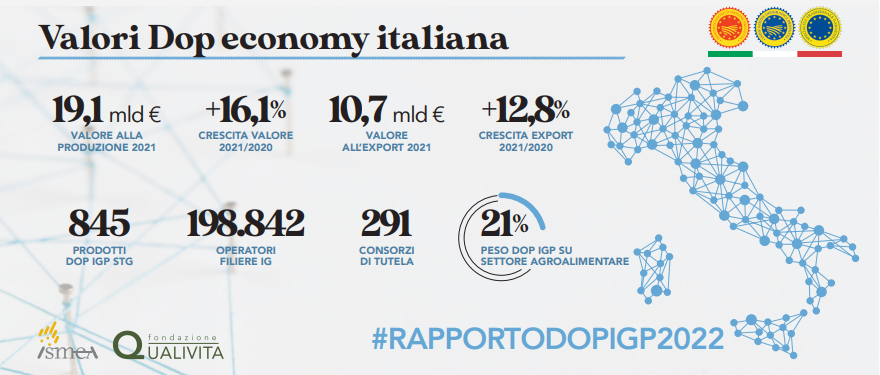
Data from the 20th Ismea-Qualivita Report confirms the sector’s resilience and productive continuity, with a total production value of €19.1 billion (+16.1% year-on-year) and exports worth €10.7 billion (+12.8%).
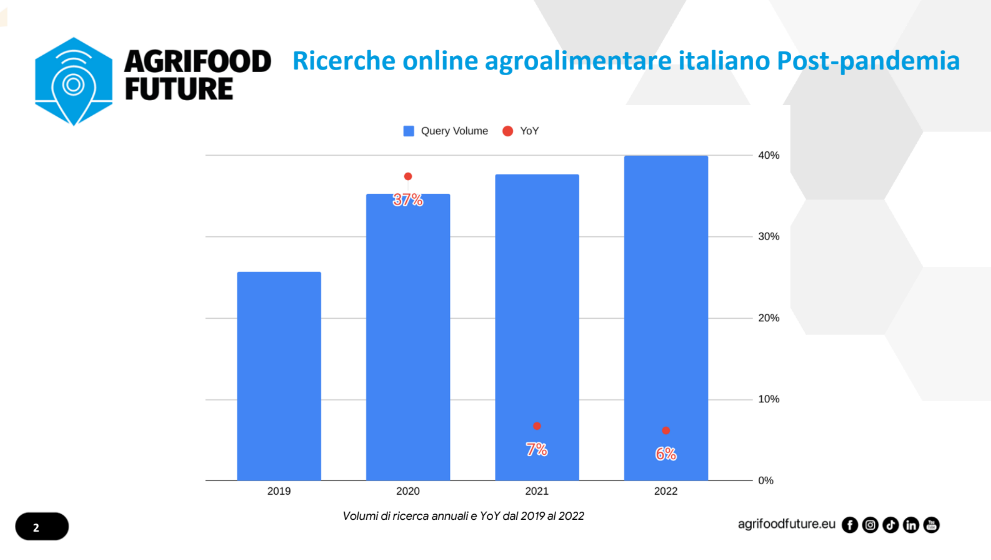
Moreover, according to Google data presented at Agrifood Future, the pandemic period marked a turning point for online searches related to Italian agri-food products (+37% in 2020). This trend continued in subsequent years (including early 2023), mirroring the growth in exports, which reached €625 billion in 2022.
It is therefore evident that agri-food is a key strategic lever for Italy’s economic development—not only for the volume of workers and production involved, but also for the positive impact on food and wine tourism and the overall enhancement of the Made in Italy brand.
But Not All That Glitters Is Gold
Even for a high-quality market like Italian agri-food, there are many threats: from climate change—affecting production and quality—to unfair practices such as Italian Sounding. This term refers to the use of Italian-sounding names, images, or branding on packaging and labels to market products (especially but not exclusively in the food sector) that are not genuinely Italian.
This practice deceives consumers and causes significant damage to Italian producers, who suffer lost revenue and market share, and to public health, due to concerns around the quality and safety of counterfeit products.
Technology and Protection of Made in Italy
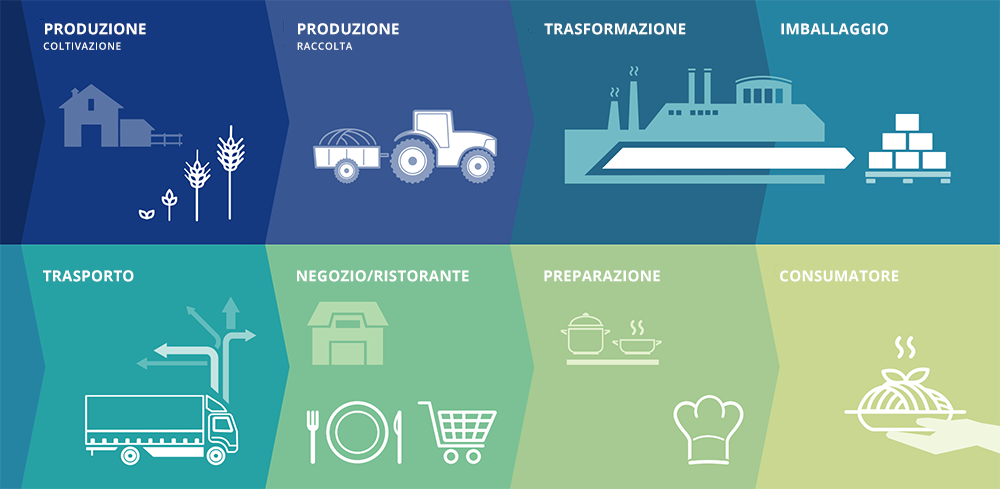
One of the most effective ways to protect Italian agri-food products from counterfeiting is innovation. Traceability is essential: each product must have a “digital identity card” that allows for tracking across every point in the supply chain, providing greater transparency and guarantees to both consumers and businesses.
This shift also allows for the value of a product to be assessed not only by its final form but across the entire production chain, promoting a model of measurable and certified sustainability.
To support traceability, recent years have seen the integration of innovative technologies alongside traditional enterprise information systems: RFID and NFC tagging, IoT and sensor systems, and Blockchain solutions that ensure data immutability and trust across the supply chain.
Innovation Through Data
The Internet of Things enables real-time data collection from the physical world through sensors, creating a digital twin of agricultural environments. With the support of Artificial Intelligence, this data can be analyzed to forecast phenomena and optimize processes.
Blockchain further enhances traceability, ensuring transparency in origin and production, while also addressing key issues of protection and value creation.
At the core of these technologies is a vast ocean of data. Agricultural systems generate massive, heterogeneous streams of information. Yet, data becomes truly valuable not just when it is collected or stored—but when patterns and insights can be extracted from it.
The real challenge lies not only in data gathering and infrastructure (which is still lacking in some areas), but in the interpretation and transformation of this data into actionable knowledge.
We must design technological solutions tailored to the specific characteristics of the Italian production system. This often means acting on aspects far beyond technology alone: strengthening infrastructure, training workers, and fostering collaboration between producers, policymakers, researchers, and consumers.
The goal is to create shared platforms for data, experience, knowledge, and skills.
To innovate the Made in Italy brand means, above all, learning how to communicate it—authentically, intelligently, and strategically.