

The Forest as a Sentient Entity and Computational Power: An Interview with Alessandro Chiolerio on “The Forest Code” and His Work as a Researcher.
We publish the interview conducted by Davide Gomba (DG) with Alessandro Chiolerio (AC), the researcher featured in The Forest Code, a documentary on plant communication.
Enjoy the read (or the watch)!
Introductions
DG: We’re here with Alessandro Chiolerio for Rural Hack.
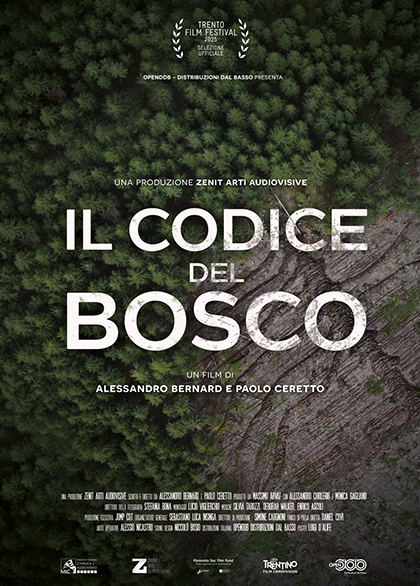
I discovered Alessandro’s story by going to the cinema, when I watched a documentary by Paolo Ceretto and Alessandro Bernard, produced by Zenit Arti Visive, titled The Forest Code.
This film explores the way plants communicate.
Thanks to the directors’ kindness, I was able to arrange this interview, which also allowed me to discover more about the world of scientific research.
So without further ado, I’d like to introduce Alessandro.
AC: Hi Davide, hi everyone.
How Can We Listen to Plants?
DG: How are we humans able to encode the information recorded by plants, and how can we read what they are listening to?
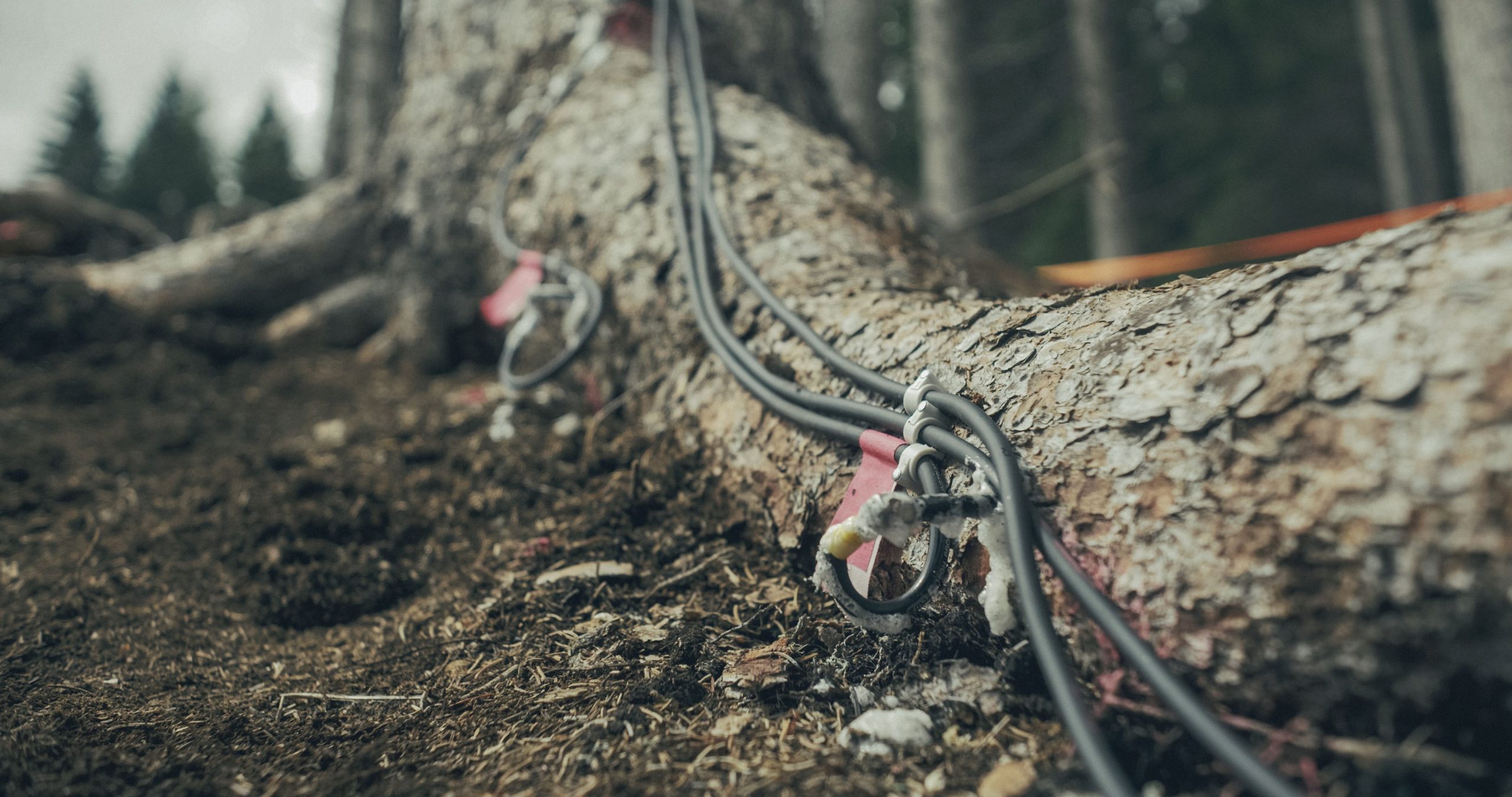
AC: Let me take a small step back and explain the recording technique. We collect electrical biopotentials, which in technical jargon is called “elettroma.” It’s essentially the equivalent of an EEG, but instead of attaching it to a human brain, we apply electrodes to the trunk of the plants.
These recordings are made simultaneously from multiple individuals within the forest. Through the electrical fluctuations of this collective, we can associate the data with what’s happening in the environment.
Obviously, we imagine the forest as a very sensitive ecosystem. A key concept is that plants don’t move—they can’t escape their surroundings. So their responses are inevitably closely tied to rain, wind, sunrise and sunset, lunar cycles, and tidal forces.
All of this is encoded in the electrical fluctuations, like an orchestra that we are able to record. To understand exactly what is influencing these responses, we can either manually analyze the data when we know a specific environmental event occurred (like a solar eclipse), or we can use more advanced tools like machine learning, numerical processing techniques that simplify the data and show us correlations with specific rhythms, such as the circadian cycle.
How Can Plants Predict an Eclipse?
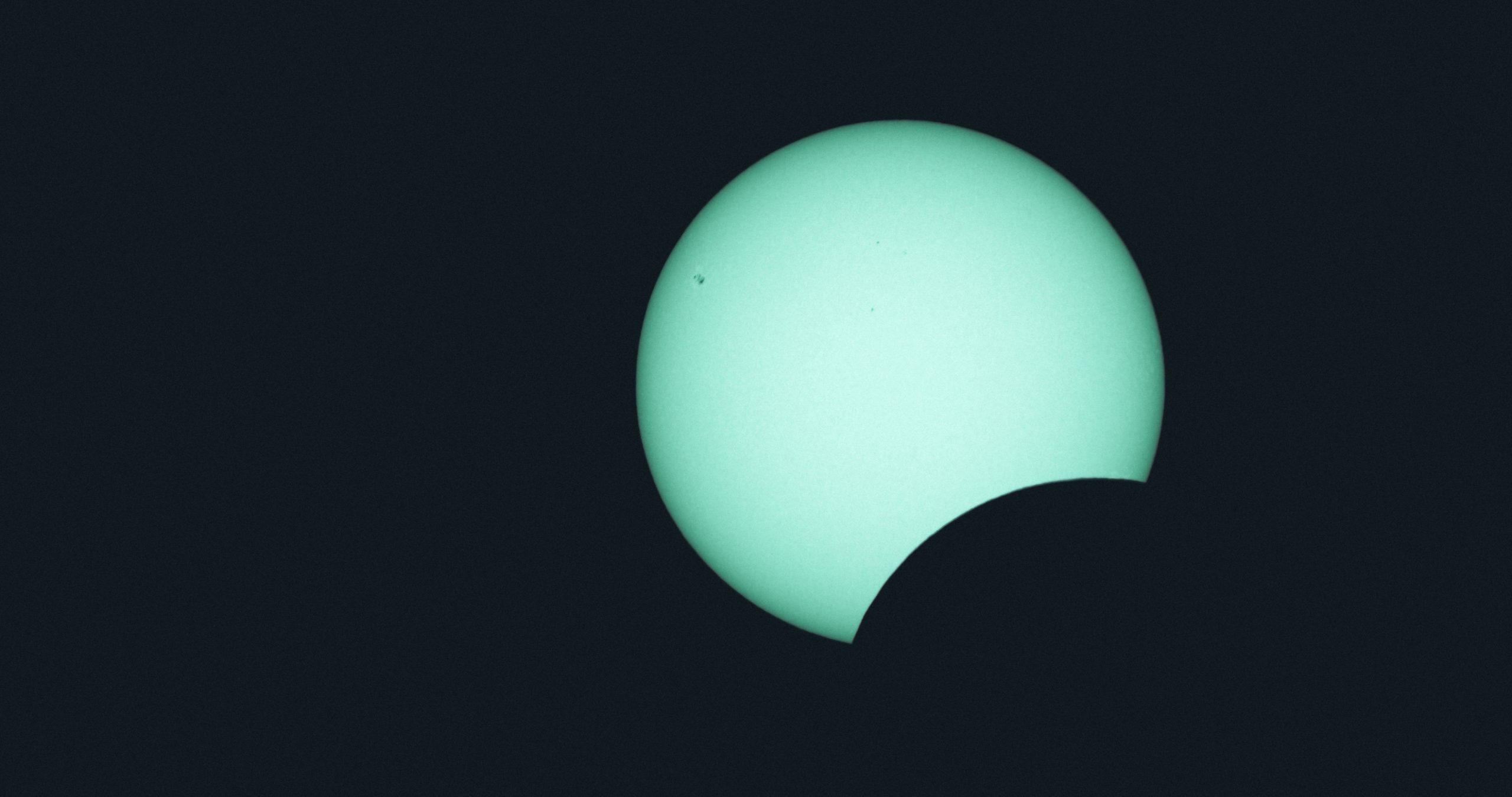
DG: Great, thanks. You mentioned the eclipse, which we see at one point in the film trailer. How can plants “predict” an eclipse so many hours in advance?
AC: I can tell you what I know: their behavior changes from the norm already 14 hours before the event. What causes this change is still uncertain. We can’t rule out several hypotheses.
Hypothesis 1: It could be memory. This idea appeals to ecologists because memory provides an evolutionary advantage. If a plant can remember a recurring event like an eclipse, it can prepare for the absence of sunlight, which causes stress.
Hypothesis 2: Plants might be sensitive to something we don’t yet understand or perceive. For example, 14 hours before the eclipse, the Moon is on the opposite side of the planet, so it can’t cast a shadow. It’s not a visual phenomenon. It might instead be gravitational. We know plants are sensitive to lunar phases and tidal forces. That could be one explanation.
Another could be the electromagnetic field. Or maybe we simply missed something that happened 14 hours earlier that we weren’t aware of. The external environment is influenced by so many factors. Let’s not forget that we are constantly exposed to particles from the Sun—perhaps the Earth-Sun equilibrium shifted. The forest is a sensor, a network of antennas aimed at what’s happening around it.
The key concept I observe in the data is that these antennas aren’t isolated—the forest behaves like a collective entity. The antennas (plants) are somehow all interconnected. I deeply believe this, especially if you’ve ever walked through a forest and seen how the roots intertwine. It’s very unlikely that plants are isolated individuals; they are part of a highly interconnected environment.
How Did You Listen to the Plants?
DG: You were able to record these interconnections through a device you developed. What’s it called?
AC: Exactly. The device is called Cybertree. It was developed and produced by a Sardinian startup—I’m not sure if I can say the name…
DG: Absolutely yes, please—tell us!
AC: It’s called Open Azienda. They’re friends and former colleagues from the Polytechnic who went on to found this company. They develop IoT devices, so they’re very skilled in electronics, circuit design, and firmware and software development. We worked together to define the technical specifications required to operate in such conditions—very strict specs, because in a forest at 1,950 meters altitude, you have to work in extreme conditions: minus 15°C in winter, up to 60°C under summer sun exposure. They did an exceptional job.
These devices worked well. We collected the data and began to figure out how to correlate and study it quantitatively. For example, from the electrical noise we measured, we ran tests to see which mathematical forms could best describe and simplify the interpretation of all this data. Imagine: 25 different data streams you need to visualize and interconnect—this is an overwhelming task for any human being. So simplification is necessary—using different parameters like entropy or fractal dimension. There are many mathematical tools we can apply to understand what’s happening in the forest.
Have You Developed a Way to “Talk” to Plants?
DG: Your work has helped reveal a concept of distributed intelligence in the forest. Have you also developed a way to interact with the plants—not just receive data from them?
AC: That’s a really important question, thank you. We haven’t developed it yet, but we recently wrote a paper—currently under peer review—and uploaded a preprint. It’s an “hypothesis paper” where we propose developing a kind of ecosystem computer.
To do this, we also need two-way communication—not just listening, but also talking. The physical nature of the signal remains the same: we read an electric signal (a voltage) and inject a voltage into the system. Doing this, we should be able to modify the state of the forest. That’s the hypothesis.
Of course, to make it happen we need funded research and a few years of work. We’ve already submitted a proposal to the European Innovation Council. We hope the evaluation is positive, so we can start experimenting.
What Are Your Next Steps?
DG: What are your next steps to support this line of research?
AC: Consider that I’m essentially a freelancer—I write projects, and those that get funded become both my income and the opportunity to work independently on a specific topic. Obviously, I have to outline all the next steps. When you create a project, besides the budget, you build a timeline with all planned activities.
Usually, things don’t go as expected—or rather, something unexpected always happens. And that’s perhaps the most fascinating part of research: what we call serendipity. If you stay alert, ears open, eyes observant, you’ll notice phenomena that guide you to the next step.
Institutional investors are essential—especially because research is costly. And this kind of transdisciplinary research requires building a team that includes many experts. For example, in the work published in Royal Society Open Science, we had ecologists, people working in unconventional computing, biologists, chemical-physicists, theoretical physicists, machine learning experts, programmers, electronics specialists… All these profiles had to work together and find a common language. That’s not always easy—getting an ecologist to talk with a machine learning expert and a quantum theorist isn’t trivial. But you eventually find a balance.
There are special cases, like the experiment in Val di Fiemme, which was entirely funded by the film production company (Zenit Arti Visive), because they had a project: making a documentary telling the story of the storm, the subtropical cyclone Vaia.
After Vaia Came the Bark Beetle
DG: Yes, that was the initial idea. But then, once filming started, you realized there was another problem in the forest, right?
AC: Exactly. The trees that were severely damaged by the storm—many were cut down—but those that remained standing had cracked wood due to intense winds, making them particularly vulnerable.
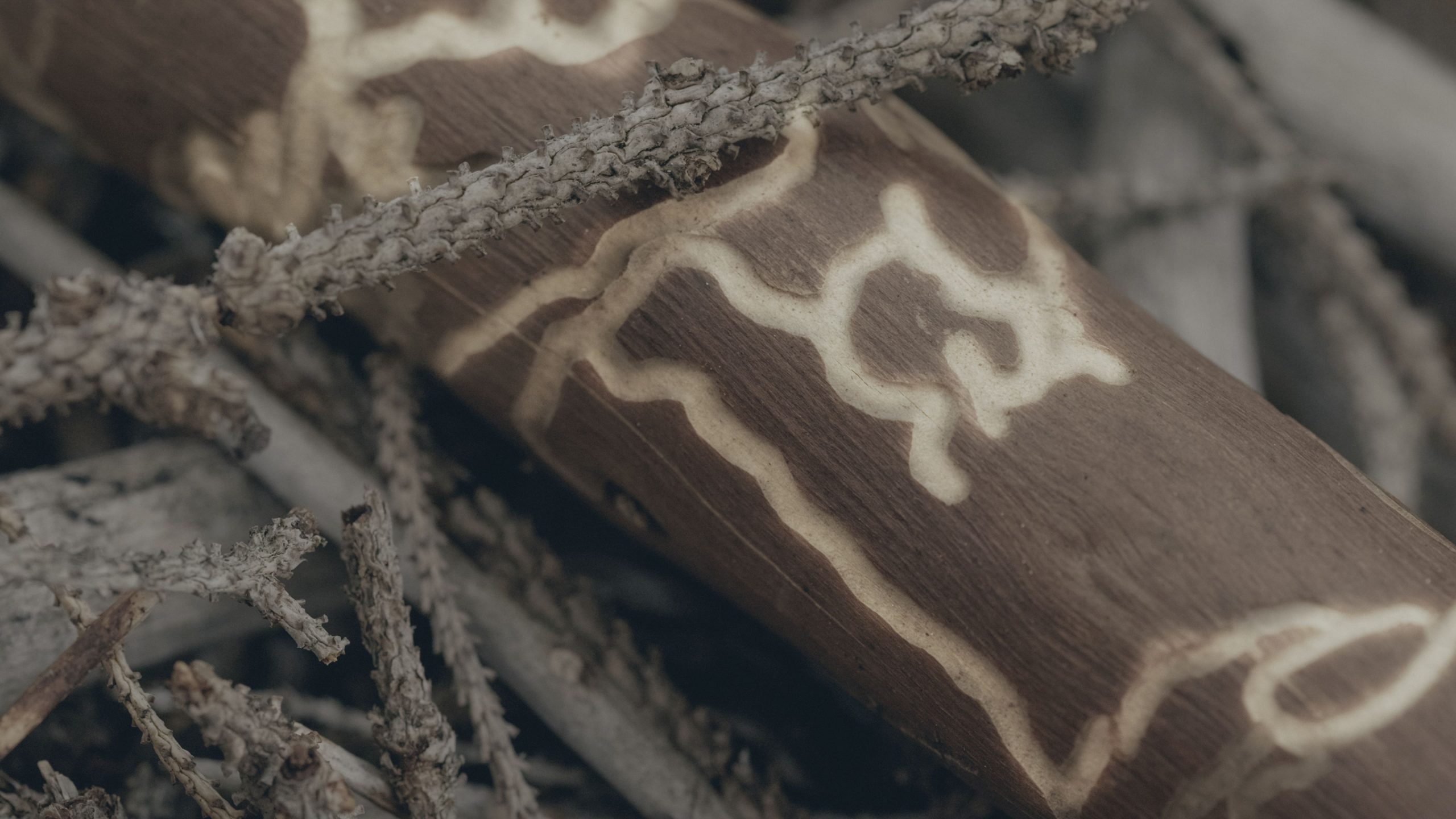
A tiny insect called Bostrico—also known as the “printer beetle”—began to spread. It digs tunnels under the bark in beautiful shapes that resemble hieroglyphs, but it intercepts the sap channels, and the tree dies.
One insect is enough to doom a tree. It’s a parasite specific to red spruce. Its spread was also facilitated by hot recent years. Instead of one or two reproductive cycles per year, it was doing three or four. So it expanded rapidly, damaging the forest even further.
There was massive tree felling by the forest service to contain the spread. Trees that started showing signs of infestation had to be cut down to avoid becoming outbreak centers. Also for safety: dead trees can fall, and there are lots of tourists hiking there.
At the same time, replanting was done—aiming to transition from monoculture to polyculture. Red spruce has shallow roots, making it very sensitive.
Do Dead Stumps Emit Signals?
DG: Let’s return to the topic of dead stumps. Are they able to transmit signals? Do they generate or carry them?
AC: In that location, there was a natural amphitheater of trees left standing after the disaster—arranged in a semicircle. In front, a desolate field with just stumps—left there by the forest service after removing the damaged trees.
We decided to place sensors on the stumps, because that area was exactly in the center of the semicircle. Other sensors were placed on the edge trees.
To our surprise, we observed that the stumps also had their own bioelectrical activity—less complex than that of a live or even a sick tree, but still present.
Why? Two possible explanations.
One: nearby living trees might keep the dead tree’s root system alive to benefit from its extension—extracting more minerals from the soil and exchanging substances via touching roots. The living tree could send processed sap with sugars and nutrients to the stump’s roots.
Two: fungi. The mycelial network is everywhere. It feeds on the cellulose of dead trees, and the electrical activity might come from the fungi.
Vines, Roots, and Hidden Life
AC: You also mentioned vines—I’m from Asti, and I have a vineyard. That curiosity led me to experiment there too.
It’s well known: when a vine dies, removing the stump manually—if you don’t have an excavator—is really hard. You may have to wait 3–4 years to pull it out. That’s because the roots are still alive.
I once saw a root separate from the stump, and the inside was still living—pinkish salmon color. I used to say: “These vines look like us humans—even in color.” The root was alive 3–4 years after the vine died, with no visible connection. Vines are planted in rows, not like a forest. The roots are deep and isolated.
Yet the life inside persists. Something keeps it vegetating.
What Role Does Artificial Intelligence Play?
DG: Great. So you collect lots of data—it gets analyzed. What role does artificial intelligence play in this? I know you’re not a fan of the term.
AC: Yes, I don’t love the term, because what we have now already existed in the 1970s—it was called machine learning. What’s new is that today’s AI systems can take actions based on data analysis—though not autonomously. These actions are pre-programmed in the algorithm.
So the interesting part for data analysis is really machine learning. In the case of plants, since these electric parameters are linked to environmental changes, we’ve proposed in some funding applications (which I hope will be approved) that this information could be used for decision-making.
If I know the forest ecosystem is sensitive to crises like extreme rainfall, earthquakes, or volcanic eruptions, I can pair this data with an AI system. When it detects the right combination of inputs, it sends an alert to civil protection agencies, for example.
That could become a useful early warning system for events requiring human intervention.
Using Plants as Antennas and Sensors
DG: So to simplify: you’re telling me that a vineyard or a forest could be used to forecast weather, or even predict earthquakes or volcanic eruptions?
AC: Yes—particularly with volcanoes, there’s a recent study by NASA, co-signed with other institutions, that was published on a website (I don’t think the article is officially out yet). It claims that plants have predictive abilities regarding volcanic activity. They noticed this through satellite images, by tracking CO₂ levels in the leaves.
I can tell you what I did: I validated the possibility of making micro-local weather forecasts using 11 days of data. It’s a fairly small dataset, but we gathered info from a vineyard and paired it with environmental parameters. We managed to predict temperature and relative humidity with very high accuracy—85 to 90%.
So just imagine: with more data, collected over an entire solar year or more, we could increase the confidence of such predictions. But again, this is very local—strictly micro-local.
DG: From my point of view as a system integrator (since I often install sensors in vineyards or fields for work), the paradigm shift here is that you’re using the plant itself as a sensor. That’s huge. The studies you refer to suggest that plants have a kind of competence, an awareness of what’s going to happen—both meteorologically and geologically—much greater than the most advanced sensors we’ve ever developed.
AC: I think so too. It’s as if we’re dealing with living biosensors. It’s pretty simple, really: an organism that can’t move is inevitably highly sensitive to environmental parameters.
Even we—who can move—are sensitive, though we often don’t pay much attention to it. Mood swings, back pain, and other bodily signals… These things echo ancestral knowledge, the temporality of events.
Are Humans Also Sensors?
DG: Ah, so you mean when it’s going to rain, I feel that ache? Like how the weather affects your body?
AC: Exactly!
How Can We Follow Your Work?
DG: Okay. So first, we’ll include in the video description and article all the academic papers you mentioned.
But more importantly, how can people follow your upcoming projects? Do you have a website or a link we can share to stay updated on your work?
AC: I can give you my LinkedIn profile link—it’s probably the most up-to-date. It’s also the professional network I use the most. I don’t use other social media.
Of course, each project usually comes with its own website—because that’s how it works nowadays. For instance, in the case of European projects, it’s mandatory that within two months of funding and the project start date, you have a website up and running. So that becomes the place to publish all project content.
Future Projects
DG: You’ve just submitted a new project. I guess you don’t want to talk about it for good luck?
AC: Let’s say there are some things I can share and others I can’t—because I’m bound by confidentiality agreements with my partners. Some of the ideas we submitted in this project are innovative, and it must be said: the research world is extremely competitive. Today, if research isn’t tied to business, nobody cares.
I believe some things are important regardless of business. But still, you need funding to work. So you package the idea the right way, and you have to respect confidentiality.
This particular project involves nine partners. We tried to cover all of the European Union—Estonia, Sweden, the UK, Portugal, Italy, Slovenia…
If the project is funded, we’ll create a pilot experiment in Slovenia, in Triglav National Park. It’s a stunning place, protected as a Natura 2000 site and also by UNESCO. Together with the Julian Alps National Park, it forms an incredible and continuously inhabited natural area.
What’s interesting is that, beyond untouched natural environments, there’s a long-standing human presence. In the case of Val di Fiemme, for example, this coexistence has been codified for over 1,100 years by the Magnifica Comunità della Val di Fiemme. I believe it’s one of the few true republics in existence, where shared management of forest resources is handled collectively by citizens. There’s even a kind of parliament that governs the forest ecosystem.
I believe that in this case, human nature combined with ecological conditions has brought out the best—and maybe also the worst (monoculture). But still, it’s a heritage and value worth preserving.
So if all goes well, in Slovenia we’ll set up a new bidirectional communication portal. The main difference with Val di Fiemme is that there, we only recorded data—here, we’ll also do playback. Who knows what will happen?
Next Check-In – Final Thanks
DG: Okay, let’s wrap it up here. But I’d love to talk to you again in six to eight months to see how the project evolves.
Thank you so much for your time—and thanks also to Zenit Arti Visive, Paolo Ceretto, and Alessandro Bernard for making The Forest Code, a documentary that tells part of the story we explored today.
AC: Thank you so much, Davide. And everyone—go watch the documentary. It’s absolutely worth it.
DG: Definitely—The Forest Code.
Bye everyone!
Referenced Papers:
https://www.nasa.gov/earth/natural-disasters/volcanoes/nasa-satellites-provide-early-volcano-warnings/
(Plants anticipating volcanic eruptions)
https://www.mdpi.com/2073-8994/14/9/1792
(Circadian rhythm, stump complexity, forest as a collective in-phase system)
https://www.mdpi.com/2313-7673/8/1/122
(Thermodynamics and quantum bioelectricity)
https://papers.ssrn.com/sol3/papers.cfm?abstract_id=5227558
(Hypothesis: Using an ecosystem as a computer)
https://www.preprints.org/manuscript/202505.1472/v1
(Micro-local weather forecasting with grapevines)