

From agriculture to electronics, from software to household appliances, the possibility of knowing how things are made, how they work, and how they can be repaired or improved is intimately tied to the concept of care, relationships, and sustainability. The repair movement has understood this for some time and is beginning to achieve its first significant victories
“Quel gran genio del mio amico
Con le mani con le mani sporche d’olio
Capirebbe molto meglio
Meglio certo di buttare
Riparare”
Lucio Battisti, Sì viaggiare, 1977
How long did it take for us to stop taking for granted that repairing is better than throwing away? Just a moment. That moment it took for the culture of consumption, of disposable use, of “you are what you buy” to become the breeding ground in which both the generations of politicians and entrepreneurs currently leading the world and the generations of citizens—at least in the global North—grew up.
The 1980s and 1990s passed quickly, mostly unnoticed, while the cycle of “produce, buy, use, throw away” became ever more frenzied, and at the same pace, all veins of common sense, wisdom, and prudence that had guided us for centuries seemed to run dry.
Fortunately, those veins had not disappeared; they had simply gone underground, like those rivers that seem to vanish but are actually flowing beneath the surface—only to re-emerge elsewhere.
Some of that common sense resurfaced at the beginning of the new millennium: perhaps it happened when it became clear that the millennium bug was, essentially, nonsense, while the spikes in so-called “diseases of affluence,” caused by the pollution of food, air, and water, were very real.
Common sense is quick to vanish and slow to return: in 2007, after at least 10 years of campaigning, the law regulating and permitting the creation of Farmers’ Markets was passed in Italy, modeled after the American counterparts. It had been preceded by years of debate between supporters of mass agricultural production—requiring global and highly technologized distribution platforms—and those who believed that small local economies should reclaim a contemporary, legitimate, and regulated form. That small and medium-scale quality productions had different needs than industrialized agriculture. With some effort and not a few compromises, that law passed, and its supporters had to work hard to explain that no, it wasn’t a “step backward” toward outdated forms of production and distribution; but yes, it was a “return”: categories and actors that agribusiness had tried to marginalize were finally re-emerging from their underground state, now recognized by law and not just custom. They reconnected directly with consumers, in the open, as they had done for millennia and, in fact, had never really stopped doing.
While everything around them was being regulated and formalized, farmers’ markets—becoming increasingly rare in the meantime—remained on the margins of this regulatory activity, until they found themselves essentially outside the law. Hence, a movement was necessary, an action from producers and consumers demanding their legal recognition as well.
To superficial observers, that law seemed almost absurd: “Farmers have always sold their products,” they rightly said. “Selling food is the origin of all market forms, so what’s the point of a law allowing it?” Why consider “modern” markets that were normal for our grandparents and great-grandparents? These were valid observations, and yet this is what happens when the regulatory framework tightens and thickens only in certain sectors: those left out risk being left outside the law.
(Credit foto: Mark A. Phillips – www.markaphillips.co.uk)
When common sense returns, it has to ask permission.
In 2012, a similar movement began in Europe: The Restart Project, thanks to the initiative of Ugo Vallauri, born in 1977, who had drawn much inspiration from his work in the ecogastronomic movements, particularly Slow Food.
Again, it was an apparently obvious issue, aligned with logic: better to repair than to throw away. But this repair is often no longer materially possible, because skilled repairers—those brilliant friends—are increasingly rare, and, above all, because production logics have drastically changed.
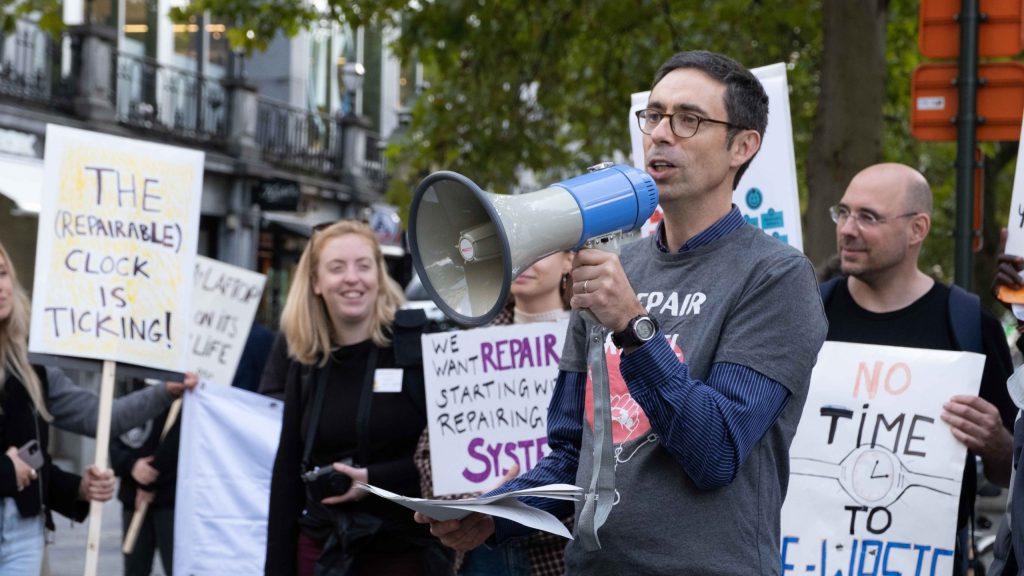
Just like those who, ten years earlier, wanted to do something as normal as legally buying their food directly from producers, groups of activists began to protest the fact that industrial objects—appliances, electronics, machinery—are too often not repairable. Not only because of what soon became known as “planned obsolescence,” but for what quickly turned out to be a design issue: these objects were not designed to last, nor to be repaired. They were designed to last briefly and be discarded at the first malfunction, replaced with a new, identical or slightly modified version
Where could this growing desire for repair, found both in big cities and small towns, lead in Europe? In what, in the United States, had meanwhile acquired a name and the dignity of a right: the right to repair.
It had been demanded, as early as the 2010s, by American farmers protesting against John Deere, a manufacturer of agricultural machinery, because repairs on new models were essentially impossible. The more software is built into new machines, the more they become sealed when they break down. Either they are sent to authorized centers—or in some cases directly back to the manufacturer—or repair is either impossible or risky for the owner: no guarantees on adapted parts, as if they had illicitly tampered with someone else’s property.
“If you can’t repair it, it is not really yours” was the movement’s slogan, and their lawsuits against Deere continue. Just a few days ago, the Federal Trade Commission filed suit against the company for unfair practices.
It’s important to understand why this issue was raised precisely by the agricultural world. In professional agriculture, time is not just money—it’s tied to the possibility of having a harvest. If a seeder breaks when fields are ready, it must be fixed immediately—you can’t wait 15 days or however long dealers or manufacturers decide. That’s why farmers often also become amateur mechanics, and why the mechanics who repair agricultural machinery in rural areas (isolated, far from industrial hubs) are essential elements of those communities. The same applies to harvesters and all other machines, especially the tractors they’re attached to
There are few situations where machines are so expensive that you can’t afford a spare—agriculture is definitely one of them.
Without Repairers, Communities Die
“Always try to repair the world,” wrote Alexander Langer, in a sort of political testament whose power has yet to influence the present. Alex Giordano recalls this in FoodSystem 5.0, highlighting the importance of relationships between the social and technical aspects that characterize a society, speaking precisely of a “socio-technical regime.” To better understand the topic, we must take a step back: it’s not just about repairing an object to avoid buying a new one—which entails the extraction of rare earths, the production of raw materials, energy use for manufacturing, energy for disposal, and pollution throughout.
The issue is broader, subtler, more structural. Richard Stallman had already fully grasped it in 1983 when he founded the free software movement, arguing that the community of programmers should not be separated from users. In his GNU manifesto, he wrote:
“Software vendors use the divide-and-conquer approach against users, making them avoid sharing software with others. I refuse to break solidarity with other users this way.”
(Credit foto: Mark A. Phillips – www.markaphillips.co.uk)
John Deere tractors cannot be repaired by farmers or independent mechanics to whom they’ve turned for generations.
It may seem minor, but things like this dismantle communities. What makes communities what they are? The relationships among people. And what is—at once—the tool and the product of those relationships? Care. We turn to others to take care of us or our things, and to take care of them and their things. The things we own help us work, manage our lives, and care for our loved ones. In a community system, repairers have an extraordinary role and indispensable skills. But if we cut that channel, if we close that possibility, we begin the drying-up process of our communities. From seamstresses to cobblers, mechanics to electricians—if they disappear because nothing can be fixed and everything must be replaced, the bonds disappear too, along with the education of care.
In a corner of Naples, there’s a doll hospital. It’s clear what a child learns when entering a shop where dolls are “cured”: they learn that this avatar of themselves and their loved ones, which they hold in their hands, shouldn’t be discarded when it loses its out-of-the-box perfection. Along with the doll, the relationship with it is repaired. Restart’s motto has always been “fixing our relationship with electronics,” but it applies far beyond electronics. How much of the deadly violence we see today when a relationship no longer meets initial expectations could be avoided with constant, everyday education in care—of self, of others, and of things?
Our communities need to to cultivate and transmit their knowledge, because a community of incapable individuals is first and foremost a group that can’t help one another—or even themselves. They’ll always need to turn to someone outside the community, always starting over with new, identical objects and ever-growing landfills, like in Italo Calvino’s Leonia, described in Invisible Cities (1972):
“More than from the things that are made each day, the city’s wealth is measured by the things that are thrown away each day.”
What’s striking today in rereading those lines is not just the madness of pollution and land use (two things we now know well), but the unquestioned mechanism: communities lacking skills, knowledge, and abilities will not be able to question the disposable logic of contemporary capitalism. They will end up applying the same logic to relationships: you don’t function, you don’t meet expectations, I discard you. If you’re not useful to me (and if you’re not how I say you should be, you’re not useful), then you’re no longer useful at all. This also denies the basic logic of nature, where every living being serves a purpose at every stage of life in a continuous and fruitful cycle of transformation, reuse, recycling, and repair.
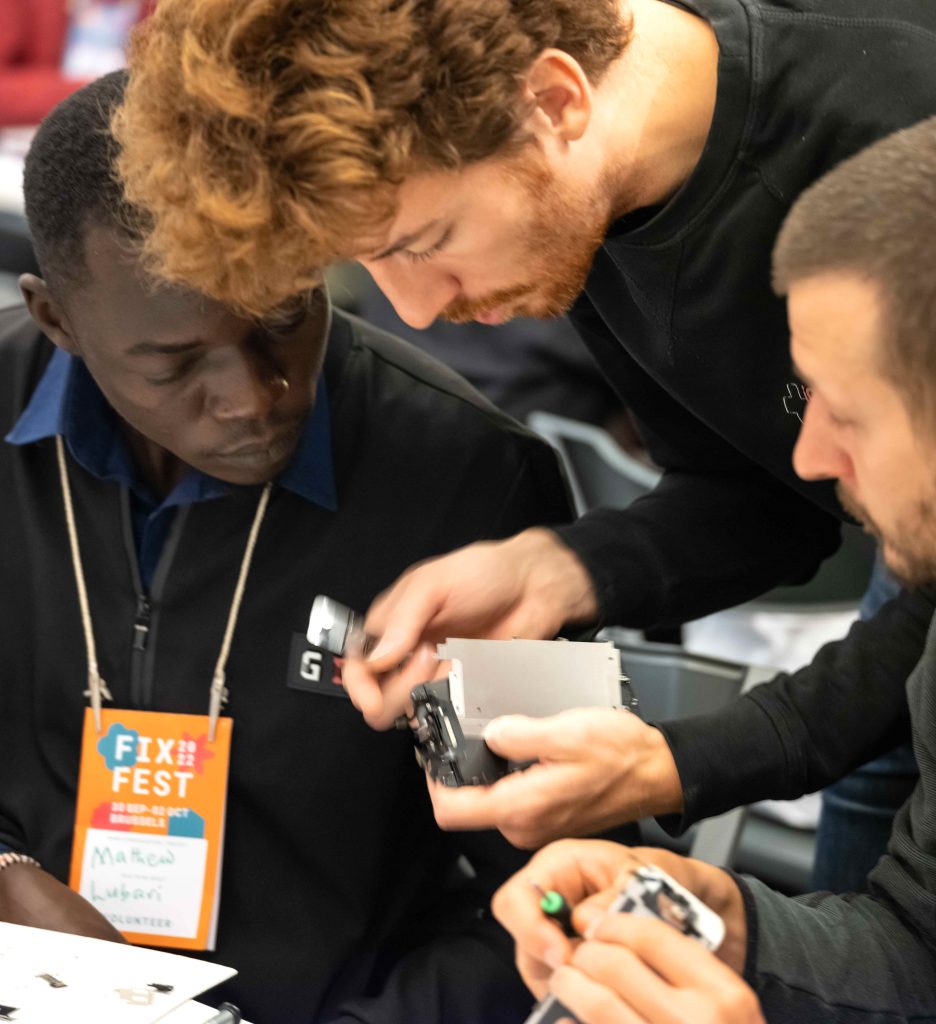
No wonder in Restart Parties and Repair Cafés—now estimated at over 4,000 groups worldwide, with around 190,000 items repaired each year—you don’t drop off an object and pick it up fixed: you repair it together, learn together, and understand together—learning from “that brilliant friend of mine” how to approach something broken that might work again.
I Offer You the Intelligence of Electricians
(Paolo Conte, Un gelato al limon, 1979)
The underground river resurfaced in the American countryside with the “Right to Repair” (now emerging in Canada, Brazil, India, Australia, and New Zealand), pushing Restart and other partners to create the European coalition “Right to Repair Europe,” involving around 180 organizations across 29 countries (the American site is repair.org, the European one is repair.eu). It has many sources and collects many tributaries. The intersections with food and agriculture reflections are frequent, especially regarding patents on living organisms—particularly seeds. The script is similar: patenting a lab-created seed through the crossing of pure parental lines or genetic engineering means sealing off that knowledge, removing from millennia-old wisdoms the ability to know, understand, and modify. Observing in the field that a plant resists a pest and trying a new cross to extend resistance is very similar to repairing a farm machine and repurposing it for something not originally intended.
The alliance long established in the countryside among engineers, farmers, and mechanics is the same that has grown between farmers, agronomists, chefs, and families to develop varieties suited to people’s tastes and environmental conditions.
Fewer farmers today can reproduce seeds for the next season, and increasingly, seeds are “unrepairable,” unusable for future cycles, requiring repurchase—from a dealer, from one or another multinational seed company (often also a chemical giant). Beyond One Health concerns and food quality, we must reflect on how much knowledge has been lost or marginalized from agriculture in favor of a system focused not on care (for places and communities), but on profit (for a few).
All this pressure has already borne fruit. While John Deere faces scrutiny in the US for its commercial practices, in April 2024, Europe passed a new Ecodesign regulation for sustainable product design. The EU is currently the only institution seriously guiding how things should be made: the design itself must change radically. Objects must be easy to disassemble, open, and repair; spare parts must be accessible and affordable; total repair costs should not exceed 30% of the new product price. These guidelines, preceding the Green Deal, are now central to it, aiming to reduce waste, optimize energy use, and rationalize raw material consumption.
Life Cycle Assessment studies—growing since 2017—helped shape this new production vision. On average, it takes 18 years to offset the resource costs of a large appliance. If today’s appliances last only 10 years—compared to the 25–30 years of those from the ’80s and ’90s—each one becomes a resource debt. To offset the raw materials needed for a smartphone, 90 years are needed: if we replace them every 2–3 years and never repair or meaningfully recycle (only 1–3%), each device deepens the resource hole.
The only sensible path is to extend the lifespan of things, creating community fabric, competence, jobs, awareness—and relationships between people and things. Every waste is a cost. But until the moment it becomes waste, even a broken object is an opportunity.