

The adoption of advanced technologies, such as artificial intelligence (AI) and collective intelligence, is radically transforming the agrifood sector. I carefully reread chapter 4 of the book FoodSystem 5.0, where Alex Giordano explores the potential of technological agriculture and data commons as tools to create a more sustainable and inclusive agricultural system. This approach proposes integrating technological solutions within a paradigm that values data as a common good, fostering innovations that respect biodiversity and the integrity of local communities.
The idea behind it all is that 4.0 technologies, like smart sensors and data analysis systems, allow real-time optimization of agricultural management, improving productivity and reducing resource waste.
Through the use of open data and collective intelligence tools, small producers could improve the quality of their productions and strengthen their market position, while also promoting greater social and economic equity. These systems do not just monitor, but also facilitate collaborative and proactive decision-making, useful to tackle the challenges posed by climate change and global economic pressure.
A central element of this transformation is the transition toward a culture of data as a shared resource. Recognizing that data collected in agriculture belongs to the communities that generate it, the “Food Systems 5.0” model aims to integrate precision technologies with traditional practices.
Very solarpunk—that’s one of the reasons I like it.
This not only preserves the cultural and environmental identity of the territories but also creates opportunities for social innovation projects that respond to local needs, promoting a new ethic of agricultural development based on cooperation and inclusivity.
Unfortunately, we know this is not happening.
Access to data is often inhibited, difficult, and not shared.
Often due to the will of the device manufacturer, but even more often due to the agricultural company itself.
On one hand, an increasingly aggressive approach sees players in the agri-tech world selling services rather than products.
What does this mean: the end user incurs fewer costs and lower investments, but the data collected on their field—which represents added value of the installation, capable of generating predictive and site-specific models—is not shared transparently.
This lays the groundwork for the agritech servitization of data.
(What does servitization mean? See: Il Post, Wikipedia.)
On the other hand, there’s the culture of the farmer.
Unfortunately, in the agricultural sector, only the large players adopting new approaches are (understandably? Yes / No? You decide) not yet willing to share important data for their companies—data that is, however, relevant to the community.
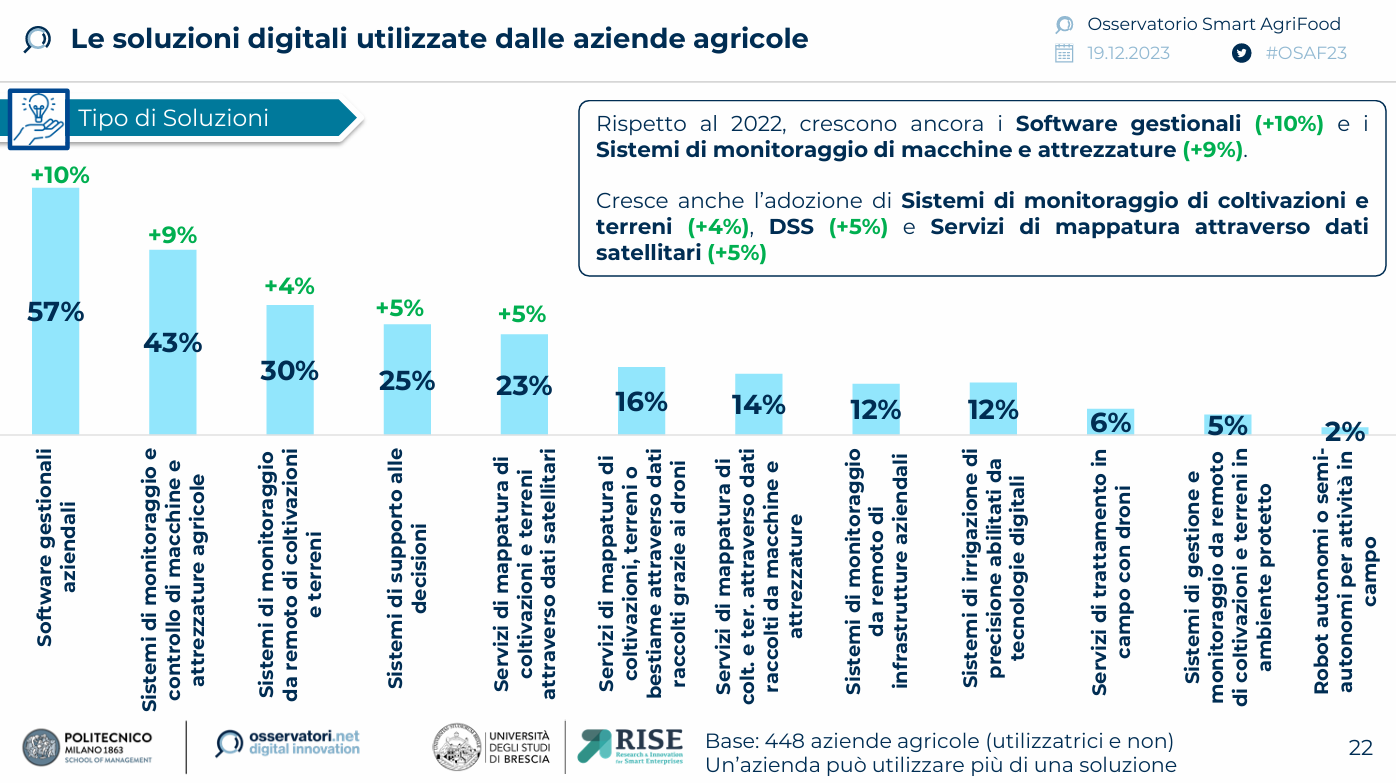
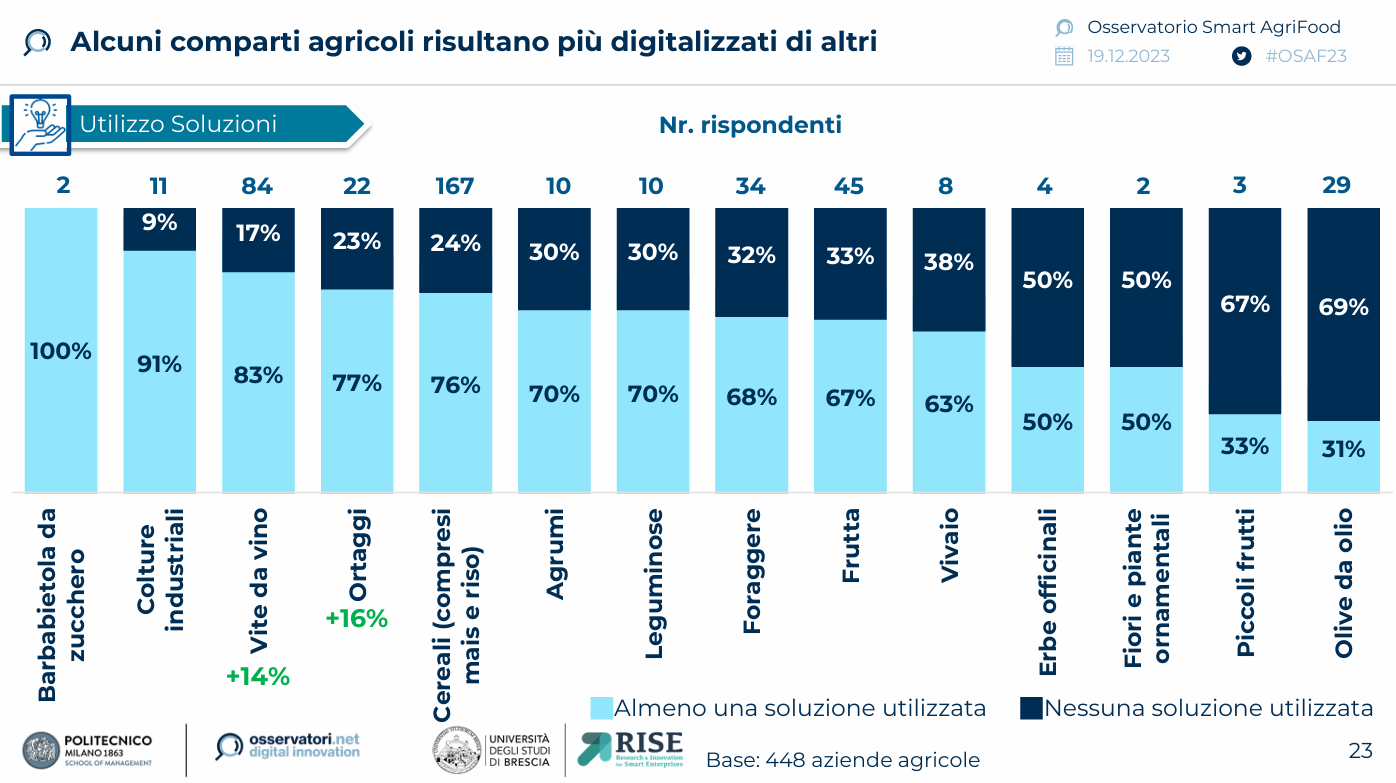
In any case, only a small portion of them carries out remote monitoring (5% of the 448 companies analyzed by the Smart Agrifood Observatory of the Politecnico di Milano).
All of this is the preamble, because the real topic of this article is the adoption of a new measuring tool: a smart leaf.
This is, in fact, an example—and a savings estimate—of funding.
From the paper “A novel low-cost smart leaf wetness sensor” (December 2017), we read the proposal for a low-cost leaf wetness sensor based on an innovative electronic interface circuit.
It’s no surprise that this sensor was proposed by a Spanish team: many of the leading IoT research efforts are based in the Iberian Peninsula—one of the most historic? Libelium.
This sensor uses a capacitive detection method via charge transfer implemented in a microcontroller, significantly reducing costs compared to commercial models, which often exceed $100 USD. The system consists of artificial leaves made on affordable substrates and integrated circuits capable of accurately calculating leaf wetness duration (LWD), a crucial aspect for plant disease management and epidemic forecasting—two of the most common in Italy being downy mildew and powdery mildew.
The main innovation lies in the simplicity and efficiency of the interface circuit, which enables reliable results in both lab and field conditions. Experimental tests have shown that the proposed sensor is highly sensitive and outperforms commercial devices in terms of accuracy and versatility. Additionally, its compact design allows for adaptability to other sensors capable of monitoring additional environmental parameters, such as temperature and solar radiation.
Thanks to its low cost and ability to simultaneously measure multiple artificial leaves with different orientations, this sensor offers significant potential for precision agriculture and large-scale monitoring networks. This system represents a step forward in improving understanding of leaf wetness cycles and their implications in agricultural systems, promoting widespread use of technology in field applications.
Now: this paper will turn 7 in about a month, and in recent years we’ve seen a price drop in leaf wetness sensors, also known as “smart leaves.”
During my recent trip to Shenzhen, I got my hands on a smart leaf sensor that I’ll be testing.
But let’s not get ahead of ourselves. These sensors still don’t have widespread market adoption, and (as far as I can find) there are no comparative field trials.
Spoiler alert: if you’re in, let’s do it!
We’re talking about fields and vineyards that identify downy mildew risk using the “three 10s rule” (link) developed by Baldacci back in 1947 (just because it’s old doesn’t mean it’s wrong—quite the opposite).
Quote:
The environment-host-fungus relationships have been known for a long time: in 1947, Baldacci proposed the well-known “3-10 rule” used to identify the moment of primary infection, based on three conditions:
- Temperature > 10°C
- At least 10 mm of rain in 24–48 hours
- Shoots at least 10 cm long
The issue here is that detection is performed by weather stations, often hundreds of meters—or even kilometers—away from the vineyard.
The result of a farmer’s subscription to a company that centralizes readings.
Think about how many orographic and atmospheric variations can affect that reading and either notify intervention unnecessarily (false positive) or not notify it at all (false negative).
How much are we losing?
A lot, meaning: downy mildew in 2023 caused damages worth…
Quote: 1 billion and 235 million euros in damages to 29,305 farmers in Abruzzo, Basilicata, Calabria, Campania, Lazio, Marche, Molise, Puglia, Sicily, Tuscany, and Umbria, who in late spring 2023 saw their vineyards ravaged by downy mildew due to persistent rain followed by high temperatures—a sequence of events that triggered the pathogen’s infection, with enormous consequences on the production of both table grapes and wine during the last harvest. In response to this disaster, 47 million euros will be distributed from the National Solidarity Fund, in two phases: 7 million will be immediately available, while the other 40 million will require a bit more waiting.
I’ll close with an old toothbrush/toothpaste adage from when I was a kid: better to prevent than to cure.
With the hope that these 7 million will also be spent on prevention, I’m preparing to test my first smart leaf sensor.
Keep you posted!