

Master DOP, Digital Agriculture and the Transformation of Sustainable Food Systems
The Master DOP program organized by Qualivita and Origin has, since its first edition, been more than a training initiative. It is a space of real pluralism. Within that classroom, consortia of different sizes, organizational cultures, economic capacities and territorial roots come together. It is precisely this diversity that generates collective learning — a process that continues well beyond the days spent in class.
At a historical moment in which Sustainable Food Systems are under environmental, geopolitical and technological pressure, consortia can and must play a central role in Food Systems Transformation. Not merely as brand managers, but as territorial governance actors.
This year, Mauro Rosati invited me to lead a two-day workshop on Artificial Intelligence. Accepting meant engaging with a subject that goes far beyond Digital Agriculture tools or generative platforms. AI is reshaping how we produce knowledge, how we make decisions, and how we govern complex systems.
Beyond ChatGPT: AI Is Not Just an Operational Tool
The easiest path would have been a technical demonstration. Showing tools, teaching prompt design, offering shortcuts. That would have been simpler — and perhaps more reassuring.
We did work on practical applications. Improving efficiency in reporting, monitoring reputation, analyzing documentation — these are legitimate uses of AI in Agriculture. If AI reduces time spent on repetitive tasks, it frees space for strategic thinking. And today, strategic time is a scarce resource.
Ma il punto non era fermarsi lì.
The real risk is not underusing AI. The real risk is adopting it without a framework of Food System Governance.
A Structured AI Adoption Roadmap for Agri-Food Consortia
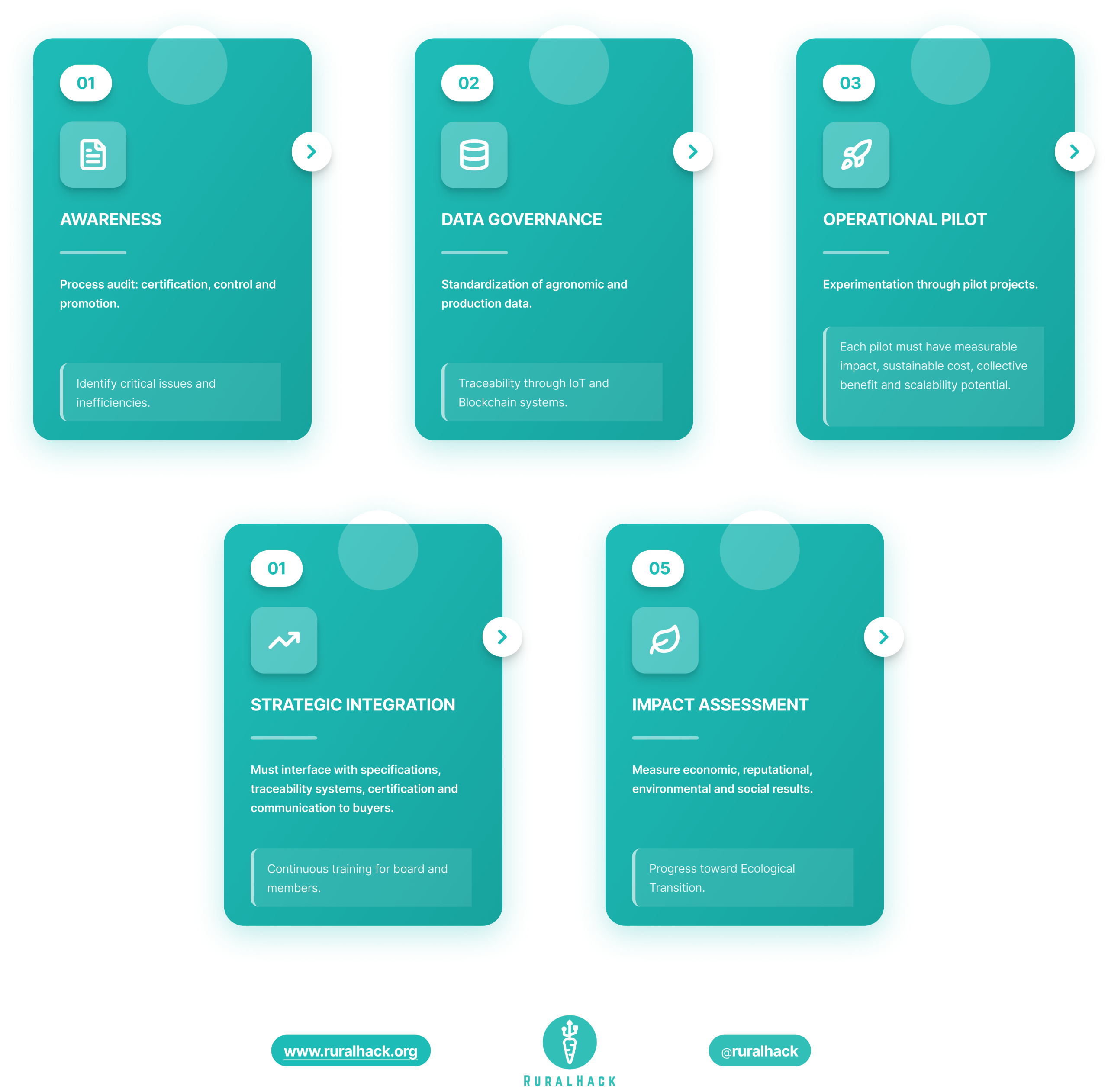
Together with the Rural Hack research team, we presented a roadmap specifically designed for agri-food consortia. Not a list of tools, but a structured adoption pathway.
Strategic Awareness
The first step is strategic clarity. A consortium should conduct an internal audit: mapping certification processes, inspection systems, communication flows, promotion and export mechanisms. It must analyze existing data flows and identify inefficiencies or opacity.
Before speaking about technology, leadership must understand where value is generated and where reputational risk lies. Only then does Agri-Food Innovation become coherent with the consortium’s mission.
Data Governance
The second phase concerns the invisible infrastructure: data.
Agronomic data, production data, certification data, market data, reputational metrics — all must be standardized and governed. The central question is political before being technical: are data an individual asset or a collective territorial good?
In a context where IoT in Agriculture and Blockchain in Food Systems are redefining traceability and transparency, maintaining territorial data governance becomes an act of protection.
Pilot Projects
Experimentation must be targeted and measurable. Examples discussed included:
- computer vision systems for product quality analysis;
- international reputation monitoring,
- territorial sustainability dashboards
- inspection optimization
- predictive models for yields and climate risk
Each pilot should demonstrate measurable impact, sustainable cost, collective benefit and scalability potential. One fundamental rule applies: no automation without human supervision.
Strategic Integration
AI cannot remain an isolated project. It must integrate with disciplinary rules, traceability systems, certification frameworks and buyer communication strategies. Continuous training is essential so that boards understand not only the potential of AI but also its limits.
Continuous Impact Assessment
Consortia adopting AI must measure economic, reputational, environmental and social outcomes. Reduced inspection costs, improved certification timelines, strengthened market trust, progress toward ecological transition, inclusion of smaller producers.
Without measurable impact, innovation remains rhetoric.
The New Regulatory Framework and the Role of Consortia in Sustainable Food Systems
The new regulatory framework for Geographical Indications strengthens the role of consortia. This shift opens a decisive scenario for Sustainable Food Systems. Consortia can become territorial sentinels. Not merely brand managers, but ecosystem stewards.
Here the perspective of FoodSystem 5.0 intersects with institutional practice. Declaring excellence is not a marketing act. It is a responsibility rooted in soil protection. Without living soil, there is no authentic quality.
Artificial Intelligence today improves efficiency. Tomorrow it may help us understand complex systems more deeply, approaching the multidimensional interactions studied in Quantum Computing and Complex Systems. AI could help reveal invisible dynamics between soil microbiomes, agricultural practices and product quality.
If properly governed, AI can strengthen Sustainable Food Systems rather than accelerate financial extraction.
Guiding Principles and Future Responsibility
Throughout the workshop we emphasized several guiding principles.
Artificial Intelligence must reinforce protection, not weaken it. Data must remain under territorial governance. No automated decision should replace human accountability. Innovation must be inclusive, avoiding divides between advanced and smaller members. Technology must serve territorial identity rather than replace it.
We also discussed strategic mistakes to avoid. Purchasing technology without a clear strategy generates dependency. Outsourcing entirely to external providers erodes internal competence. Failing to train leadership creates disconnect. Neglecting data policy exposes vulnerability. Using AI only for marketing reduces systemic transformation to communication tactics.
Now responsibility shifts to the participants. Experimentation must be deliberate and aligned with Food System Governance, contributing concretely to Sustainable Food Systems transformation.
A First Step Toward Digital Transformation
It is always a pleasure to participate in initiatives organized by Qualivita and Origin. Meeting the plurality of territories represented by the consortia reminds us of the biodiversity — economic, cultural and organizational — that defines our country.
Technology is often feared until it becomes familiar. Helping someone approach it with confidence is the first step toward a conscious relationship.
Together with the Rural Hack team, we aimed simply to facilitate that first step toward digital transformation. The rest will depend on how consortia choose to govern innovation — placing Artificial Intelligence at the service of Sustainable Food Systems rather than the other way around.