

f an alien observed our life up close, trying to understand the reasons behind the very strange behaviors that human beings—in the various cultural forms present on Earth—have negotiated with the surrounding territory, they would probably be surprised by one element of our lives.
I imagine this element would not be the food we eat, highly refined and in some cases produced thousands of kilometers away, nor the way we move around, producing large amounts of gases that negatively impact the atmosphere.
No. My alien would be more surprised by the fact that we disperse direct waste, generated by us (our—using a scientific term—fecal biomass), into the environment through—where present—an intricate system of pipes.
In recent centuries, an important innovation has been the development of modern sewer systems, which transport liquid and solid waste (wastewater) to treatment plants, preventing them from directly contaminating soil or natural waters. Through a complex processing system, a portion of the solid sludge can be used as composting material or fertilizer, while the rest is stabilized, incinerated, or used to produce energy (biogas). Urine, along with wastewater, is treated and purified to remove pollutants before being released into nature in compliance with environmental regulations.
Needless to say, this approach has huge margins for improvement in Italy and Europe: this article by the REF Laboratory lists various issues, from bureaucratic and legislative problems to cultural ones.
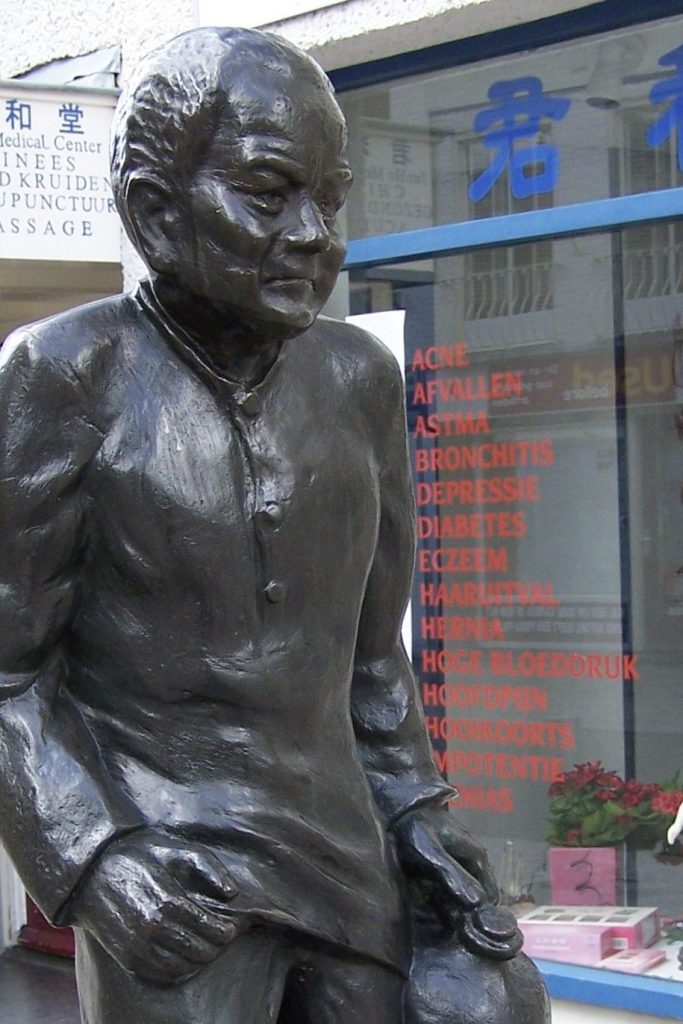
The statue depicts the tannery worker from Brabant bringing his family’s urine to be used in the process.
Let me focus on this last cultural topic: it is evident that identifying excrement, human or animal, as a resource rather than a threat—or even a taboo—is at the root of this tremendous waste. And yet, human history is full of proactive uses of this unmentionable matter of our own making: from “Night Soil” to the “terra preta” of pre-Columbian civilizations, a truly engineered soil made super fertile by a mix of feces and charcoal.
A Challenge in Italy and Europe
There are many organizations trying to innovate in this field, both in Italy and Europe. Here are some stories.
In Italy:
- HBI Srl: This startup, based at NOI Techpark in Bolzano, specializes in the circular treatment of sewage sludge for fertilizer production. HBI was awarded at the Quirinale for its contribution to the circular economy, showing how sludge treatment can generate significant savings and reduce the EU’s dependence on fertilizer imports.
Alto Adige
- CarboREM: Based in Italy, CarboREM designs and builds innovative industrial plants for the treatment of sewage sludge and organic waste, such as the organic fraction of urban and agri-food waste. The company develops small-scale plants aimed at improving energy efficiency, reducing waste volume, and increasing biogas production.
StartupItalia
- CAP Evolution: Born from the experience of Gruppo CAP, CAP Evolution operates in the sectors of wastewater treatment, waste valorization, and green energy production. It manages purification plants that function as biorefineries, transforming sludge into fertilizers, bioplastics, cellulose, minerals, and biomethane.
Gruppo CAP
In Europe:
- Sanitation 360 Offers a unique solution that converts urine into a dry fertilizer, preventing water pollution and enabling easier circular management of wastewater and nutrients. Sanitation 360
- VunaNexus: Based in Zurich, this startup uses a patented treatment technique to transform urine into an ecological fertilizer called Aurin. The process stabilizes urine, removes contaminants, and converts it into a ready-to-use fertilizer. Brokenhouse Company
- NPK Recovery: Located in the United Kingdom, NPK Recovery has developed a system to convert human urine collected during events like the Glastonbury Festival into eco-friendly fertilizer. The process recovers and transforms essential nutrients like nitrogen, phosphorus, and potassium into safe fertilizers for agriculture.
The Times & The Sunday Times
And What Happens Across the Ocean?
In an article by Brian Nelson, author of Flush: The Remarkable Science of an Unlikely Treasure, for MIT Technology Review, we are given a very aware snapshot of the use and valorization of animal and human excrement and the conversion of urine.
The problem in this sector, even in the USA, is that many existing regulations have never contemplated the possibility that wastewater could generate useful products instead of pollutants.
Perhaps the next step is generational, and about greater awareness of excrement as a resource.
When will we see the first hackathon on the topic?
[2] https://www.technologyreview.com/2025/01/03/1108658/poop-feces-agriculture-varcor-biowaste/