

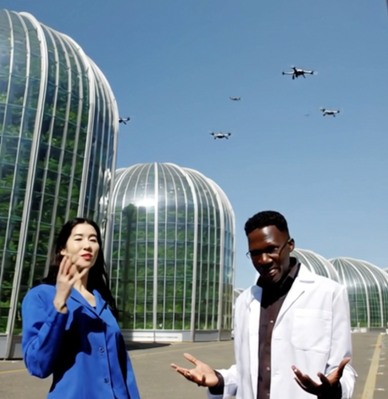
Reportage by Maria Rinaldi and Pandar Sukta
March 2026, Ñan Valley, AgroTechnological District 5.
On earth there are 9 billion inhabitants and 3 billion robots. Here in the Ñan valley, which in the Marshallese Micronesian language means food or nourishment, tractors do not exist and there are no farmers. Only the low and constant hum of drones, the muffled noise of autonomous vehicles that dart among the crops and the cold lights of an LED plant that feeds plants in tidy rows, as tall as miniature skyscrapers.
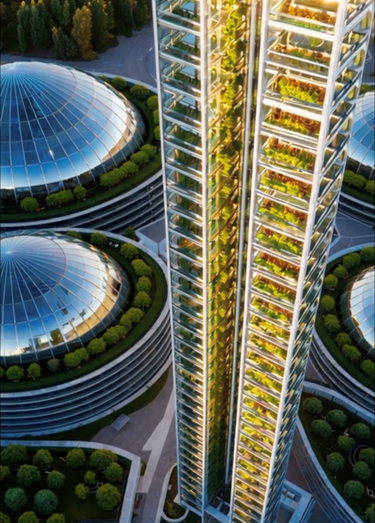
Welcome to what they call AgroNet, the most advanced autonomous agricultural ecosystem on the planet. Once there were family farms here, today there is an expanse of vertical greenhouses, geothermal domes and data centers. Here no human being touches the earth.
AgroNet Valley is not a district, but an integral artificial ecosystem, in the heart of the Pacific Ocean, where once there were only islands, palms and wind. A completely closed agricultural area, operating 24 hours a day without any human intervention, distributed over 12,000 hectares divided into climatic modules, optimized through sensors, drones and AI. Everything starts well before the sowing: Gaïa-7, a distributed neural intelligence, continuously receives data from geostationary satellites, atmospheric probes and field sensors to generate predictive models of global demand, climatic variability and environmental stress. This artificial intelligence does not limit itself to planning: it designs the crops. It decides which varieties to use based on 128 parameters (among which metabolic efficiency, viral resistance, response to nutrients, robotic compatibility), selecting them from a dynamic genetic archive integrated into the system. The sowing is executed by swarm robots RoboSeed S9, equipped with artificial vision and LIDAR mapping, which follow adaptive tracks generated by swarm optimization algorithms: they deposit the seeds with a margin of error under 2 mm, regulating depth and orientation based on the soil microstructure detected in real time.
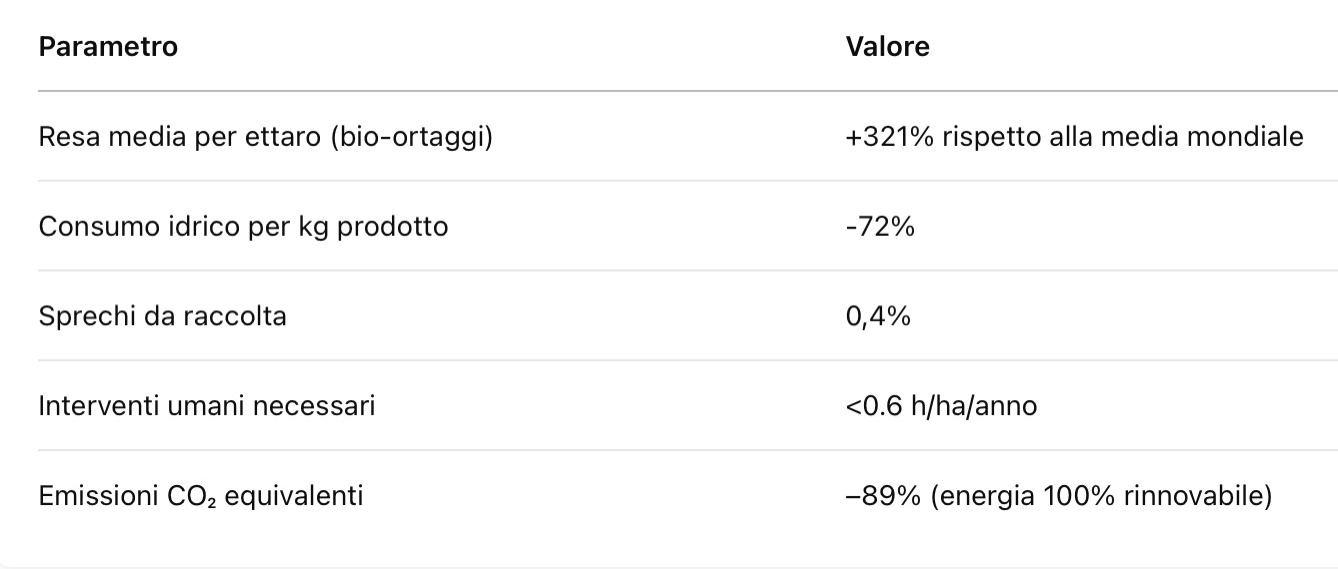
The growth phase is entirely controlled by multispectral LED matrices for modulated photosynthesis, hydro-intelligent vaporizers that dose the water drop by drop according to the biochemical feedback of the roots (monitored by BioRoot v3 sensors), and nutrient PHA microcapsules that release active molecules only when the plant requires it. The system analyzes the VOCs (volatile organic compounds) emitted by the leaves to anticipate stress, deficiencies or infections: in case of threat, it activates BioGuard molecular nanobots, programmed to recognize pathogenic RNA sequences and deactivate them without systemic intervention. The harvest is managed by Karm S-18 robotic manipulators, with gripping arms sensitive to the millinewton, which analyze the fruit individually through NIR spectrometry, internal pressure, epidermal structure and aromatic signals. Only products that pass all filters are harvested, the others remain to ripen. All data collected are encrypted and recorded in a food blockchain system (FoodChain-7), which assigns a digital identity to every plant unit.
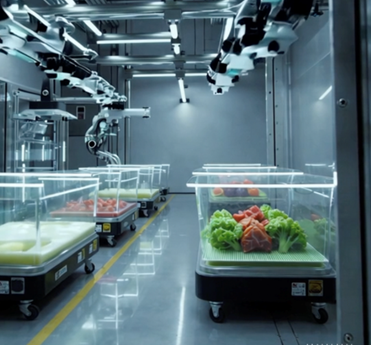
After the harvest, the supply chain continues in a closed environment: foods are conveyed onto automated transformation lines where gastronomic artificial intelligences execute functional recipes, optimized for nutritional values, shelf-life and regional consumption preferences. Fermentation, low temperature cooking, preservation and packaging occur without human touch, using biopolymers self-produced from plant waste, reducing organic waste to zero. Finally, the finished product is sorted through electric convoys on magnetic tracks, loaded onto hydrogen cargo drones and delivered to the consumer in an average time of less than 3 maximum 5 hours. Every step from the genotype to the plate is controlled by predictive algorithms, monitored by adaptive AIs, validated by independent neural networks.
Agriculture, in AgroNet Valley, is no longer a biological cycle: it is a closed algorithmic process, a cybernetic circuit where man has been completely expelled.
Outside the fence, the agricultural world has emptied. “When they dismissed us, they handed me a USB stick with the user manual of the new system,” tells Amin, 57 years old, field technician, now unemployed. “All the knowledge that I had learned in forty years, condensed into a 94-page PDF.” In many areas, the district replaced the local supply chain in less than nine months. Traditional varieties, excluded from automated production standards, were archived as non-compliant relics. “The eggplants of my land do not enter their greenhouses. They do not have the right genetic profile. They grow crooked,” says Lucy, a farmer from a nearby island. In the automated world, curves and irregularities equate to inefficiency. The peasants resist in residual spaces, often illegal, and produce food that no longer falls within official food parameters. Governments do not intervene: the food arrives, it is safe, traceable, sellable. But in case of a system crash, blackout, network collapse, the chain breaks. The estimated urban resilience time is 27-32 hours. After, the hunger begins.
“We accepted total control in exchange for absolute availability,” wrote Nero Jorban, the last Agriculture Minister of the Federated States of Micronesia, before his resignation. “We won the war against uncertainty, but we lost the right to choose.”
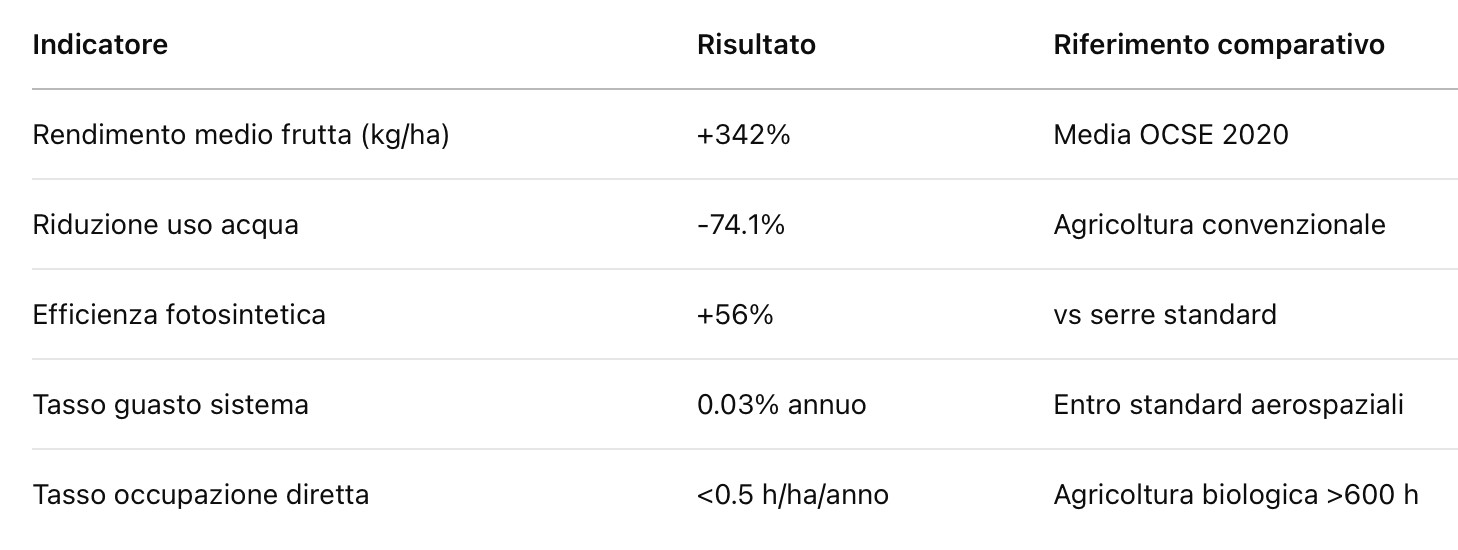
Five multinationals hold the entire cycle seed, land, system, distribution and every attempt to produce food outside of these networks is considered inefficient, not competitive, marginal. Traditional agriculture was abandoned in less than a decade: in Central Asia, in sub-Saharan Africa, in South America, entire agricultural civilizations were dissolved by the inability to compete with a model that produces three times as much with a tenth of the resources. Global agricultural unemployment has exceeded 90% in non-automated areas, and the reintegration rate into new sectors AI mechanics, agritech data analysis, and robotic maintenance remained under 30%. Peasant skills are considered obsolete. Knowledge transmitted for generations is irrelevant in a world where the terrain is an artificial substrate and biodiversity is reduced to a patented catalog. Food varieties are no longer selected for taste or for resistance, but for compatibility with automation protocols. Taste was standardized. The memory of food disappeared.
Pandar Sukta and I walked in the Ñan Valley with an idea in mind and we came out with a conviction: something must be done. Getting out of this dependence does not mean giving up technology, but redesigning the relationship between automation and autonomy. An operational bioethics in agricultural robotics is needed: transparent, modular algorithms, with real margins for human intervention. A public agricultural artificial intelligence is needed, managed by the community, not proprietary, which does not replace family and territorial agriculture. It is necessary to build mixed networks, where human work and automated work balance each other: machines for labor and precision, man for vision and adaptation. Native varieties must be digitized and integrated into automated systems, not excluded. Agricultural data must be common goods, not private assets. Agritech must remain a tool, not a regime. Agriculture remains the base of every civilization: whoever controls it, controls everything. The risk is not technological: it is political, cultural, existential. Food is not only nourishment. It is power. And we cannot allow it to be distributed only by those who know how to program.
And above all, we cannot sacrifice global biodiversity and technodiversity on the altar of unified efficiency. Every territory has agriculture that is born from climate, culture, genetic variety, and secular cultivation methods. Standardizing robotic systems on a global standard means sweeping away thousands of local adaptive solutions that artificial intelligence is not able to replicate. Technodiversity, the variety of agronomic solutions, of robotic architectures, of decisional models is the digital equivalent of natural biodiversity: it is what guarantees resilience, adaptability, and survival. If we entrust production to five global platforms, we lose not only freedom, but also ecological flexibility. A modular, decentralized, contaminated agriculture is needed: an alliance between local technologies, peasant networks and targeted automation. Because a living system is not the one that produces most, but the one that knows how to change when the world changes. And the world is changing much faster than any algorithm.
Maria Rinaldi and Pandar Sukta.