

The Forest as a Sentient Entity and Computational Power: Interview with Alessandro Chiolerio on “The Forest Code” and on his activity as a researcher.
We publish the interview conducted by Davide Gomba (DG) with Alessandro Chiolerio (AC), the researcher protagonist of “The Forest Code,” a documentary on the communication of plants.
Good reading (or viewing)!
Introductions
(DG) We are here with Alessandro Chiolerio for Ruralhack.
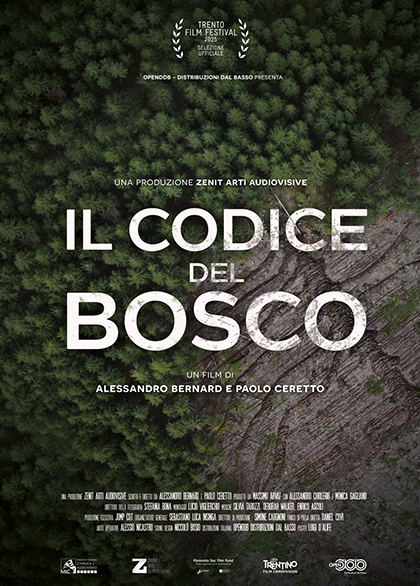
I learned about Alessandro’s story by going to the cinema, because I saw a documentary by Paolo Ceretto and Alessandro Bernard produced by Zenith Arti Audiovisive, “The Forest Code”.
In this film was told the way that plants have to communicate.
Thanks to the kindness of the directors I managed to organize this interview which also allowed me to know and discover the world of scientific research.
So without further ado I wanted exactly to introduce Alessandro.
Hi Alessandro.
(AC) Hi Davide, hi everyone.
In what way can we listen to plants?
(DG) In what way are we, human beings, able to encode information that is recorded by plants and therefore how can we read through the plants what they are listening to?
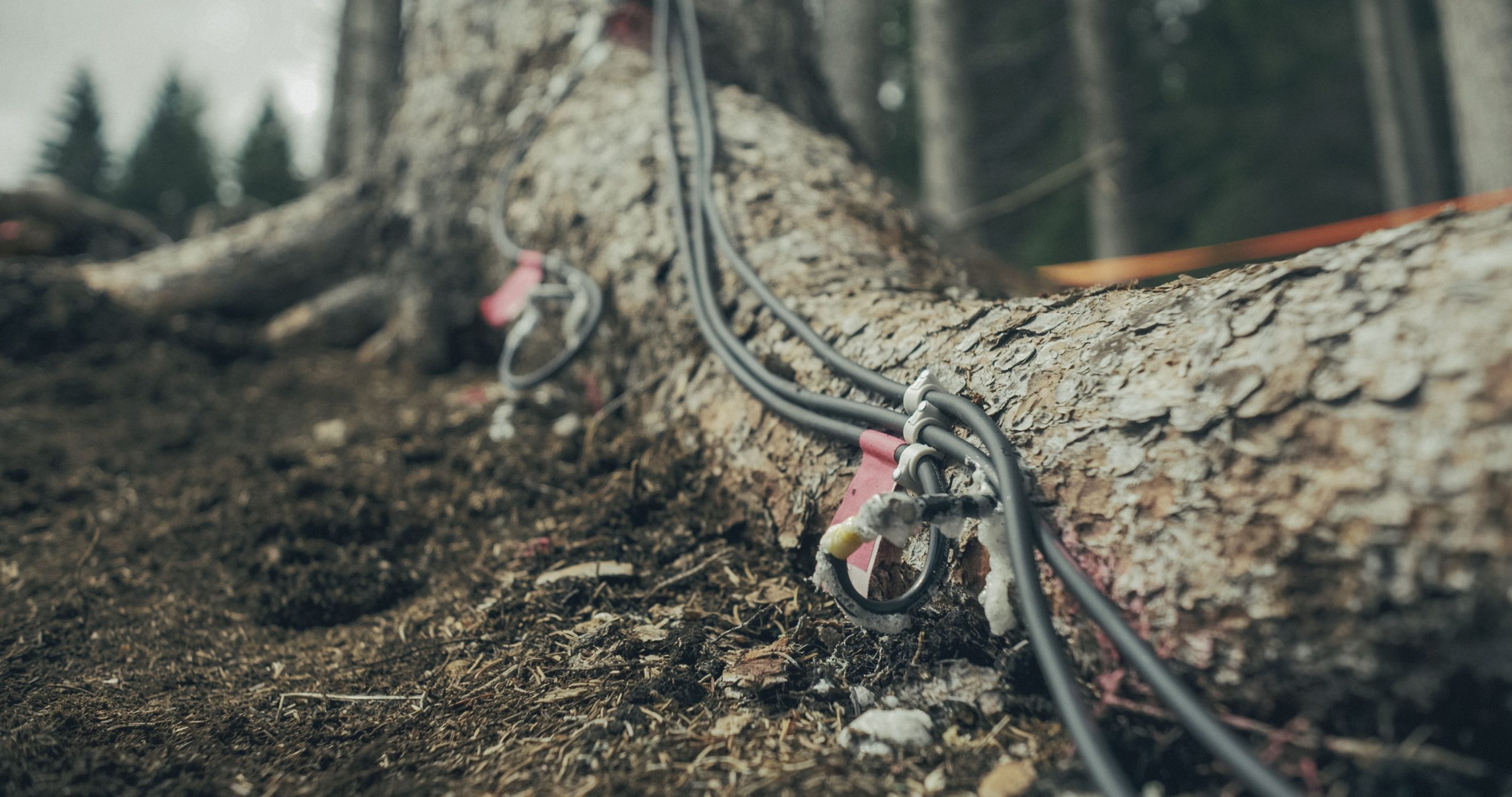
(AC) So I will take a small step back saying something about the recording technique. We perform a collection of electrical biopotentials which in the field is called an electrome. Substantially the equivalent of an electroencephalogram, only that instead of doing it to a person or a brain, electrodes are applied to the trunk of the plants in this case and through the electrical fluctuations of this set of plants—because the recordings simultaneously come from multiple individuals within the forest—we can associate this information with what happens in the environment. Obviously, one imagines the forest as an ecosystem that is very sensitive to what happens in the surroundings. One of the key concepts to consider is that plants do not move, they cannot relocate, so they are inevitably at the mercy of the environment literally.
For which their responses always result strongly correlated to the rain, to the wind, to the sun that rises or that sets, to the lunar cycles, therefore to the tidal forces. All this information is encoded within the electrical fluctuations as if it were an orchestra playing that we manage to record. To go and understand exactly what has influenced these responses, we can do it both manually by analyzing the data, having the certainty that there is a specific source in a specific moment that exerts its action, for example the case of solar eclipses, or in other situations by availing ourselves of tools a bit more advanced for data analysis, machine learning in particular, therefore numerical techniques of information processing that provide us then in a simplified way numbers that tell us, look, this data here is very probably correlated—and they also tell us how much—with for example the circadian rhythm cycle, therefore the rising or setting of the sun.
In what way can plants predict an Eclipse?
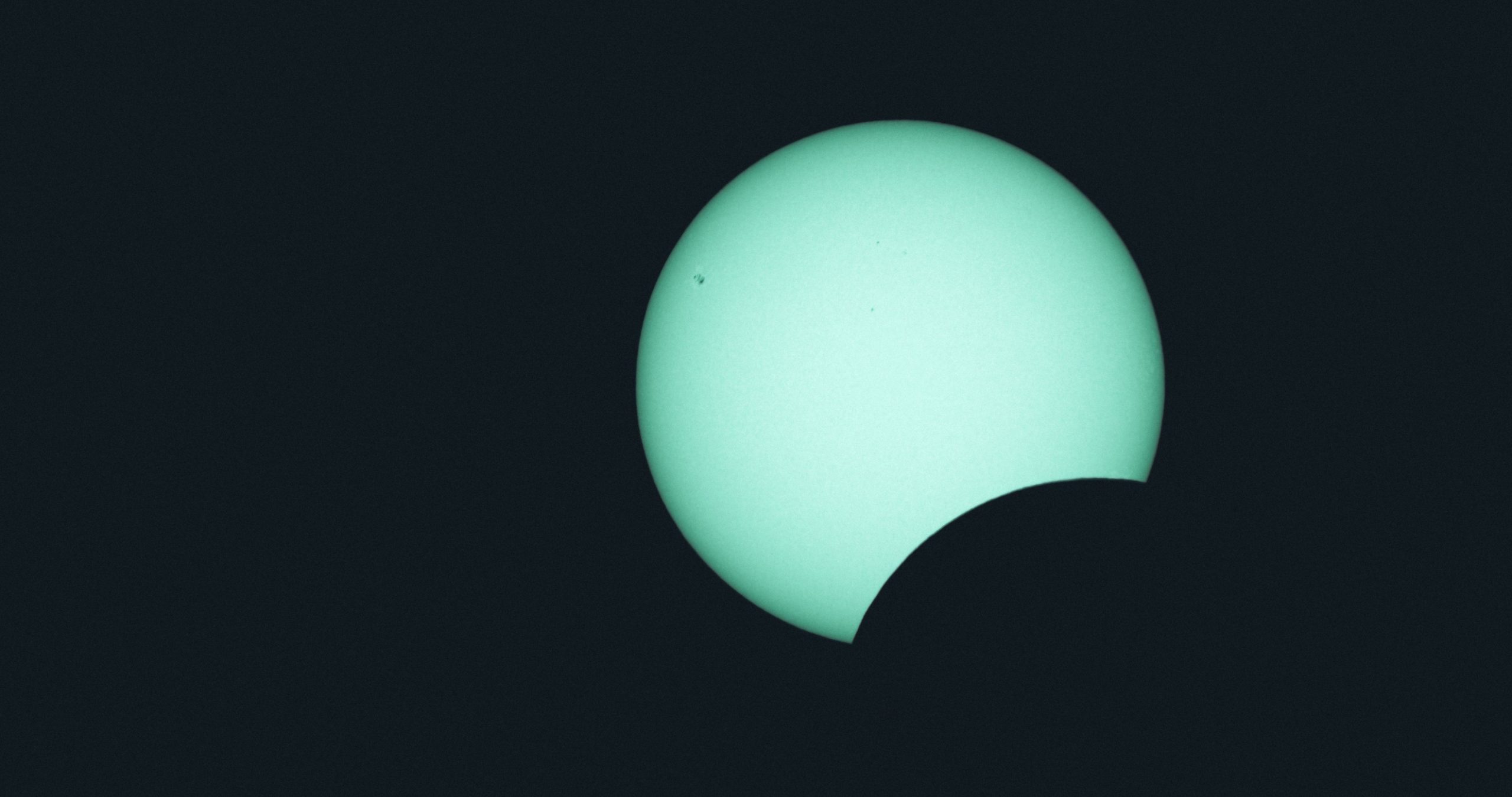
(DG) Perfect, thanks. Before you were citing the eclipse that is seen at a certain point in the trailer of the film: in what way are plants able to “predict” an eclipse event with so many hours of advance?
(AC) I can tell you what I know: their behavior changes from the norm already 14 hours before. Whatever the source of this is is still to be seen, one cannot exclude a priori any of the following hypotheses:
Hypothesis 1, it could be a matter of a memory. This is an idea that those who deal with ecology like very much, because memory gives an evolutionary advantage, so if one remembers a recurring periodic event like the eclipse it brings an advantage, trivially because the eclipse—let’s say that one was partial, but in its totality—means for the plants the absence of the source of energy, the sun, so it is something that perturbs them, that potentially generates a situation of stress.
Hypothesis 2, The other hypothesis that could be equally valid is that plants are sensitive to something that we right then and there do not know and do not see. For example, 14 hours before the Moon is found on the opposite side of the planet, so it cannot cast its shadow, it cannot be a phenomenon of masking of the sun and therefore purely optical, but it could instead be a phenomenon of gravitational nature, we know that plants are very sensitive to the phases of the Moon, therefore to the tidal forces and therefore this could be an explanation, or the electromagnetic field, or maybe simply we have excluded some important information of something that happened 14 hours before of which we were not aware, because then anyway the external environment is subject to very many influences, let’s not forget that we are exposed anyway to a flow of particles that arrive from the sun and therefore maybe the balances between the planet and the sun have changed, so the forest is anyway a sensor, it is a series of antennas that are aimed towards what happens around.
The key concept that I seem to see through the data, is that these antennas are not each for itself, but the forest behaves as a collective whole where the single antennas in some way are all connected among themselves, I deeply believe that this exists, also because if it has ever happened to you to take a walk in a woods and to see how the roots are placed all overlapping one above the others it is quite unlikely that plants are isolated, they can be thought of as isolated individuals, they are part of a strongly interconnected environment.
With what did you listen to the plants?
[Davide Gomba]
(DG) You were able to record these interconnections through a device that you have developed: what is it called?
(AC) Exactly, the device is—this one is called Cybertree, it was developed and produced by a Sardinian startup. I don’t know if I can say what it is called…
(DG) Absolutely yes, speak tell us, tell us,
(AC) it is called Open Azienda, they are some friends ex-colleagues from the Politecnico who then formed this company and who develop devices for the IoT, so they are very good in electronics, in designing circuits, in developing firmware, software for their operation, therefore together we defined the specifications, what was necessary to be able to work there and it is anyway a matter of very stringent specifications because in a woods at 1950 meters of altitude you must manage to work also in extreme conditions, from 15 degrees below zero to 60 if you are exposed to the summer sun and therefore, well, they have done an exceptional job.
These devices have worked, we have collected this information and then we began to understand how to manage to correlate it and to study it in a numerical quantitative way, for example from this electrical noise that we measured, then we did tests and verified what could be the mathematical forms to describe and simplify the vision of all this information: 25 data flows to visualize and interconnect is an arduous task for a human being, it takes a simplification for example using different parameters, like entropy, fractal dimension, there are very many mathematical varieties that can be used then to understand what is happening in the forest.
Have you also developed a way in which you can interrogate the plants besides only receiving data from them?
(DG) Therefore your work has allowed us to touch with hand a concept of distributed intelligence in the forest. Have you also developed a way in which you can interrogate the plants besides only receiving data from them?
(AC) This is truly an important question, thanks. We have yet to develop it, we have recently written an article that at this moment is in peer review, there is a preprint that we have uploaded online, with a proposal and an “hypothesis paper” it is called. The proposal is that of developing a system, a sort of ecosystemic computer.
To do this we also need to communicate, therefore in a bidirectional way, that is not only to listen but also to speak. Remaining the fact that the physical nature of the signal is the same, therefore we read an electrical signal, a voltage and we inject within the system a voltage, so doing we should be in the condition of being able to modify the state of the forest. This is the hypothesis.
Obviously to be able to realize it there is a need to have funded research and work on it. It will be a task of a few years. We have already sent a proposal, a request to the European Innovation Council, we hope that the evaluation is positive and that therefore we can start to do this type of experimentation.
Next Steps? Prossimi Passi?
(DG) What are the next steps that you are doing to be able to accommodate this type of research?
(AC) Consider that I am like a freelancer, so I write projects, those that are funded, for me constitute on one hand the salary and on the other also the possibility of operating in autonomy on a certain specific theme, obviously specifying all the subsequent steps.
Therefore when you build a project besides doing a budget, you build a timetable with all the more or less plausible activities. Then usually what you expected never happens, or better an unforeseen event always happens and it is perhaps the fascinating part of research, that which is called serendipity.
Therefore if you remain in a conscious way with the ears open and the eyes likewise, you observe phenomena and things that in some way then direct you on the subsequent phase. Surely institutional investors are fundamental in all this, also because research has a certain cost. Above all this transdisciplinarity is indispensable so that you manage to build a work group that includes many experts, for example for this specific work that was published in the Royal Society of Science.
We had within it ecologists, people who deal with unconventional computing, then there are biologists, theoretical chemical physicists, experts in machine learning, and programmers experts in electronics. All these figures must work together to find a common language and sometimes it is not simple because making an ecologist talk with an expert in machine learning, with a quantum theorist, is not trivial but in all this obviously a balance is always found. And then there are particular cases like this of the experiment of Val di Fiemme which was instead entirely funded by the film production company (Zenit Arti Audiovisive, ed.) because they had in project to realize a documentary that told a story, that of the Hurricane, of the sub-tropical storm Vaia.
After Vaia, the Bark Beetle
(DG) Yes, that was the initial reason, but then when you started to film you realized that there was another problem in the forest, right?
(AC) Exactly. Practically the plants were gravely damaged by the storm, well, many were knocked down, those that remained standing clearly subjected to very strong winds, so they had a structure of cracked wood, therefore particularly sensitive.
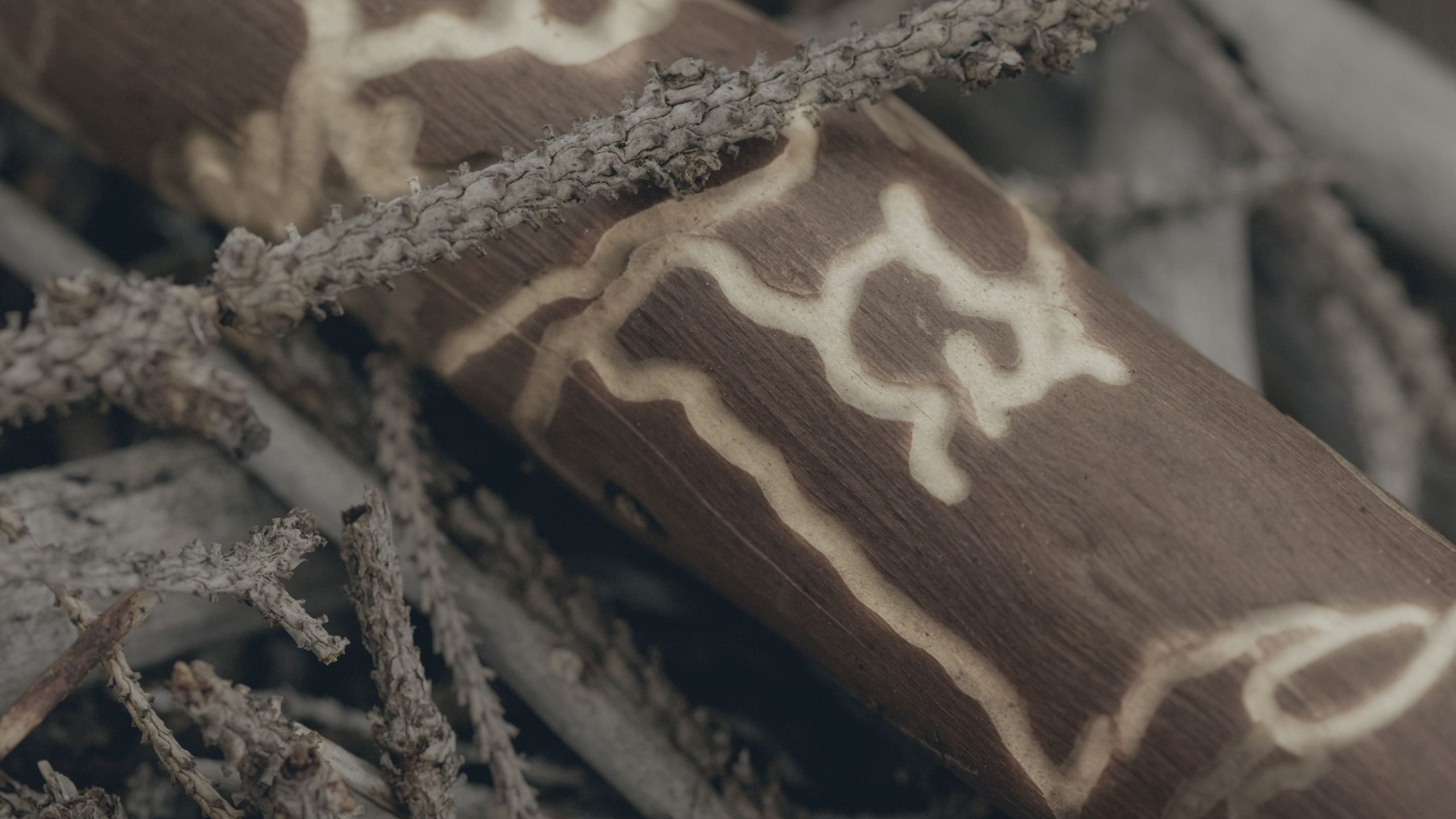
It is a tiny insect that is called Bark Beetle, known also as the engraver beetle because it digs tunnels under the bark with very beautiful shapes that vaguely remind of geoglyphs, it intercepts with these tunnels the channels of the ascending sap, and the plant dies.
One insect is enough and the plant is condemned, it is an insect moreover that I believe is a specific parasite of the Norway Spruce, therefore exactly specific and it has built a situation of discomfort and devastation also thanks to the fact that the last particularly hot years have allowed its development with very high numbers, instead of doing one or two reproductions per year it did three or four and therefore slowly like an oil stain it expanded and obviously it further damaged the forests, so there was a strong felling activity by the forestry corps because anyway to contain this diffusion of the insect the plants that were starting to be attacked necessarily had to be felled both to not become true and proper outbreaks of this Bark Beetle and for safety reasons the dry plants are unstable and there are many tourists who walk there. Simultaneously they have done planting trying to go towards a situation of polyculture instead of monoculture. The Norway Spruce has superficial roots therefore it is very sensitive.
(DG) In this documentary one talks a lot about the concept of monoculture versus a much more diversified woods as it normally and naturally would be. The Norway Spruce is used for the realization of violins right?
(AC) The resonance harmonic of this wood is very particular. It is said that in these woods Antonio Stradivari would go to look for the wood for his celebrated violins.
Does a dead stump send signals?
(DG) I would return to the theme of dead stumps: are they able to transmit signals? Do they generate them or send them?
(AC) In this place there was a natural amphitheater of trees that remained standing after the disaster, in a semicircle in front of an expanse of total desolation
On the stumps that the forest guard had left following this event (after the felling of the damaged plants) we had therefore decided to place some sensors in the stumps because naturally that area exactly at the center of this semi-circumference would have been and the other sensors instead on the plants on the edge…
With our surprise we observed that even the stumps had their own bioelectrical activity less complex than that of a living or sick tree that it was but anyway always present whatever could be the causes even here there are two I wouldn’t know how to exclude one or the other:
The first is that the nearby plants—the living ones—keep in life the root apparatus of a dead plant to be able to exploit its extension therefore having more mineral salts extracted from the ground and exchanging therefore with this apparatus since the roots anyway touch in some way they can exchange chemical substances therefore the living plant sends the refined sap with sugars and what is needed to the root apparatus of the stump
The other possibility is that there are fungi—the mycelial network is present everywhere obviously it feeds on the cellulose of dead plants and therefore it is possible that that electrical activity was that characteristic of fungi.
The interesting thing that you alluded to is that of vines because I am from Asti. I have a vineyard so obviously curiosity led me to do experiments there too.
Now it is well known that when a vine dies removing the stump manually if you don’t have an excavator is a very difficult thing, maybe having to wait three or four years before being able to remove it definitively, this because why? Because the roots below are still alive so it had happened to me to see the stump detach from the root and see that the interior of the root was still alive moreover it has a very particular color type salmon red so every time I thought how much these vines were similar to us human beings even in color and the fact that the root was alive still after three or four years without any type of connection.
Probably vines are in a different situation compared to a woods especially if in a vineyard they are planted in a row in the rows and there isn’t a true and proper connection among them the roots are deep evidently it means that there is some type of support mechanism for which the vine does not die immediately but continues in some way to vegetate.
The role of Artificial Intelligence in your work
(DG) Excellent. Ok, so you record a lot of data, this data is analyzed, what role does artificial intelligence (I know that you then don’t appreciate much the use of this term) play in the processing and in the creating meaning from this data that is collected?
(AC) Yes, I don’t appreciate it because basically what we have today already existed in the 70s, it was called Machine Learning, what there is more in artificial intelligence compared to what we already had for years, for decades, is the fact that effectively on the basis of a data analysis a system of artificial intelligence can perform choices or actions, obviously that it does not decide autonomously but that are set, pre-set in its algorithm.
Therefore I would say, as far as data analysis is concerned, the interesting part is that of Machine Learning. In the specific case of plants, given that these electrical parameters are connected to what happens in the environment, what we have imagined and that we have also written in some proposals, which I hope are funded, is that it is possible to use this information to make decisions. For example, if I know that the forest ecosystem is sensitive to crises, such as for example devastating rainfalls rather than maybe earthquakes or volcanic eruptions, I can flank the reading of this information with a system of artificial intelligence that when it encounters a suitable series of inputs sends an alert for example to the civil protection.
Therefore this could become a useful tool to ensure that we have early warnings of situations that must be managed at a human level.
Use plants as antennas and sensors
(DG) Translated, you are telling me that one could use a vineyard or a woods as weather forecasts, or to anticipate the occurrence of earthquakes or volcanic eruptions?
(AC) Of a volcano in particular there is a work by NASA, signed also with other institutions, which was recently published on a website—I don’t think the article has come out yet—in which it is stated to have encountered a forecasting capacity on volcanic events, from the part of plants, and this they have encountered with some satellite photos, because they went to trace the CO2 present in the leaves.
I can tell you what I did, that is to say a validation of the possibility of doing weather forecasts, micro local basing on 11 days—therefore let’s say a data base also quite limited, if we think about it—of collection of information from the vineyard and obviously of environmental parameters, we managed to make a forecast of the temperature and of the relative humidity with a very high precision, 85-90%. So imagine that maybe having much more data collected during an entire calendar year or even more, you can even increase the confidence of this forecasting capacity which anyway I repeat is local, absolutely local, it is natural to think about it.
(DG) The paradigm shift from my point of view as System Integrator (it happens to me to go to install sensors in the vineyard or sensors in the field for work), is that you with this device use the plant as a sensor, that is this is a paradigm shift perhaps, or anyway these studies to which you make reference seem to give the direction that plants have a competence, an awareness of what is about to happen both at a meteorological level and at a telluric level, of terrain, much better than the most refined sensors that we can have developed ourselves over the years.
(AC) (AC) I exactly think so, that is it is as if we had to do with living biosensors. I think it is quite simple to consider the fact that an organism that cannot move is sensitive, inevitably sensitive to environmental parameters. But even we who can move are, however, maybe we don’t pay too much attention to changes of mood, back pain, especially all these things that recall as if old wisdom recall the temporality of events.
Are we sensors as well?
(DG) Ah, you say, when it is bad weather it hurts, I have the ache, that is the fact of having in some way health influenced by atmospheric events.
(AC) Certainly!
How can we follow you?
(DG) Ok, and listen, primarily we try to accompany the article and interview with all the numerous links to the academic papers that you cited.
But above all, what do we do to follow your next projects, that is, can you give us a site, some link to be able to follow the activities that you carry forward?
(AC) I can give you the link to the linkedin profile, which is perhaps the most updated thing there is, it is anyway that which from a professional point of view as a network, that which I use the most, I do not use other socials. Then obviously every initiative always carries behind its own site, because by now it is how it works, so when a project, for example if a European project is funded, it is made an obligation towards the European Commission that within two months from the funding, from the start of the activity, you have the site up and running, so you can effectively publish all the contents.
Future projects
(DG) You have just presented a project, but maybe you don’t want to talk about superstition?
(AC) So let’s say that there are things that I can say and others no, because anyway I am bound to a confidentiality compared to the partners, because certain ideas that we have put down in this project, anyway are innovative and there is to say that the world of research is extremely competitive, also because by now research, if it is not connected to business, interests no one. I maintain that anyway there are important things that regardless of the business must be carried forward, but apart from this you need funding to be able to do activities and therefore consequently you package things in the right way, for which it is fundamental to keep in consideration the confidentiality of information
This project specifically is a project with nine partners, therefore we are talking, we have tried to cover the entire European Union, Estonia, Sweden, England, Portugal, Italy and Slovenia.
If it were to be funded we would go to build a pilot experiment in Slovenia, in the Triglav National Park. This is a wonderful place and moreover protected as a “Natura 2000” site, protected also by UNESCO, because together with the Julian Alps National Park it constitutes an incredible district of an always populated area. The interesting thing is that beyond natural environments, let’s say still virgin, therefore little modified.
Beyond this there is anyway a known permanence, of the human being, who always tries to live together with what is there. So in the case of Val di Fiemme this is encoded from 1,100 years “the magnificent community of Val di Fiemme,” I think it is one of the very few examples of Republic in all effects where there is a co-participation of the good, which in this case is the forest, from the part of private individuals and there is exactly a structure with a sort of Parliament or equivalent that deals with keeping the ecosystem alive. And I believe that in this case human nature, paired to the ecological situation, therefore to the ecosystem present there, has given the best of itself and perhaps also the worst with monoculture.
Therefore it is anyway a richness and a value to preserve this of the dialogue. In Slovenia if all goes well, we will constitute this new bidirectional communication portal, therefore the big difference compared to Val di Fiemme is that in addition to recording we will also do Playback. Who knows what comes out.
The next appointment – Greetings
(DG) Very well. Ok, let’s say that we stop here, but I want to hear from you again, maybe in six / eight months, to understand in what direction the project is evolving. Many thanks for your testimony and also a thanks to Zenit Arti Audiovisive, to Paolo Ceretto and Alessandro Bernard for having developed this documentary, “The Forest Code” which tells a small piece of everything that we talked about today.
(AC) Many thanks Davide, go see the documentary because it is worth it.
(DG) Absolutely, “The Forest Code”. Bye everyone.
Cited Papers
https://www.mdpi.com/2073-8994/14/9/1792 (circadian rhythm, complexity of stumps, forest as a collective set of elements in phase)
https://www.mdpi.com/2313-7673/8/1/122 (thermodynamic relation and quantum nature bioelectricity)
https://papers.ssrn.com/sol3/papers.cfm?abstract_id=5227558 (hypothesis of using an ecosystem as a computer)
https://www.preprints.org/manuscript/202505.1472/v1 (micro-local weather forecasts with vines)
https://www.nasa.gov/earth/natural-disasters/volcanoes/nasa-satellites-provide-early-volcano-warnings/ (plants that anticipate volcanic eruptions)