

Dieta Mediterranea? Sì, no, forse, quasi.
The history of the Mediterranean diet seems to waver, both collectively and individually, between the “not yet” and the “no longer.”
Vito Teti, in his Mediterranean Diet. Reality, Myth, Invention (Treccani, 2024), argues that this dietary model was incompatible with the backwardness and poverty of southern Italy in the 1950s, especially in inland areas. So rather than representing the way Mediterranean peoples ate, it represented the way they dreamed of eating.
On the other hand, the “Moli-Sani” study launched in 2005 by the Neuromed Institute of Pozzilli (IS), which continues to monitor about 25,000 people in Molise, tells us that adherence to the Mediterranean diet today is no longer as obvious as when Mediterranean populations (especially coastal ones) had essentially no other choice. Today, younger people especially tend to adopt lifestyles that include a high intake of ultra-processed foods, high levels of physical inactivity, and weaker social ties.
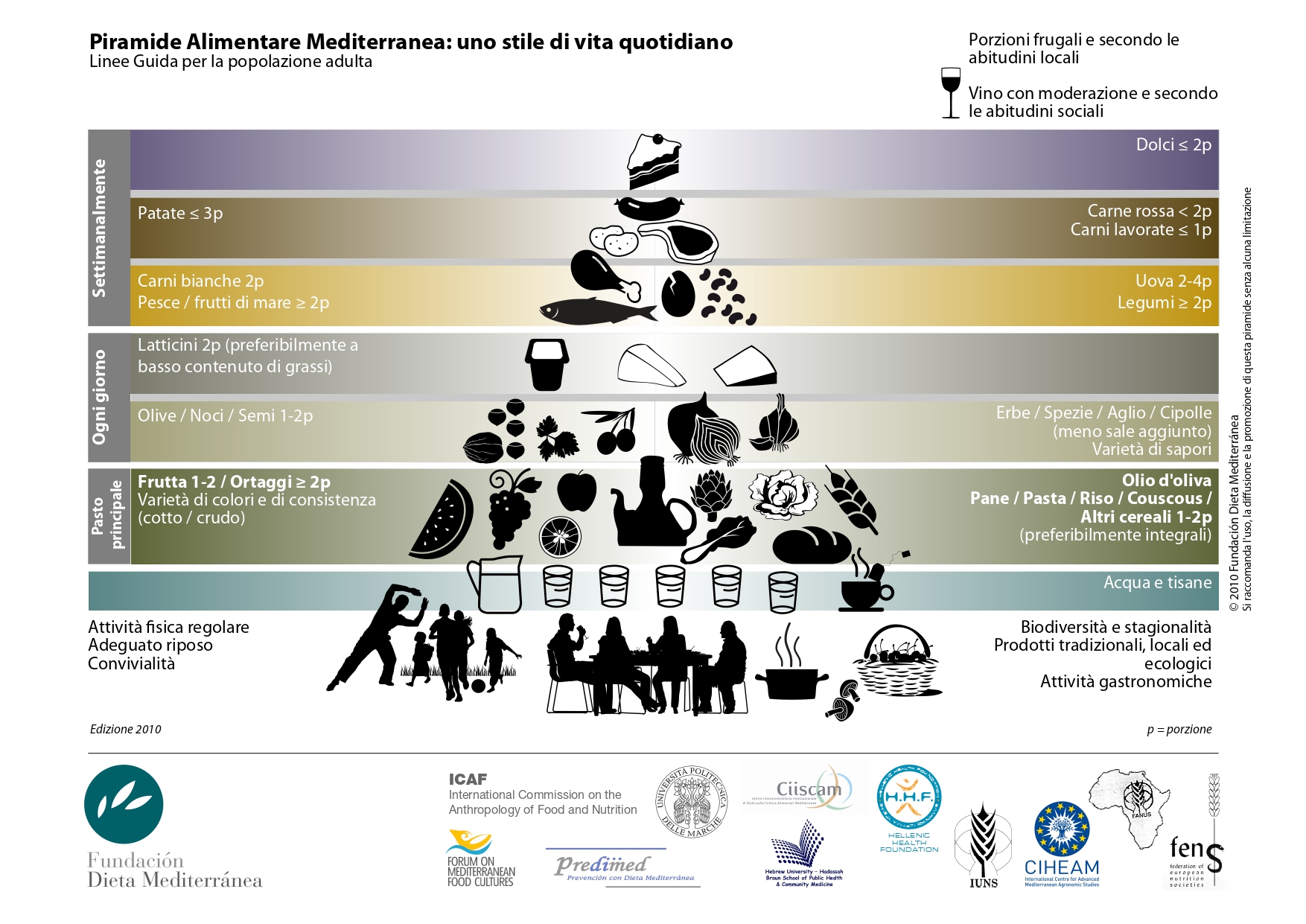
Surely in the decades that the Keys couple spent studying the dietary (and not only dietary) habits of coastal populations in various Mediterranean countries, it was easier to adhere to what they later called the Mediterranean Diet, which in 2010 became part of UNESCO’s Intangible Cultural Heritage.
Today the situation is very different, to the point that nutritionists describe the environments in which Western societies live as “obesogenic environments.” This means we live in situations where the omnipresence and constant availability of ultra-processed foods, the encouraged and facilitated sedentary lifestyle, and the marketing pressure to buy unhealthy products create a behavioral drift—one that requires willpower and awareness to resist, which we are not always able to summon.
Unlike Mediterranean populations of seventy years ago, we are not “forced” to follow the Mediterranean diet. Quite the opposite: less healthy alternatives are increasingly within reach, easy to access, and economically affordable.
We Are Genetically Energy Savers
This socio-cultural factor combines with a genetic predisposition for accumulation: the technological, productive, social, and economic development of our societies has advanced much faster than our genetic evolution. So today, we find ourselves with a body formed in an environment of food insecurity, where it was important to take every opportunity to eat, not knowing when the next one would come. Yet we now live in an environment where food not only abounds but is presented to us far more often than we need physiologically. Our metabolism still works as if we were hunter-gatherers, but now we only need to go to the supermarket.
And we go there by car, not by walking for hours in the forest, so we keep accumulating, but the opportunities to burn calories are much fewer. We are not genetically programmed to handle all this food abundance.
We Really Like Species Survival
As if it weren’t hard enough to try to maintain healthy eating behaviors, there’s another complicating factor: pleasure.
The two activities that have always guaranteed species survival are eating and sex. For millennia, they were activities that required a lot of effort and sometimes carried a fair amount of risk. This applies to us and to all animals: getting food and finding a mate has never been easy. Food can be toxic, for example, or particularly difficult to find in the case of plants; or it can be hard to catch—or even have the same intentions toward you as you have toward it, in the case of animal protein.
As for the dangers—or at least the difficulty—of finding a mate, we’ve seen dozens of documentaries and countless battles in the animal kingdom. We’re no different.
That’s why living beings developed reward mechanisms for such energy expenditure and calculated risk, and they found them in the forms of pleasure that food and sex bring with them—pleasures that are less trivial and primitive than we might think. No surprise that the food industry has devoted time and capital to researching the so-called “bliss point”: that perfect combination of salt, sugar, and fat that makes many industrial foods irresistible.
When we joke that a certain junk food is “addictive,” we should think twice—we’re not really joking.
With the advent of the food industry, the pleasure mechanism is significantly distorted because ultra-processed foods are immediately available, unlike those that require even minimal preparation. This means that the reward comes even without the effort of preparing or procuring healthier food. Junk food wins hands down.
A Reward Mechanism Was Needed
From these reflections and from what he observed during his work at the Severe Obesity Clinic of the Health Center in Turin, Andrea Devecchi—who holds a degree in Medicine and Surgery and a specialization in Food Science from the University of Turin—had an idea. This idea was refined during his doctoral studies in a joint program between the University of Gastronomic Sciences in Pollenzo and the University of Turin on the topic of “Good and Healthy Food,” which he is currently pursuing.
The idea was to create a mechanism that concretely rewards purchases that align more closely with the Mediterranean diet model: something very similar to the point cards that supermarkets have offered for over half a century, but not to promote brand loyalty—instead, to encourage dietary habits that align with the Mediterranean model.
In short, a tool to promote primary prevention—that which is implemented by adopting healthy behaviors (as opposed to secondary prevention, which uses screenings to detect early signs of disease, and tertiary prevention, which includes regular checkups to prevent recurrence after recovery).
From YourPappa to EatMed
The beta version of the app was called YourPappa. Devecchi self-funded it, and it was developed in 2021–2022 and tested over four months on a small group of users.
Then in 2023, when Devecchi began his PhD at the University of Gastronomic Sciences in Pollenzo, the current research group was formed, coordinated by Professor Luisa Torri, now Vice-Rector of the University. The group includes Devecchi, Riccardo Migliavada (expert in decision-making processes), Maria Piochi (researcher in sensory analysis), Michele Ricci (data analysis expert), and Francesco Novarese (external collaborator for corporate relations).
Thanks to the NODES (Northwest Digital and Sustainable) funding program from the Piedmont region under the PNRR, the project received about €70,000, which allowed significant progress: hiring a research fellow (Michele Ricci) to manage the database, improving the app with the help of a new software company (B4Web of Alessandria), and integrating artificial intelligence to solve the challenge of reading receipts. A blog was also added, along with the ability to track one’s progress in terms of score and carbon footprint.
Then came the need to find a group of users, and two large companies from the agriculture and agri-food sectors agreed to collaborate. Yes, the world is full of contradictions. But if companies of that size are willing to participate in a project that aims to increase adherence to the Mediterranean diet, then this collaboration could even spark interesting and fruitful reflection among all stakeholders. In any case, 70 employees of the two companies have been using the app for about six months, while another 70 individuals—recruited externally with the same characteristics (healthy adults without allergies or conditions that affect food choices)—received only a sheet of dietary recommendations.
Soon, the six-month data from EatMed will be available and published in academic journals. But from what can currently be glimpsed in the app’s database, the results seem promising. Adherence to the Mediterranean diet by the advice-only group will be measured using a questionnaire called Medi-lite.
Promising results had already come from the YourPappa pilot phase: in four months of testing, both groups had improved their Mediterranean Diet adherence scores, but the improvement was ten times greater in the app-using group (7.1% increase) compared to the group that received only written advice (0.7% increase).
How Does EatMed Work?
EatMed is a web app that works on both computers and smartphones. Users create a profile and start uploading their receipts by photographing them with their camera.
“Non-food” items on the receipt (detergents, cosmetics, etc.) are not considered, while all other items are recorded and categorized (vegetables, meat, fruit, legumes, cereals, etc.). Each category has a score, which is influenced by both diversity (buying only vegetables gives a lower score than buying vegetables, fruit, legumes, etc.) and quantity, which is calibrated according to household size and recommended intake (for example, red meat has a stricter weekly limit than vegetables).
Points can be redeemed for rewards, which, depending on the total accumulated, may include items like record players or electronics, or gift vouchers for bookstores or sporting goods stores.
Currently, the companies providing these rewards or the stores where vouchers can be spent do not sponsor the initiative—in fact, they benefit from free advertising. At present, the prizes are paid for by the companies whose employees are testing the app. The logic is that healthier-eating employees will be healthier overall, which can only benefit the company, which in return covers the reward costs.
What’s Next?
As mentioned, the research phase ends in late October. After that, an article will be written and submitted for academic publication
Then, a limited liability company (srl) will be created, and it will be crucial to reorganize the structure, further refine the point system, and especially figure out how to keep the app free for users—who will finally be able to register freely, receive the newsletter, access the blog, and all other services, whereas use is currently limited to the 70-person test group. This also means figuring out how to cover the cost of the rewards. It might also make sense to change the types of rewards, making them all digital vouchers or discount codes—because it doesn’t make much sense to track the carbon footprint of food purchases and then reward users with a physical object that has to travel many kilometers for delivery.
See You on EatMed
In any case, the important part of all this work is finding the motivation—inside or outside ourselves—to improve our adherence to the Mediterranean diet, which, over the decades and with increasing data, continues to prove itself a lifestyle that promotes physical, mental, and relational health. EatMed is an app aimed at healthy adults, inviting them to follow a healthier, more enjoyable lifestyle with a lighter environmental footprint. It also allows users to compare their results with others, as happens in online games—something that helps move from “community” to a small sense of “common-unity.”
It’s not easy to predict what kind of impact an app like this might have on the food purchases of an average family. But the foundations are solid, and the basic structure is in place to make this tool—currently limited to collecting research data—a helpful and rewarding part of daily life. The central research question remains: Can adherence to the Mediterranean diet be improved through a reward-based mechanism? Even though the results are still being analyzed, the answer so far seems to be yes.
Does It Make Sense to Pair the Mediterranean Diet with an App?
When Ancel and Margaret Keys conducted their studies, mobile apps weren’t even science fiction yet. And yet, it was immediately clear to them that the system they had codified would only make sense if applied in daily life to change the unhealthy eating habits that were beginning to take hold in American (and not only American) society in the 1960s and 70s. Their book The Mediterranean Diet. How to Eat Well and Feel Well (Slow Food Editore, 2024), which presents the results of their research, was published in 1975. It’s not an academic paper but a popular guide filled with recipes to help readers practically apply each dish. And the theme they keep coming back to is pleasure—the idea that this way of eating provides great sensory satisfaction while building overall well-being.
Alex Giordano, in his FoodSystem 5.0 (Edizioni Ambiente, 2023), speaks of the Mediterranean diet as one of the hacking tools that can help reorient our food system toward sustainability. We’re not talking about hacking software here, but hacking a system of habits and economies and production that is making people sick because it is making the environment sick.