

From social agriculture to “proximate agriculture”. Notes from SàFF 2026
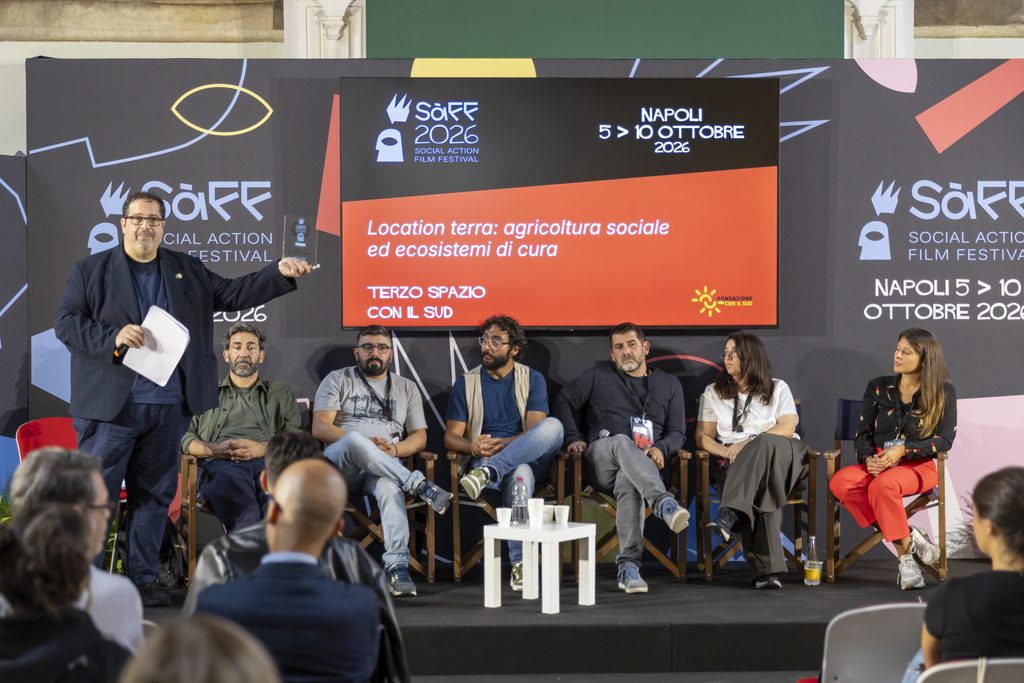
Location Terra: social agriculture and ecosystems of care, SàFF 2026, Complesso Monumentale di Donnaregina, Naples.
Location Terra panel on social agriculture and ecosystems of care at SàFF 2026 in Naples”.
On 7 October, in the Sala Solimena of the Complesso Monumentale di Donnaregina, I had the pleasure of moderating, for SàFF – Social Action Film Festival and within Terzo Spazio con il Sud, curated by Fondazione CON IL SUD, a conversation entitled Location Terra: social agriculture and ecosystems of care. It was the day the Festival had devoted to the word “Care”, one of the six words around which this third edition built a programme that now extends well beyond the conventional format of a film festival, bringing together cinema, masterclasses, meetings, training and dialogue among the Third Sector, the audiovisual industry, universities, businesses and institutions.
Around the table were Lorenzo Scaraggi, director of Madre Nostra; Eugenia Laneri and Antonella Russo, respectively a socio-occupational inclusion specialist and nutritionist with Action Against Hunger; Marco Notarnicola of Qualcosa di Diverso and XFarm; Daniele De Michele, Don Pasta; and Giorgio Ruggeri of Santi Paduli and La Buona Mensa. Time, as often happens when a conversation stops following a script and begins to acquire a life of its own, quickly became compressed, and we never reached the second round I had originally imagined. I do not think this was a problem, because the questions I wanted to place in relation to one another emerged anyway and, more importantly, they began to contaminate one another in productive ways.
The starting point was only apparently simple. When we bring land and care together, we run the risk of producing, almost immediately, a pacified imaginary: the countryside that welcomes, good food, the small producer who resists, the community that comes back together, the young person who returns to the village and perhaps rediscovers the work of their grandparents. These are images I know well and to which, in many respects, I am deeply attached. Precisely for that reason, I believe they must be rescued from pastoral idealisation.
The interesting question is no longer whether reclaiming a confiscated asset, producing healthy food, creating inclusion through work, maintaining a landscape or guaranteeing better nutrition for children are socially desirable activities. The real problem begins immediately afterwards, when we ask under what conditions all this can endure, and why experiences that are now mature, often built through years of research, cooperation and experimentation, continue to be presented as virtuous exceptions rather than as challenges to the ordinary functioning of our agricultural, social, health and economic policies.
From Barren Lands to restanza: distant images, perhaps images from the future
We opened symbolically with the Social Storytelling Award assigned to Barren Lands – Terre aride, by Hervé Barmasse. Barmasse was not present, but we nevertheless wanted to show an extract from the documentary, set in north-western Kenya, in a territory where water scarcity, climate change, human health, animal life and the continuity of pastoral communities are becoming progressively impossible to separate.
Barren Lands – Terre aride, Hervé Barmasse
As those images unfolded, something apparently paradoxical happened to me. The more I looked at a territory geographically and culturally distant from our own, the more I felt I was seeing, naturally in an extreme form and on a scale that cannot be compared directly, some possible images of the future of our own fragile territories. Not because North Horr can be turned into a metaphor for the Apennines or the internal areas of Southern Italy, which would be simplistic and even disrespectful of the differences involved, but because in both cases a radical question emerges about habitability: what happens when the environmental, economic and infrastructural conditions that make it possible to remain in a place become progressively harder to sustain?
It was this feeling that brought me back to a word around which Vito Teti has developed an important reflection and which, in recent years, we have increasingly used when speaking about Italy’s internal areas: restanza.
What interests me in that word is the right not to be forced to abandon a place in order to build a dignified life, but I am equally interested in protecting it from the rhetoric that has rapidly grown around it. To remain does not mean standing still, preserving a world exactly as it was, or turning attachment to one’s land into a form of identity-based sacrifice. Remaining has meaning only if it continues to be a choice.
There is something profoundly unfair in asking young people, above all, to stay in villages, return to pastoralism, cultivate their grandparents’ land, protect forests, maintain landscapes and keep communities alive while, at the same time, transport, schools, healthcare, connectivity, cultural spaces, markets and professional opportunities disappear around them. At that point, restanza risks becoming a pedagogy of sacrifice through which individual biographies are expected to compensate for what institutions and markets have progressively ceased to guarantee.
A freedom, after all, is real only when the conditions exist for it to be exercised. This is true of the right to leave, and it should be equally true of the right to stay.
Telling stories without forcing reality to end well
From Barren Lands we moved to Madre Nostra, Lorenzo Scaraggi’s documentary made seven years ago with the support of Fondazione CON IL SUD and Apulia Film Commission. We chose to screen the trailer of that work, rather than the contribution initially planned, precisely because Lorenzo was there with us and we could use the distance created by time to ask what had actually happened after the story had been told.
Madre Nostra, directed by Lorenzo Scaraggi
I asked him what had changed over those seven years in the way we represent social agriculture, marginality and redemption. His answer had the merit of refusing to protect his own profession:
“In these seven years I have not seen an evolution in the storytelling, or a strengthening of the storytelling. The risk of telling the wrong story and spectacularising it is always there.”
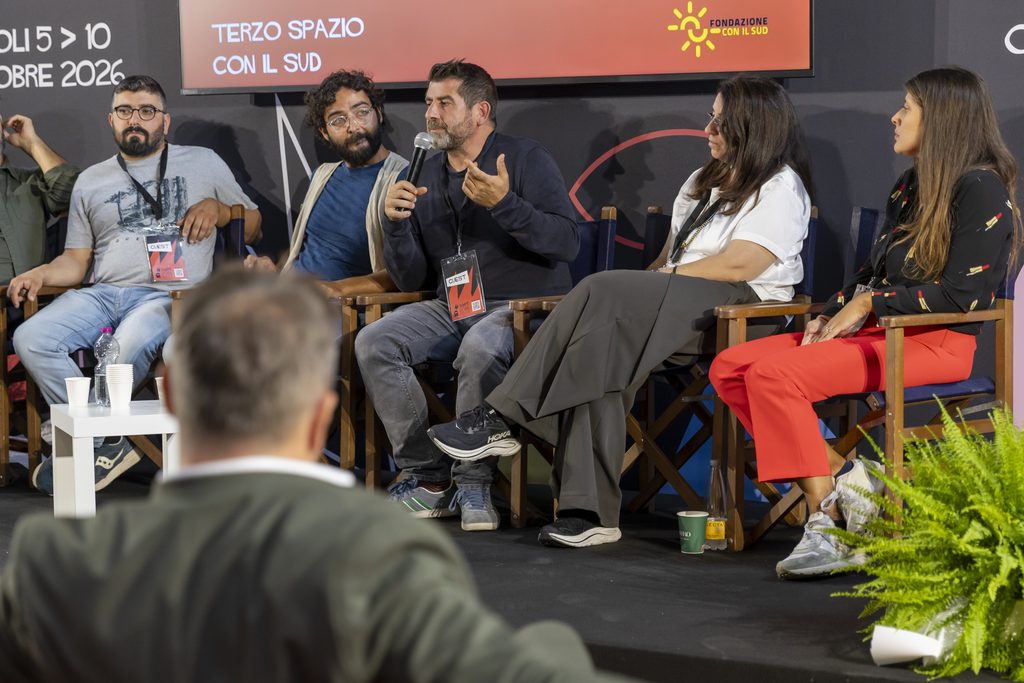
Lorenzo Scaraggi during the discussion on cinema, social agriculture and the responsibility of storytelling.
I think this is a crucial point, because the issue is not merely the possible rhetoric of social cinema, but a much broader difficulty affecting all of us who work around processes of territorial transformation. We understandably need stories capable of showing that change is possible, yet precisely this need can push us to select reality according to the thesis we wish to demonstrate, turning people and communities into characters in a screenplay that is somehow expected to produce a happy ending.
Lorenzo also spoke about experiences in which the path of redemption did not hold, about people in whom others had invested and who later fell back into difficult trajectories. Perhaps this is exactly where social storytelling becomes more mature: when it accepts that reality has no obligation to confirm our representation of it.
“We have to accept the risk of telling stories without spectacularising them,” Scaraggi said. It is a sentence I feel very close to, because I believe we should increasingly try to make cinema not simply about social agriculture, but with social agriculture, remaining inside the processes long enough to observe their frictions, reversals and contradictions as well. This becomes even more necessary at a time when words such as sustainability, resilience, community, territory and regeneration have become powerful devices of communication and, inevitably, of marketing. We do not need to stop telling stories; we need to prevent the quality of the story from becoming a substitute for the quality of the transformation.
When the Mediterranean Diet becomes an image of itself
The same question runs through food. During the panel I returned to several figures that had stayed with me particularly strongly during our work on Campania Mater. The Campania Model for the Food to Come, the report I edited together with Nicola Caputo and Teresa Del Giudice, for which Rural Hack coordinated the Content Lab and a research process carried out by Nomisma and subsequently discussed with more than 150 stakeholders through nine thematic working tables.
In the chapter devoted to the relationship between food and health, the data processed by Nomisma from Istat and the Italian National Institute of Health’s OKkio alla SALUTE surveillance programme offered a picture that is difficult to forget: among eight- and nine-year-old children in Campania in 2023, 24.6 per cent were overweight and 18.6 per cent obese, compared with national figures of 19.9 and 9.8 per cent respectively. This means that in the region which perhaps more than any other likes to recognise itself in the narrative of the Mediterranean Diet, more than four children in ten were living with excess weight. The report also insisted on the need to read nutrition, public health, schools, agricultural production and inequalities together, rather than reducing nutrition to the simple sum of individual behaviours.
These figures are not an argument against the Mediterranean Diet. If anything, they tell us exactly the opposite. They remind us that geographical proximity to a cultural heritage does not guarantee access to it. We can live in the territories that helped shape one of the most studied dietary models in the world and, at the same time, find ourselves within social, economic and organisational conditions that make it increasingly difficult to translate that model into everyday practice.
This is the point at which the Mediterranean Diet risks becoming a narrative brand, a repertoire of ingredients, images and words used to position territories and tourist offerings, while we progressively lose the complexity of the system that generated it. The Mediterranean Diet is not the mere coexistence of olive oil, tomatoes and bread within the same photograph. It is a historically constructed relationship among biodiversity, seasonality, affordability, domestic transformation, moderation, embodied knowledge, the time required for cooking, agricultural labour and conviviality. If we extract foods from the social conditions that once allowed them to exist in relation to one another, the brand may survive while the model disappears.
Food poverty also means having fewer possibilities from which to choose
Eugenia Laneri and Antonella Russo brought to the table the work of Action Against Hunger and the Mai più fame programme, making concrete another question that tends to disappear when we speak generically about access to food. Food poverty concerns not only the quantity of food a person can obtain, but also the progressive narrowing of the range of options from which they can genuinely choose.
Antonella Russo described it through her experience with participants in food education programmes:
“Almost all participants associate the idea of healthy eating with a very large and expensive grocery bill.”
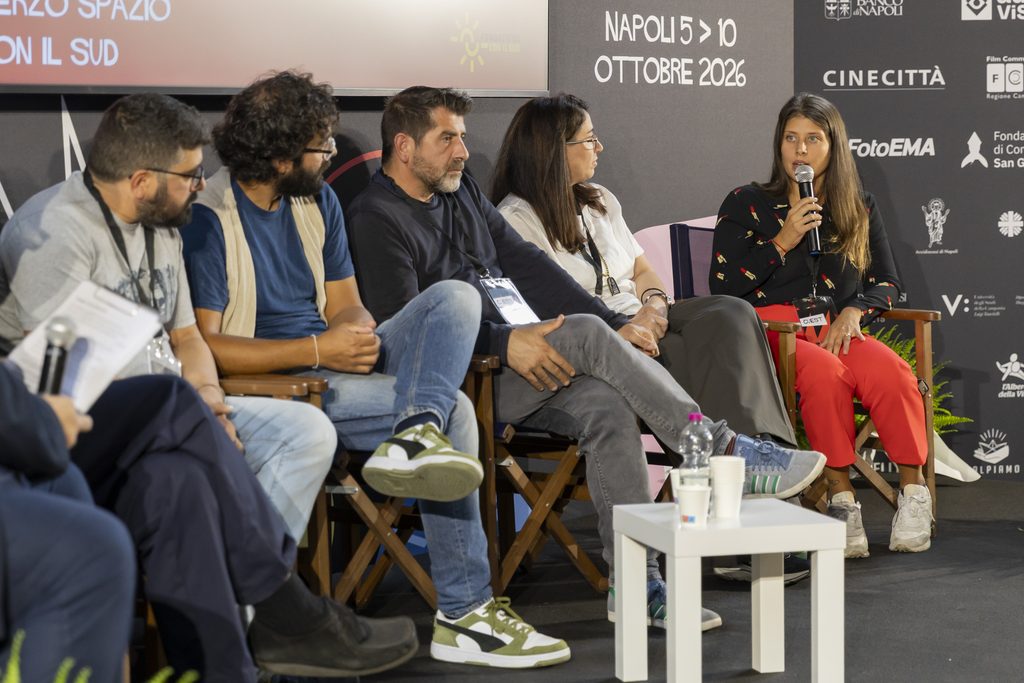
Antonella Russo of Action Against Hunger during the panel.
It is an apparently ordinary sentence that, if taken seriously, opens a major political question. When financial resources shrink, but so do time, access to knowledge, the availability of shops and markets, the possibility of planning purchases or economically absorbing waste, the space of food freedom shrinks as well. It is within that space that ready-made or ultra-processed food can become not evidence of ignorance or poor judgement, but a rational response to very constrained living conditions.
This is why I find it significant that the work described by Action Against Hunger combines employment autonomy with food education, moving from weekly menu planning and shopping lists to the rediscovery of relatively affordable ingredients and simple culinary skills. The point is not to deliver a moral lesson to people with fewer resources, but to understand that increasing autonomy also means increasing the range of possibilities that are actually available.
Cheap food and poor food, moreover, are not the same thing. Pulses, eggs, seasonal vegetables, grains and many preparations of popular Mediterranean cooking tell a long history of the ability to produce quality within scarcity. Yet that competence is not a natural heritage that preserves itself automatically. It can disappear, be squeezed out by the rhythms of contemporary life, or become less accessible as families, work, neighbourhoods and retail systems change. Rebuilding it does not mean nostalgically restoring the past; it means restoring margins of autonomy in the present.
From ExFadda to XFarm: the community comes before the field
I know the XFarm experience well, also because I know the history from which it emerged and to which I feel personally connected. ExFadda, in San Vito dei Normanni, was one of the experiences that marked an important season of social innovation in Southern Italy and, for me, it is inseparable from Roberto Covolo, a dear friend, whose impulse helped give shape to that extraordinary laboratory within the former Dentice di Frasso winery.
It is significant, moreover, that ExFadda already appeared in the Manifesto of Rural Social Innovation as one of the experiences through which we were trying to understand what a Mediterranean model of social innovation might concretely mean. Roberto’s contribution focused precisely on the need to reinterpret belonging in relational terms and to build trust as a condition for producing new organisational models.
The Manifesto is still available here:
(https://www.ruralhack.org/wp-content/uploads/2018/08/The-manifesto-of-the-Rural-social-innovation.pdf)
For this reason I consider the genealogy leading from ExFadda to Qualcosa di Diverso and then to XFarm particularly important. It helps us avoid one of the most common simplifications in the way social agriculture is narrated: the idea that making land available, perhaps a confiscated asset, is enough for a community capable of making it productive to form automatically around it. In their case, something almost opposite occurred. First, over time, came the capacity for relationship-building, organisation, enterprise, design and community activation; then that accumulated capacity encountered the land.
Marco Notarnicola explained very clearly why, at a certain point, the conventional definition of social agriculture began to feel insufficient:
“We realised that social agriculture carried with it a narrative that was no longer enough for us. We began to speak of agricoltura prossima. Prossima because it contains relationships and closeness, but also because it has to look towards the near future.”
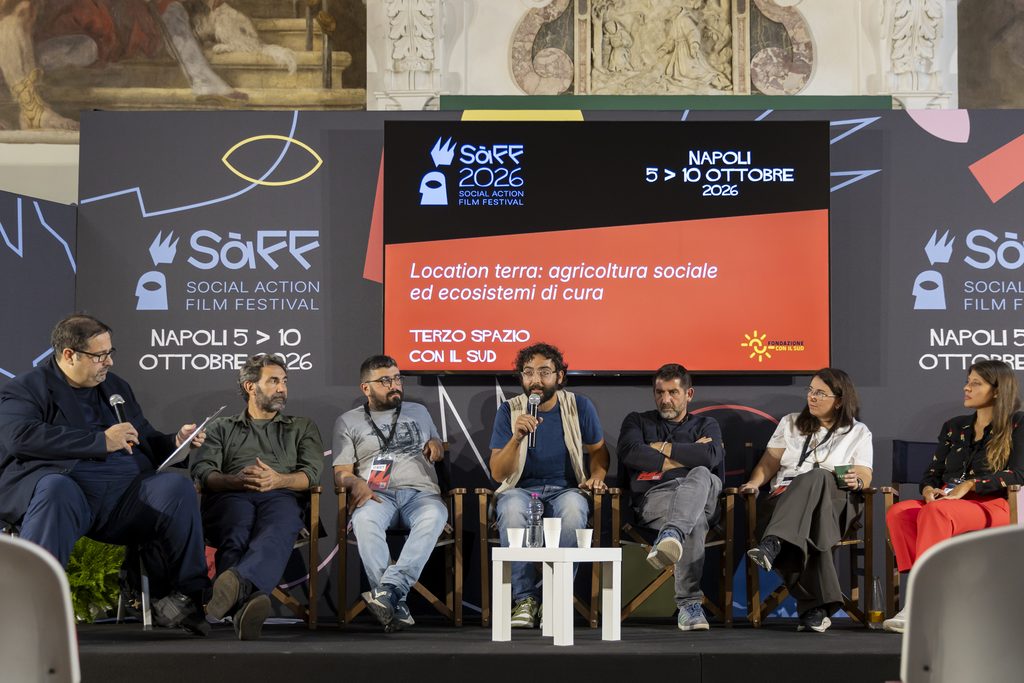
Marco Notarnicola, XFarm and the Qualcosa di Diverso Social Cooperative.
I am deliberately retaining the Italian expression agricoltura prossima, because its meaning is difficult to exhaust with a single English equivalent. Prossimo is what is close to me, the neighbour towards whom I assume a responsibility and with whom I build a relationship, but prossimo is also what comes next, the future that is not abstract or remote but close enough to demand decisions in the present.
Within this double meaning I also recognise an evolutionary tension that I feel strongly and that, in my view, is necessary if we are to protect rural culture from nostalgia and pastoral idealisation. I have always struggled with the idea that saving agriculture somehow requires us to move backwards, reconstructing a past imagined as harmonious, uncontaminated and naturally communal. Peasant cultures contain extraordinary reservoirs of knowledge, adaptation, moderation and ecological understanding, but inheriting them necessarily means translating them, contaminating them with science, technology, new rights, new organisational forms and new forms of sensitivity.
Agricoltura prossima is interesting to me precisely because it does not oppose proximity to the future. On the contrary, it asks us to design the future starting from relationships, territories and the ecological limits within which we are embedded.
When Marco described the farmer as a “gardener of the landscape”, the metaphor struck me as immediately political even before it became poetic. The moment we recognise that those who cultivate land do not merely produce commodities, but also contribute to maintaining soil, landscape, biodiversity, human presence, knowledge and relationships, another question necessarily appears: how is that work economically recognised?
A question that has been with us since the days of Rural Hub
In truth, this question has accompanied me for many years. During the Rural Hub years, in the Manifesto of Rural Social Innovation that I wrote with Adam Arvidsson, we deliberately devoted an entire section to measuring the impacts of rural social innovation. The Manifesto identified the ability to make multidimensional impacts visible as one of the most difficult challenges faced by rural innovators, and argued for moving beyond an accounting logic based exclusively on the sequence input, transformation, output, because whatever falls outside that sequence tends to be relegated to the category of externalities. Environment, health, the quality of relationships, the redistribution of value and the vitality of communities consequently appear economically secondary precisely because conventional instruments struggle to represent them.
It was a battle that, at the time, may have seemed methodological, but for me it was already profoundly political. We argued for impact measurement precisely because markets are not enough. Not because markets should be removed or replaced, but because price can capture only one part of the value generated by an activity.
Marco expressed this from the very concrete standpoint of someone who has to make the numbers work:
“If we looked only at agricultural production, we would have no chance of surviving. The surrounding market values the final product, whereas we also value the relationships we are building.”
If a farm regenerates soil, sequesters carbon, keeps land under cultivation that would otherwise be abandoned, trains young people, includes vulnerable people, preserves biodiversity, produces knowledge and strengthens local networks, all of this value exists regardless of whether the market possesses a price through which to remunerate it. Measuring it does not mean reducing every relationship to an indicator or surrendering complexity to a spreadsheet. It means precisely the opposite: trying to prevent only what already possesses a price from continuing to be treated as real.
This question is even more visible today than it was fifteen years ago, because we are asking agriculture to perform an expanding range of climatic, social and ecological functions without having yet built an equally mature system for recognising them.
A school canteen can become agricultural policy
Giorgio Ruggeri brought to the table the experience of Santi Paduli and La Buona Mensa, developed in Salento within a landscape deeply marked by Xylella, fires, abandonment and the fragmentation of agricultural land.
It interests me because it allows us to reverse one of the questions we most frequently ask when dealing with small-scale territorial production. We are accustomed to starting from the supply side: how do we bring a local, sustainable or socially responsible product to market? La Buona Mensa instead forces us to look from the opposite end and ask whether it is possible to design demand.
Giorgio explained it through a very concrete relationship:
“For every given quantity of fresh produce required by the school canteens, there is a corresponding amount of landscape that is brought back into active use.”
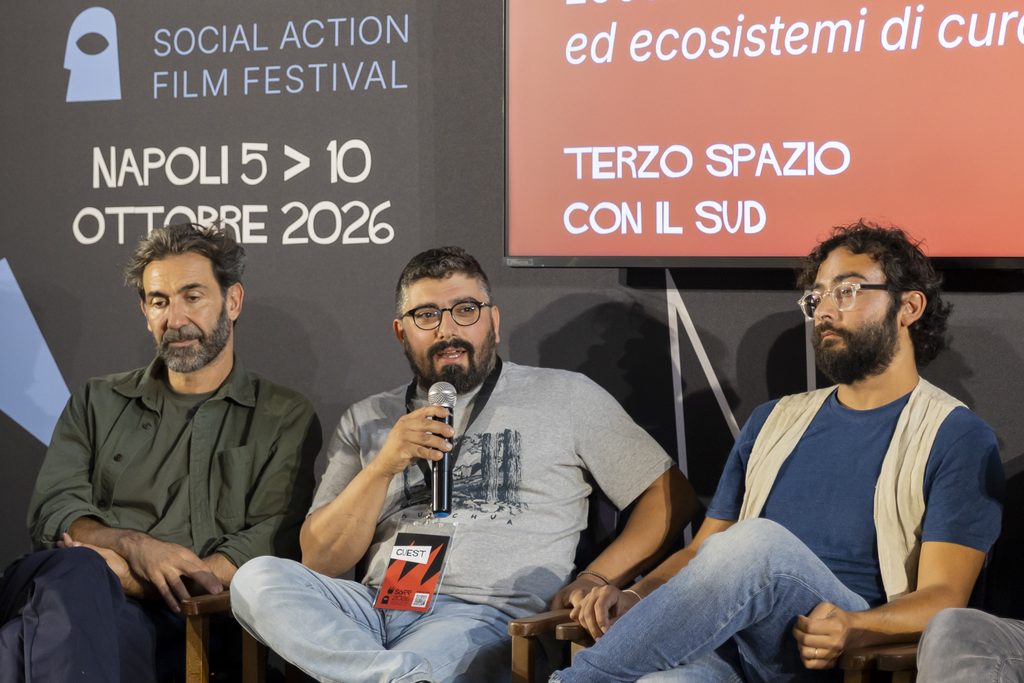
Giorgio Ruggeri discussing the experience of Santi Paduli and La Buona Mensa.
Contained within that sentence is a small revolution in the way we can think about public catering. A school canteen does not have to be understood simply as a cost centre whose task is to provide a certain number of meals while meeting health standards and keeping prices down. If organised as part of a territorial policy, it can become stable demand for local farms, a tool for food education, a public-health infrastructure, an opportunity to return abandoned land to production and even a mechanism through which a community redefines its relationship with the landscape.
Public administrations purchase food anyway. The political question is what that expenditure sets in motion. It can simply purchase calories and services, or it can help generate agriculture, employment, health, biodiversity and territorial continuity.
I was also struck by the story of the “parent tasters”, involved not as a miniature MasterChef jury called upon to approve or reject a dish, but as participants in a process of taste education and participatory guarantee. The difference may appear small, but it radically changes the position of the consumer: from external judge to participant in a system of shared responsibility.
Don Pasta, the national poet of agricoltura prossima
And then there was Daniele.
I have always felt a particular intellectual and human affinity with Don Pasta, because for many years he has continued to do something that is very difficult in Italy without slipping into folklore: to take popular culture seriously.
For me, Daniele De Michele remains a kind of national poet of that diffuse movement of agricoltura prossima which, over the years, we may have called neo-rurality, rural social innovation, civic agriculture or territorial regeneration, but of which I have always felt part. I call him a poet not because he softens reality, but because he is capable of restoring political dignity to gestures, forms of knowledge, kitchens, memories and people whom Italy’s grand gastronomic narrative constantly uses as symbolic raw material, only to forget them when the time comes to distribute value.
During our conversation he posed a question containing far more politics than might appear at first sight:
“Italian cuisine is the cuisine of grandmothers and grandfathers who worked in the fields. It is food born from ordinary people. Why do ordinary people no longer have access to food?”
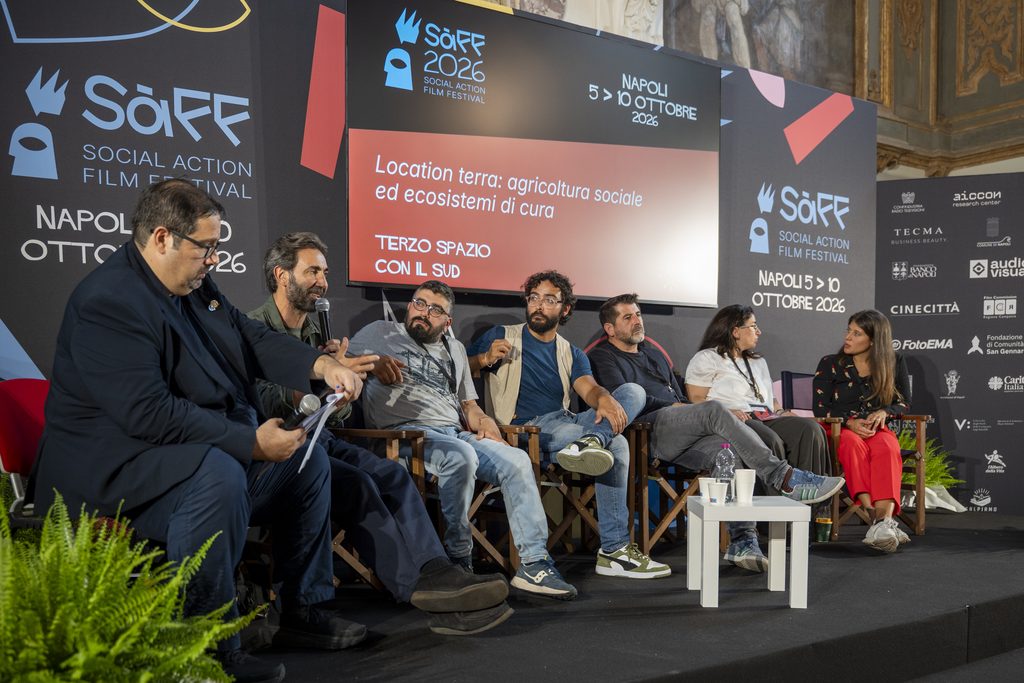
Daniele De Michele, Don Pasta, during the SàFF panel.
I believe this is one of the great contradictions we should have the courage to confront. We have turned Italian cuisine into heritage, cultural industry, tourism, soft power and an international brand, drawing much of its symbolic capital from a repertoire historically created by poor cooking and household economies, while a growing part of the population struggles to access the ingredients, time and skills needed to practise that very cuisine.
When Daniele speaks of defeat at the hands of the “MasterChef meta-narrative”, I do not think he is putting a television programme on trial. MasterChef is an effective metaphor for a cultural transformation through which food becomes spectacle, performance and individual excellence while risking the loss of its relationship with labour, land and that vast distributed intelligence which, for centuries, allowed popular cuisines to transform simple ingredients into culture.
This is why I find what he added immediately afterwards equally important:
“The knowledge we still have among us has to be regenerated collectively. The answer lies in collective practices.”
In the end, it is this regeneration, far more than preservation, that interests me. Knowledge remains alive not when we place it under glass, but when it returns to use, when it is discussed, contaminated, adapted and transmitted.
Land as an infrastructure of care
At the end I tried to bring the conversation back together around an image that, to me, is capable of holding together experiences that at first may appear very different.
The land we encountered during the panel was not producing commodities alone. It produced food and income, of course, but also health, biodiversity, training, inclusion, landscape maintenance, knowledge, relationships, autonomy and the possibility of continuing to inhabit a place.
For this reason I proposed thinking of land as an infrastructure of care, deliberately using the word care outside any sentimental register. An infrastructure is something that makes a collective function possible: a water network enables access to water, a road enables mobility, a school socially organises the right to education. Land governed in a certain way can simultaneously make production, work, ecological balance, sociality and permanence possible.
The problem is that we continue to produce value systemically while accounting for it sector by sector. The farm measures production costs; the municipality sees the cost of the canteen; the health system may encounter the consequences of nutrition many years later; welfare services record labour inclusion; environmental policies attempt to measure carbon, biodiversity and ecosystem services; schools deal with education. They are different administrations, budgets and competences operating, however, on the same living system.
Perhaps part of the fragility of the experiences we call innovative lies precisely here: we ask organisations, through extraordinary project-based effort, to reassemble what our policies continue to keep apart.
We ask farmers to be producers, custodians of biodiversity, maintainers of landscapes, educators, social innovators, bulwarks against depopulation and allies in the fight against climate change, yet when it comes to recognising their work economically we quickly return to the price per kilogram of the product. This contradiction cannot be solved simply by multiplying calls for proposals and temporary projects. We need to learn how to distinguish the occasional funding of a good practice from the stable remuneration of a collective function.
This is also why I continue to insist on impact measurement. Not to transform the life of territories into a battery of KPIs, but to make politically visible what still risks remaining invisible in accounting terms.
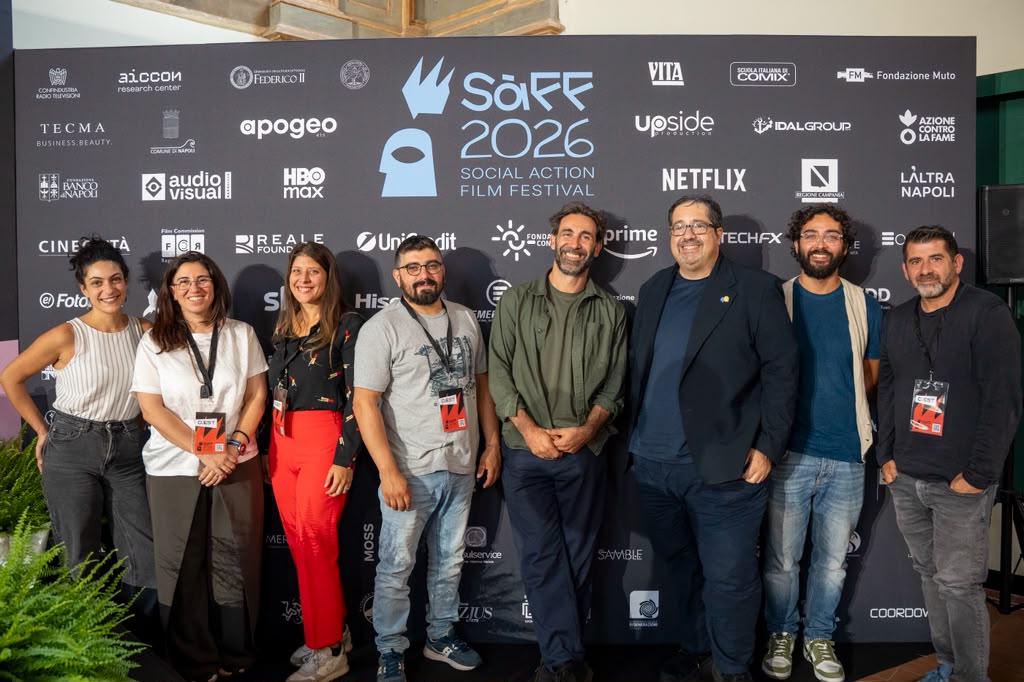
SàFF: less a stage than a training ground
There is one final dimension of SàFF that I would like to dwell on, because it concerns Naples and, more broadly, the way in which a cultural event can grow without severing its relationship with the place that generated it. The Festival’s own history, and even the evolution of its name, seem to me to tell an interesting story.
The Festival was born in 2024 in the Rione Sanità as SàFF – Sanità Film Festival. It was a strongly situated name, almost a declaration of belonging: cinema entered one of the neighbourhoods in which Naples has experimented most intensely in recent years with forms of cultural and social regeneration, and from within that experience sought to connect the audiovisual world, communities and the Third Sector. Today the Festival has grown, moved into the heart of the historic centre at the Complesso Monumentale di Donnaregina, and its name has evolved into SàFF – Social Action Film Festival. The acronym has remained, while the semantic field around it has expanded. And I find Social Action almost programmatic in itself: not simply cinema choosing “the social” as something to represent, but the possibility for audiovisual languages to enter processes, generate relationships, make conflicts and transformations visible and, when they succeed, contribute to activating new ones.
I also find it significant that the organisers do not describe this expansion as an emancipation from the Sanità district. On the contrary, they explicitly speak of a “Sanità method” moving from the neighbourhood into the centre of the city: a capacity to connect people, organisations and different forms of expertise, using culture as an instrument of participation and regeneration. Perhaps this is the most interesting transition of all. Sanità gradually ceases to be only the physical location in which the Festival takes place and becomes instead a cultural matrix that can travel elsewhere.
In only three editions, SàFF has therefore expanded its spaces, programme and network of interlocutors, but above all it has begun to operate at a different urban scale. Its architecture now attempts to bring together cinema, the Third Sector, education, universities, the audiovisual industry, businesses and institutions, treating this convergence not as an accessory but as part of its identity.
I believe SàFF is progressively entering the fabric of the city, and that this is far more interesting than simple growth in scale. Naples already possesses an extraordinary density of festivals, events and cultural occasions; what it needs is not merely another showcase capable of attracting prestigious guests, but places where culture can also become social reconnaissance, training, the production of skills and the opening of possibilities.
From this point of view, I felt a certain emotion in meeting again people who many years ago had been my students and whom I now encounter as mature cultural operators and professionals capable of taking responsibility within complex processes. Others were part of the staff that materially makes the Festival possible. These are moments in which you realise that time has also passed through the people you have encountered, and that some of the things planted long ago have taken directions entirely independent of your own.
And then there are the young women and men of Audiovisual Napoli Hub. I watched them working on cameras, filming, sound and production. They are genuinely talented young audiovisual professionals, but more importantly they are learning a profession by practising it within a real context, with responsibility, unforeseen problems, deadlines to meet and quality to guarantee.
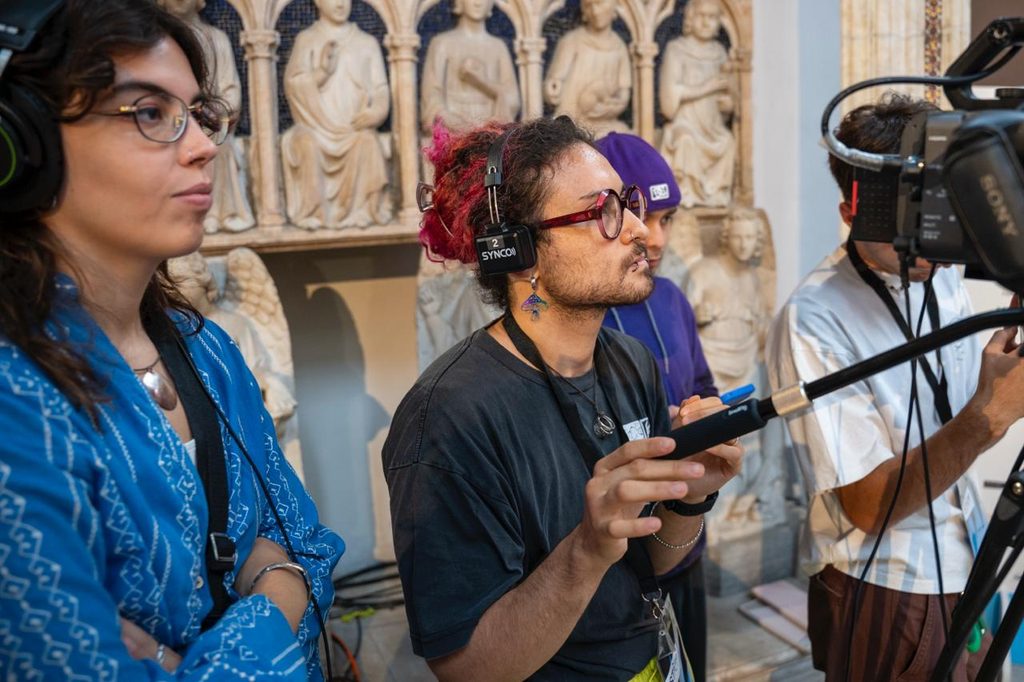
Young professionals from Audiovisual Napoli Hub at work during SàFF 2026.
Perhaps this is the definition that comes most naturally to me when I think about SàFF: less a stage than a training ground. Not a training ground understood as a preparatory space separate from “real life”, but as a place where one trains precisely because one is already inside the professional and cultural life of the city, working alongside more experienced people, making mistakes, correcting them, building skills and relationships.
My thanks therefore go sincerely to the organisers, together with one wish above all: that the Festival may continue to grow without losing this function. I am convinced that SàFF is destined to become an increasingly important event precisely if it preserves its ability to use cinema not only as spectacle, but as a device through which the city observes itself, connects worlds that usually only brush past one another and trains the people who will have to move through those worlds in the years ahead.
There is, ultimately, a connection less obvious than it may seem between this idea of a Festival and the conversation on land from which these reflections began. In both cases, the issue is not simply to make something visible that already exists, but to build the conditions that allow it to continue existing, to transform and to remain accessible to those who will come after us.
Perhaps this is why I keep returning to the question with which I closed our conversation. When we speak about social agriculture, confiscated assets, public canteens, food poverty, ecosystem services and communities, institutions still too often ask us how much it costs to support all this. Perhaps we should learn to formulate the question from the opposite direction and begin to calculate how much it costs people, health systems, communities and territories to continue not taking care of it.
This is not simply a different way of balancing the accounts. It is, perhaps, a different way of deciding what really has value.