
“Vineyard to Glass” sounds almost like a toast among friends. But behind these words there is much more: an entire world in ferment. If Farm to Fork tells the journey of food from the earth to the table, Vineyard to Glass is the version with a bit more … of tannins and anthocyanins!
Because wine is not just any food: it is a universe in itself, with its rules, its magics and its small big manias. Every bottle is the result of a profound link with the territory, the so-called goût de terroir, the “flavor of the earth”, which reflects the geographical origin and the environmental characteristics in which the grapes are cultivated.
Moreover, wine is a pillar of Made in Italy, and who better than Irpinia and Sannio can understand its importance?
During the press conference of presentation of the participation of Irpinia and Sannio in the 57th edition of Vinitaly, data were illustrated that confirm the strategic role of these two areas in the Campanian viticultural sector. With almost 17,000 hectares of vineyards, Irpinia and Sannio represent two thirds of the vine-growing surface of Campania and generate 80% of the regional certified wines. The annual production stands at about 35 million bottles, for a production value of 120 million euros.
On the export front, 2024 marked an increment of 7%, bringing the overall value to almost 30 million euros. The United States confirmed themselves as the main outlet market, absorbing 30% of exports (+27%), followed by Germany (+7%) and Switzerland (+10%). Sannio recorded a boom in requests from Spain (+292%), while the United Kingdom marked a decrease of -48.5%.
This is the reason why the viticultural sector is increasingly attentive to environmental challenges and many producers aim for sustainability, not only for reputation and marketing, but to respond to the growing request for authentic, safe and environment-respectful wines. Besides direct revenues, wine generates benefits for the entire supply chain and positive effects on landscape, ecosystems and tourism.
It is precisely this commitment that the company Mastroberardino, situated in the heart of Irpinia, wishes to communicate. The Agronomist Doctor Antonio Dente, Head of Grape Production, explains: “In a context increasingly complex and difficult to manage it is the task of technicians, agronomists and oenologists, to try to follow new paths both in the cellar and in the vineyard. . Global warming, combined with the variation of the precipitation trend and the increase in frequency of extreme meteorological events (late frosts, heat waves, prolonged absence of rain, water bombs in summer), is influencing in a significant way the physiology of the vine and exposing, more frequently, the plants to serious biotic and abiotic stresses. This represents a challenge for viticulturists who must take complex decisions to adapt the management of the vineyard and reach oenological objectives. This translates often into an unwanted increase in the use of fertilizers, biostimulants and pesticides, losses of fruit yield and changes in the composition of berries at the moment of harvest, with a negative impact on sustainability. It is clear that one must start to think about viticulture in a different way, change one’s approach and consequently modulate differently the company management modelas the Mastroberardino Company is putting in place, through the enhancement of experimentations in the vineyard that see the modification of training systems toward solutions more suitable to specific varieties, the displacement toward higher altitudes, the absolute respect of the soil, the return to low planting densities, the increase of organic substance of the soils through targeted green manures, the use of mixtures for green manures aimed at soil mulching interventions, the correct management of the green so as to create the right shade zones for the clusters, the use and the support of decision support systems. The choices must then be focused always to the specificities of the single territories, vines and microclimates. ”
Regarding the cellar, it is reported to us that climatic changes have impacted above all on the management of temperatures, which require today greater energy expenditure, and on the management of grapes more mature and concentrated compared to the past. Such phenomenon was recorded in a more important way exactly in a moment in which the Mastroberardino company had planned a series of investments aimed at the acquisition of machines and plants at greater efficiency, lower energy consumption and high degree of digitalization with development of particular systems of sensoristics and control.
On this front, the Oenologist Doctor Massimo Di Renzo, Head of Wine Production, intervenes: “In recent years our investments in the cellar On this front, the Oenologist Doctor Massimo Di Renzo, Head of Wine Production, intervenes: “In recent years our investments in the cellar All phases aim at energy saving and at lower production of waste water, with an evident gain in terms of environmental impact. The introduction of smaller capacity tanks allowed to perform separately the vinification and all subsequent phases of the production process of different batches of grapes so as to enhance and study the peculiarities of single vineyard parcels. Systems of tartaric stabilization of wines at room temperature were employed, compared to the traditional system which provides for the use of cold with consequent important saving of electric energy. Not to forget the use of more delicate wine filtration systems, without the use of adjuvants, with a very conservative impact on the quality of wines. Finally, the important investment in the installation of solar panels for the production of electric energy. ”
Also the Consortium for the protection of Sannio wines continues to work actively on new initiatives aimed at sustainability. Libero Rillo, president of the Consortium for the protection of Sannio wines and Nicola Matarazzo, management consultant of the Consortium for the Protection of Sannio Wines, underline that a project dedicated to sustainability certifications for some companies is in the start-up phase. During the first year, the Consortium will support these businesses in the certification process, with the objective that, in subsequent years, they can proceed autonomously on this path. This need arises from the insertion, in the DOC wine regulations, of the obligation for all vineyards to possess a sustainability certification: in absence of it, they cannot be considered suitable.
Another significant initiative in which the consortium is engaged is the re-proposition of the Sannio Academy, with an investment in highly qualified speakers. It is a training center for students and operators of food & wine and of promotion of the historical-museum and landscape cultural heritage of the Benevento Sannio. The intent, besides providing free training on the denominations and increasing the quality and competitiveness of the local food and wine sector, is to create a training hub of support for producers for development policies and for increasing attractiveness regarding wine tourism hospitality. In parallel, projects of promotion at European and international level proceed, thanks to OCM funds. The Consortium commits to support small companies in accessing the American market, providing them the possibility to participate in B2B collectives and commercial meetings, facilitating thus their expansion in a context otherwise difficult to reach. A goal of great relevance is the introduction of the guarantee label for IGT Benevento wines which underlies the introduction in Italy of the digital passport of GIs (https://www.pass-it.it). The Consortium is the first and only one to have adopted this measure, which from this year becomes obligatory for all IGT producers, as already happens for DOCs. This system guarantees greater security and traceability to consumers, consolidating further the credibility of local productions.
Finally, the Consortium is working on a modification of the regulations, currently in phase of presentation to the Ministry for approval. Although the new rules are not yet operative, the Consortium has already outlined a clear and targeted path in this direction, confirming its own commitment for a more sustainable and conscious future. In fact, in the proposals for modification were inserted the obligation in the vineyard and in the cellar of integrated production certification (SQNPI) and/or sustainability.
The pilot project SANNIO_SUSTAINABILITY, promoted by the Consortium, points ambitiously to transform the local viticultural sector through a model of sustainable and replicable territorial development. In fact in the strategies are inserted the actions Sannio Wine experience (sustainable wine tourism packages in collaboration with tour operators). These actions are in line with what is provided by the reform REG UE 1143/2014, contributing to enhancing the territory through responsible food and wine tourism. The objective is twofold: on one hand, to preserve the resources of Sannio, on the other, to generate new economic opportunities founded on sustainability..
Other strategies refined and oriented in this direction include Sannio Energy (energy efficiency and supply chain energy community) and Sannio Observatory.
Two territories, therefore, that are investing in the future, between lush hills and historical cellars, where technology meets secular knowledge, giving life to a new way of making wine, guaranteeing to producers the necessary tools to preserve and enhance their authentic jewels. This is made possible by adapting cultivation techniques, with the application of innovative knowledge and tools like those of PV (precision viticulture) or digital viticulture, that is the intelligent development and implementation of technologies in viticulture. But new technologies do not stop at the vineyard, because they can be placed in any phase from the vineyard to commercialization, supporting all production processes.
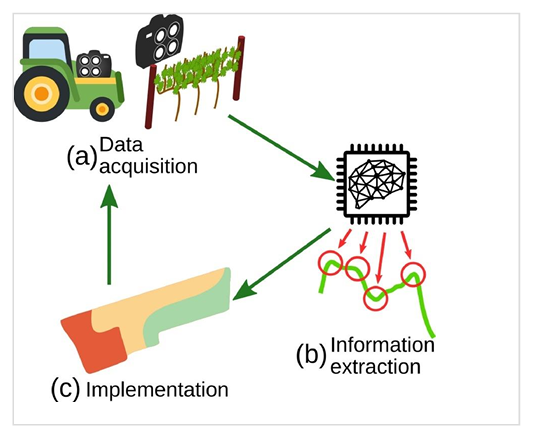
The cyclic process in three phases in the adoption of precision viticulture. (a) Acquisition of data from the vineyard; (b) extraction of information from acquired data; (c) development and implementation of a targeted management plan based on the previous… Source: (Tardaguila et al. 2021)
Now let’s imagine being able to traverse all phases of the production chain, exploring the technologies involved, their potential for implementation.
IoT, AI, Big Data, Blockchain… but how do they reach up to our bottle?
The Internet of Things (IoT) represents any traditional object that, through chips and sensors inserted inside it, is able to interact with other devices and with the surrounding reality, collecting and transmitting data. In the field it allows to monitor soil and crop conditions, manage irrigation or parasites through automated camera traps, or even analyze water quality. During processing and logistics it allows the traceability of products from production to the final consumer, real-time data collection on the production process, on output quality, on the status of machinery and on maintenance, which becomes preventive and predictive.
Automation and robotization refer to the use of robots and automated systems with advanced sensors to perform agricultural tasks in an autonomous or controlled way. Robotics, instead, integrates autonomous or semi-autonomous robots with artificial intelligence, sensors and machine learning capabilities. These systems are applied in the field for agricultural operations such as pruning and weeding. Thanks to sensors like cameras, scanners, RFID and RTK, these robots can also perform a selective harvest of fruits with high precision.
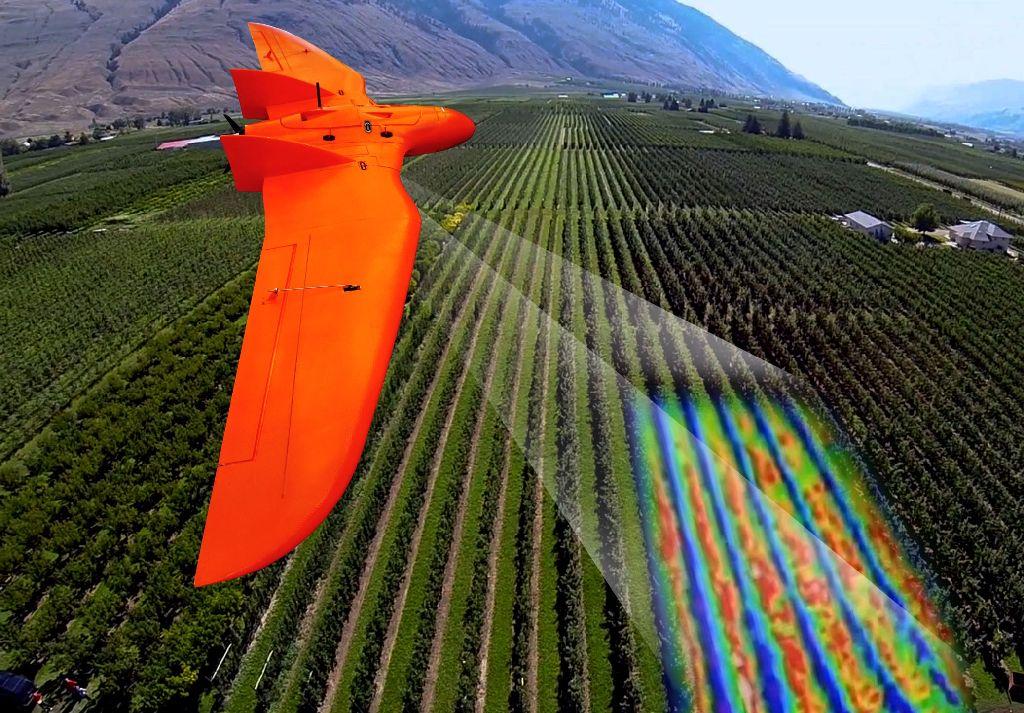
Drones also exist which can manage with precision crop conditions in small areas, and identify areas that need further investigations. Furthermore, drones can analyze the terrain, showing humidity and erosion through accurate 3D maps (ITFARM). They can also take care during processing and packaging of operations such as cleaning, counting, filling and arrangement of bottles.
Artificial Intelligence (AI) includes technological systems able to solve problems and perform activities similar to those of the human mind in autonomy. In the field it is used for soil management, crop management, yield prediction, plant disease detection, water resource management, crop quality for weed detection and species recognition, development of fertilizer use and harvesting practices, which take into account in a more punctual and predictive way the information relative to the cultivated area. Furthermore it allows the reduction of waste and greater sustainability through a targeted use of inputs like water and fertilizers. It can, instead, in the processing and logistics phase, monitor product conditions during storage and during transport through intelligent packaging. Also interaction with customers becomes more usable, automating customer service and collecting feedback.
Big Data (BD) are large quantities of data that can be read and interpreted by machines rather than by human beings. [cite: 16] [cite_start]They are generated in a very rapid way by other technologies, providing advanced tools in the field to improve agricultural management with climatic predictions, identification of pests and improvement of agricultural decisions; in logistics they optimize chain management allowing a better coordination of transport and delivery of products and guarantee the safety and quality of the product along the entire supply chain.
Blockchain is a secure and transparent means that records every phase of the chain in a permanent database, guaranteeing authenticity, security and traceability. In this way it allows one to find the origin of the problem as it tracks in a register all the steps of the value chain providing a platform of shared information for all members of the supply chain. Therefore, it involves all phases along the chain because it allows to track the quantity and quality of pesticides and fertilizers used in the field during the cultivation process, to record environmental data like temperature and humidity, and ensure that products are stored correctly during the transformation and distribution processes.
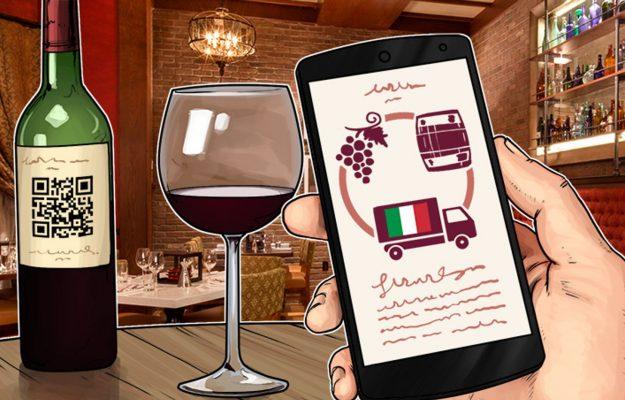
Consumers can access this information through the scanning of a QR code or an RFID tag, obtaining details on the producer, the vineyard of origin, agronomic practices, transport conditions, provenance, date of origin and expiration, batch numbers, environmental impact and other relevant information of the chain and that influence purchase decisions. In this way one has greater trust between the actors of the chain and reduction of information asymmetries.
The Global Navigation Satellite System GNSS refers to the constellation system of satellites in orbit around the Earth that transmit signals to receivers present on the Earth’s surface (e.g., GPS) allowing it to determine the precise position of an object. In other words, GPS is used to detect the position to which every measured intra-plot characteristic must be associated to that in which the dose of a production factor must be applied. For this reason they are placed in the first phases of the chain, those relative to the field through variable rate applications, automatic section control, avoiding overlap in treatments and reducing costs up to 25%, a better operative efficiency, with lower fuel consumption, greater precision, less waste and less fatigue for operators, operability in adverse conditions, like rain, fog and darkness. Furthermore, GNSS allows farms to monitor in real time machines and operations on the field, verifying respect for timelines and intervening in case of delays or problems.
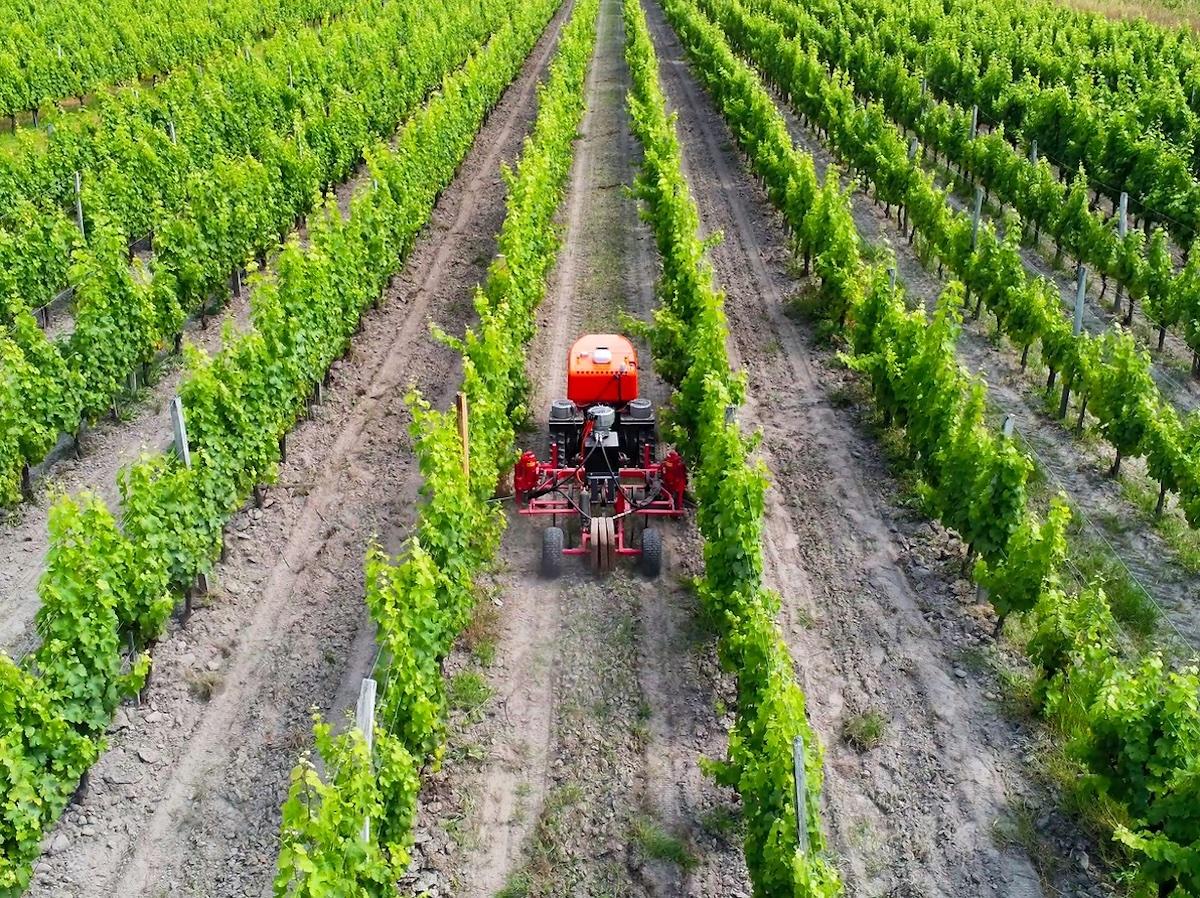
Ceol, the hybrid tracked robot capable of tending to vineyards in full autonomy – Meccagri
Cloud computing is a method to obtain computing resources (servers, archiving, databases, data storage etc.) from a provider, on request, by a client who uses a computer connected to a network (usually Internet) with a pay-per-use rate. Users do not physically possess the hardware or software, but access the necessary resources using a browser on a device connected to the network. It can involve, therefore, by definition, all phases of the chain because it allows to archive and manage data, centralize and share information in a secure and immediate way.
Virtual reality (VR) is an advanced interface between man and computer that simulates a realistic environment and whose users can interact through appropriate hardware devices (computing technologies like headsets) to develop the simulated environment, while Augmented Reality (AR) is a technology that allows to see directly or indirectly a physical environment of the real world, enriched by virtual information generated by the computer.
Although at an academic level there would seem to be many studies aimed at the realization of applications for cultivation operations – such as analyzing the soil and simulating virtual to decide which crops and techniques are more suitable to a determined terrain or monitoring crops closely without physically going to the fields – the application of augmented and/or virtual reality in the field would seem to be still at an embryonic state. However, applications of AR and VR start to find ever more fertile ground in marketing and communication operations of products aiming to realize a purchase and consumption experience that enhances the consumer and their purchase choice. For example transforming packaging into interactive and involving experiences can increase product attractiveness, help in the design and planning of products and solutions, allowing to visualize and interact with the product in the planning phases, greatly optimizing the production phases and reducing considerably development costs.
Additive Manufacturing, known also as 3D printing, is an advanced production method that allows the creation of three-dimensional objects by adding material layer after layer. This process occurs using digital data coming directly from a computer. This technology is not placed along the chain in a specific phase, but if present in a winery it allows to print new parts and equipment directly on site, on request. In fact it offers numerous advantages like the creation of complex shapes impossible with other production methods, reduction of production times thanks to direct printing from digital files, personalized production of components on request, reducing costs compared to mass production, rapid creation of prototypes, cutting times and costs of developing new products and one has less waste of raw material, using only the necessary material for the final product and recyclable materials, favoring a sustainable circular development model. Furthermore one has the optimization of geometries and lighter components, reducing waste, a simplification of the production process, with the realization of products in a single block, cutting labor costs.
It is important to emphasize that many of the previously examined technologies, as already mentioned, operate in synergy and interact among themselves (IoT, AI, Big Data, Cloud Computing or AI with robotization or drones and GPS satellites).
For example, IoT implies the use of sensors to collect data which then are sent to cloud services and processed through a platform, on which they are stored, and analyzed through artificial intelligence algorithms to obtain useful information and predictions. The manager of the farm can access this information (for example via app) and receive notifications or instructions through an Internet connection.
Big data, in order that they can be a precious resource for the entrepreneur and for the company, it is not enough that they are stored, but they must be analyzed and processed in an effective way, to be translated into information of true value. In this regard, sophisticated applications of Artificial Intelligence exist, which through precise machine learning algorithms allow to transform what is contained in the data into information. The great availability of information translates in fact directly into the possibility of optimizing all the activities that compete to the realization of the final product
It is fundamental therefore to understand that the functioning of the tools occurs, as it is easy to notice, through the integration and concomitant use of almost all the mentioned technologies.
Let the vineyards and cellars speak
From the chat with Antonio Dente and Massimo Di Renzo it emerged that, while facing the problem of Climate Change for some time, it is only recently that one has started to take full awareness of the problems induced by climatic changes also in the viticultural and oenological field, as highlighted also by the dramatic climatic course of 2023. “… the studies and correlated oenological literature, produced so far, as far as vinification and wine quality are concerned, are still marginal and need greater and more punctual scientific in-depth studies. There is still much work to do, and much is also the space for research and projects that aim at the limitation of damages caused by climatic changes, by thermal rise and by drought on grape composition and on wine quality, with particular attention to the specificities of single viticultural districts…”
It is fundamental, first of all, to educate and increase the awareness of the sector regarding digital opportunities, to then incentivize a true and proper large-scale application.
In this regard let’s see in more detail what the world of wine tells us. But first, it is good to ask ourselves, do we know how to make wine? Perhaps it is better to leave this task to those who know and can.. What we can do, however, is appreciate it, follow it and love it. To have a general vision of the different production phases, we propose here some schemes of our elaboration and let’s see then where we can intervene, with our technologies.
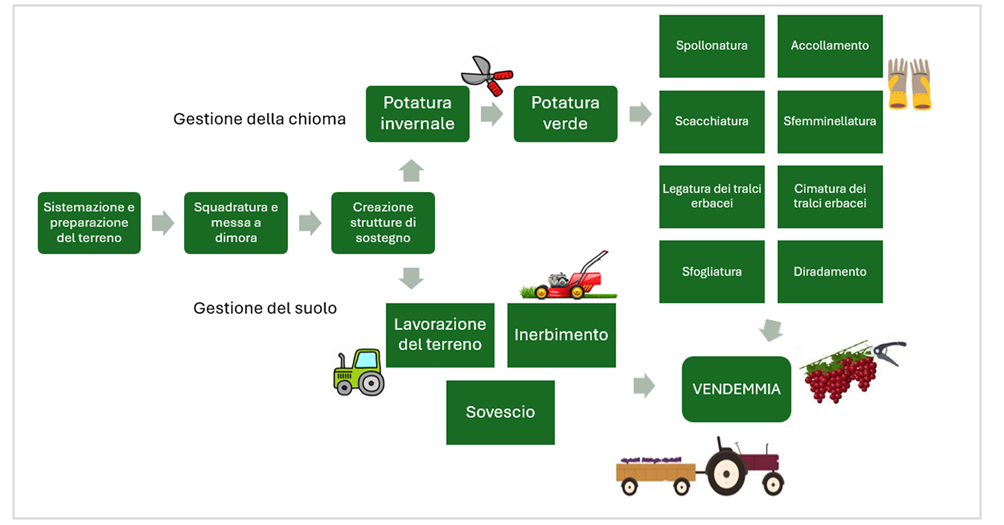
Wine supply chain, field phase – Source: our processinge
In the vineyard, tools like robots, IoT and augmented reality improve cultivation: during the harvest they are essential to protect vineyards and obtain good results. For example IoT identifies with precision the moment in which clusters reach optimal maturation to be harvested during the grape harvest and provide detailed information on the water status of the plants, allowing an accurate analysis of vine conditions.Through drones which return a detailed digital image of the crop in a vineyard, it is possible to obtain diversified information in large-sized vineyards in which there can be variations in production due to different factors, such as terrain morphology, soil type, treatments and fertilizations, as well as microclimatic characteristics, which can differ also along the same row.
Numerous projects realized in Irpinia and in Sannio have known how to put into practice the following solutions. For example, the GREASE project used 4.0 technologies like sensors, drones, weather stations and isotopic analyses to monitor resources, water stress and climatic impacts. Various pruning, canopy and soil management methods were also tested to improve wine quality and environmental sustainability. The VINTES project developed a low-cost hardware/software system to collect and analyze georeferenced data via smartphone, using multispectral sensors on tractors. The objective was to reduce the use of phytosanitaries, creating vigor maps for targeted interventions, with the intent of improving the sustainability of vineyards in Sannio. The INNFARES project sought to improve the resilience to climatic change of the Falanghina del Sannio vine, creating a monitoring and assistance network for viticulturists. An advanced system of georeferencing of vineyards, geopedological analysis and territory zonation was implemented, to optimize management and improve environmental and economic sustainability. The PRECIVIT project aimed to improve intra-vineyard management of the main Irpinian native varieties, like Aglianico, Greco and Fiano, studying the physical variability of vineyards and its repercussions on physiological and qualitative performances of plants. Finally, the SENSOBIO project developed innovative and low-cost biodegradable sensors, based on microelectronics and high energy efficiency materials, with the objective of optimizing precision agriculture in an eco-compatible way.
These projects were explored in depth in one of our previous articles, which you can read at the following link: Wine 4.0: Projects for Climate Change and Digital Transformation.
And to cite other examples, like “Viteres Zero” in Fontanarosa and the VISCA project (Vineyards Integrated Smart Climate Application), which provided climatic services and a decision support system (DSS) integrating climatic and agricultural models. These projects demonstrate how much the Campanian territories have always been one step ahead, despite sometimes appearing to stay behind.It was their vision that pushed for innovation and constant commitment in this field.
We want to focus our attention on a recent project, concluded on February 28, 2024: VitiGEOSS (Vineyard Innovative Tool based on the InteGration of Earth Observation Services and in-field Sensors), financed by the European Union “Horizon 2020” program and its interdisciplinary Consortium is composed of nine partners coming from four European Countries (Spain, Italy, Portugal and Netherlands). Part of it are three research and technology organizations (the Project coordinator Eurecat, the BSC Barcelona Supercomputing Center and the Links Foundation of Turin), a university (the Department of Agriculture of the University of Naples Federico II with scientific manager prof. Boris Basile), an SME (eLEAF), a consulting company (Price Waterhouse Coopers – PwC) and three high-quality wineries (Symington Family Estates, Douro valley, Portugal; Familia Torres, Catalonia, Spain; Mastroberardino Società Agricola, Avellino, Italy).
The project aims to develop commercial activities and services that employ GEOSS and Copernicus data, setting as main objective that of contributing to a more sustainable wine production, reducing to the minimum the use of fertilizers, of water and offering at the same time solutions for an optimized management of vineyards through decision support systems (DSS) on climate, phenology, irrigation, diseases, business and sustainability management. In particular, the project combined data coming from sensors positioned in the field (like those for monitoring soil humidity and other environmental variables) with satellite data, using European Earth Observation (EOS) services, to obtain more precise and timely information on climatic and environmental conditions.
In this regard, an innovative platform was developed that integrates data from different sources, like satellites, field sensors, weather stations and drones.
The platform includes 5 main services:
(i) Weather-climatic forecasts, for the application of short-term weather forecasts and sub-seasonal to seasonal climatic forecasts for decision-making processes;
(ii) Phenological monitoring and prediction, an automated system to plan and organize in the best way the management of the entire vineyard through phenological models, satellite and in-field observations;
(iii) Crop status, which involves satellite images to optimize irrigation, sampling or selective harvest to improve grape quality and production;
(iv)Defense management, which allows to predict the evolution of diseases considering meteorological conditions and crop status to optimize treatments and resource use;
(v) Business and sustainability, an optimization and planning service of activities for field operations in order to give priority to sustainability and reduce greenhouse gas emissions. The innovative solution for winery management leverages technologies like artificial intelligence, the Internet of Things, remote sensing, Earth observation satellite services and field sensors to generate predictions and recommendations. This allowed viticulturists to monitor in real time plant health and climatic conditions, improving precision in management and allowing informed decisions regarding crop management and grape harvest.
Finally, one of the most appreciated aspects of the project is the personalization of the platform. Every viticulturist was able to adapt it to their specific business needs, further optimizing resource management and improving productivity.
However, as happens in every experimentation, some observations raised the suspicion of difficulty in reaching long-term success.
“The use of new proximal and remote sensing technologies in wineries finds notable obstacle both in the data collection and raw analysis phase and in their final interpretation.– explains Prof. Boris Basile (Department of Agriculture, Section of Vine and Wine Sciences, University of Naples Federico II), scientific manager of the project – For this reason, the VITIGEOSS project provided, within the partnership, the presence of three wineries distributed in Portugal, Spain and Italy. This collaboration allowed the co-development of smart services offered by the platform, which translated into the development of a graphic interface for presentation of information offered by different mathematical models that could not only provide information really useful to viticulturists, but also be of easy interpretation for the final user. In several workshops (one held right in Irpinia), organized within the scope of the VITIGEOSS project and which were dedicated to the presentation of the developed platform, a notable participation of wineries external to the partnership and of technicians operating in the sector was recorded. In these events, the intense discussion that took place between project partners and stakeholders, highlighted a notable interest from the productive world for these new technologies, making one hope well for their application in the near future. It is necessary to consider however that much of the information provided by these new technologies can be translated into innovative precision management techniques of the vineyard (for example variable rate fertilization and defense), but their implementation can be limited by costs for the purchase of agricultural machines that allow these types of application.”
Despite this, the project was successful, garnering great satisfaction and fueling the hope that this path will be pursued in the future, offering solutions to the issues encountered to make the use of technology easier and more accessible to everyone.
For further details and in-depth information, we recommend watching the video.
It is also possible to download the following PDF: 00_VITIGEOSS_Presentation
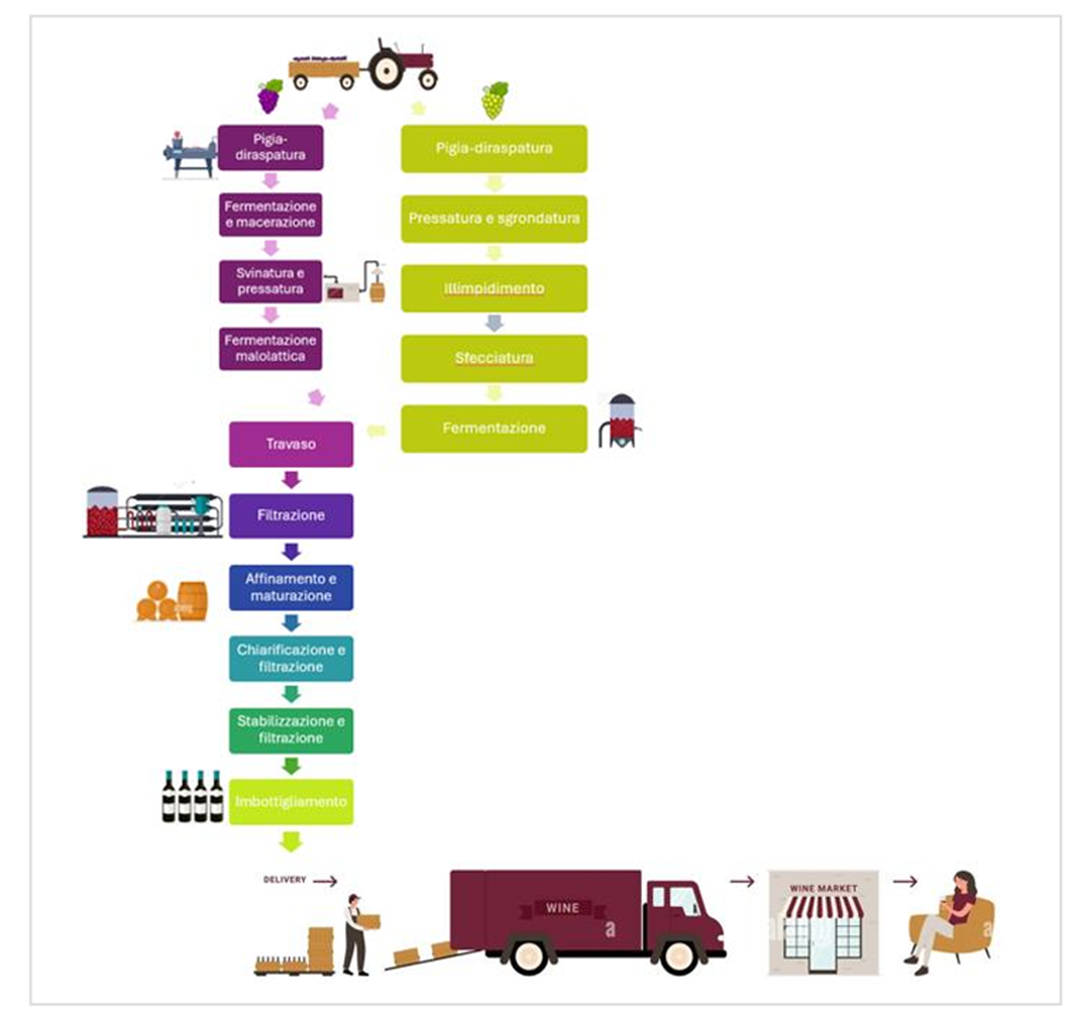
Wine supply chain, winery and distribution phase – Source: our processing
Passing to the cellar, in the transformation phase of grapes into wine, sensors and IoT allow to plan production according to business needs, allow continuous monitoring of processes, transferring data remotely or integrating them on operative platforms. This system provides essential information on temperature, conditions and biochemistry of wines, improving traceability and reducing operative risks. A practical example is the use of thermal sensors that detect temperature variations and activate the refrigeration plant, simultaneously transmitting real-time data via the internet. In case of malfunction, the system sends notifications to allow timely interventions.
These sensors can be applied also to barrels to control the aging status of wine, monitoring temperatures, light and humidity. Large viticulturists also use intelligent storage systems, which through warehouse management software allow to control incoming and outgoing product flows, tracking every liter of wine produced. This system optimizes space and available resources.
Attention also during transport, in fact with some sensors it is possible to monitor the temperature of bottles, an extremely important factor if the contained wine is rich in esters that confer the fruity aroma, molecules that strongly undergo acid hydrolysis under the influence of temperature. Distribution, enhanced by e-commerce, IoT and Blockchain, allows to expand sales also to international markets.
For example in Sannio interesting was the ISBAV project (Implementation of a Blockchain System for the protection of the wine supply chain) ISBAV – Sannio Wine, financed by the Campania Region within the PSR Campania 2014-2020 (Measure 16, Type of Intervention 16.1 Action 2, which supports Innovative Operative Projects), based on blockchain to guarantee transparency and traceability of the entire wine supply chain.
The importance is due to the fact that in the viticultural sector, where in about 15% of cases irregular products are discovered which include seized bottles, manipulations of the chain, and low-cost wine sold as organic or with false denominations, this technology certifies the provenance, quality and territoriality of raw materials, documenting every phase of production and distribution.
The study, realized by the Metrica Ricerche Institute of Milan, was commissioned by the Sannio Consortium for the Protection of Wines, which benefited directly from project results since the Sannio wine market was analyzed between September and October 2024. In particular, market dynamics of these wines were analyzed, positioning and current reputation index acquired by Sannio IGs with the use of traceability through a blockchain system in collaboration with the University of Sannio. 40 store-checks in GDO were carried out and interviews with purchasing managers, Horeca and producers. Results indicate a good presence of Falanghina, positive growth in exports and appreciation above all in the GDO channel. Interest for traceability and quality of wines is high, with growth predictions.
Dr. Nicola Matarazzo is the author of the project report, which he kindly provided to us and which is available for a more detailed consultation by downloading the following PDF: “ISBAV_Data Analysis and Strategies”
But continuing the analysis, market management requires use of management software and Big Data to obtain significant results.Finally, in the consumption phase, augmented reality and intelligent labels improve the purchase experience of consumers. AI, combined with user reviews, helps to map and select similar wines, making the choice process easier for consumers.
AI, combined with user reviews, helps map and select similar wines, making the selection process easier for consumers.
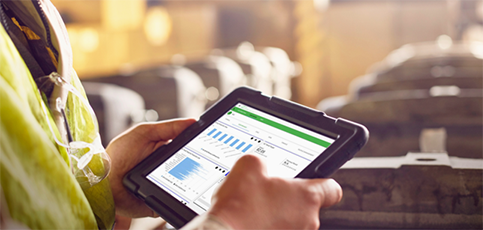
DIONISO: when precision viticulture meets Data Commons
In the heart of inland areas of Campania, between rows of vines in Irpinia and Sannio, a project is taking shape, led by the Aerospace District of Campania DARC managed by prof. Luigi Carrino and the Chamber of Commerce (CCIAA) of Irpinia Sannio, represents a great initiative that collects what has been discussed so far in a single, wide Campanian territory.
Its name is DIONISO — evocative, certain, but above all symbolic: the Greek god of wine who today returns as archetype to tell a renewed vision of the relationship between agricultural tradition and digital innovation. Thus the project is defined by Prof. Alex Giordano, expert in digital transformation.
The project adopts an approach of co-creation with local wineries, responding to their needs through modular and scalable solutions configuring itself as an enabling platform for the sharing of agro-environmental data: climatic data, satellite images, surveys on soil, leaf and fruit, information on the production chain. But above all: accessible, readable, reusable data.
These data do not end up in a closed drawer, nor in distant and inaccessible servers. They are collected, processed and returned to viticultural companies of the territory in the form of agronomic recommendations, decision tools, visual dashboards that help to improve cultivation practices, save resources, increase quality and resilience of the final product. Therefore thanks to this model, businesses can benefit from an integrated system for precision viticulture, which combines field measurements, remote sensing systems, airborne sensors, satellite information and microclimatic monitoring through sensor networks. The project concentrates on seven strategic objectives fundamental for viticulture, including yield estimation and quality control, management of soil and water movements, prediction of varietal migrations, sustainable viticulture, analysis of water stress, prediction of diseases and pathogens, and enhancement of agricultural practices through a traceability system based on blockchain.
Using advanced technologies like satellite data, drones, field sensors and artificial intelligence, the platform monitors vineyards in real time, optimizing use of water resources and predicting impact of climatic changes. Furthermore, thanks to multispectral sensors and infrared thermography, DIONISO is able to detect diseases and stresses in plants early, reducing use of pesticides.
Download the following PDF for more details: DIONISO_Nota_Audizione
In this regard, DIONISO is not only a precision viticulture project. It is a territorial laboratory of Data Commons, a concrete example of how we can rethink data not as a commodity to extract, but as a common good to share, govern together, and use to generate collective value. True innovation is that this information flow is not someone’s property: it is collective heritage, made such thanks to forms of participatory governance, supported by public subjects like Chambers of Commerce. It is this the pulsing heart of the Data Commons concept.
Prof. Alex Giordano explains that the project embodies, in practice, many of the ideas he sought to explore and tell in his book FoodSystem 5.0: “Every single actor of a social-territorial-cultural-economic context belongs to a wide system of possible connections that can generate new value. For this reason socio-technical transformations are favored, according to our experience, by creation of bridges that, as we said, put in communication and in relation both businesses diverse among themselves and eventual other actors that can create shared data stocks (data commons) ” . He in fact explains that, in our digital imaginary, too often colonized by extractive and vertical logics, data are a resource to capture, accumulate, monetize.Technical infrastructure that surrounds us, from IoT sensors to cloud platforms, tends to convey information toward large centers of economic power, leaving peripheral agricultural communities in the condition of passive users, more than protagonists of digital transformation.
“But there is another way. A way that I defined in my book as Data Commons: open, interoperable data, produced and managed in a cooperative way by local communities, institutions, businesses and universities. Data that are born from territory and that stay in territory, to be put at disposal of who, that territory, inhabits it, works it, cares for it. The DIONISO project, in this perspective, is an emblematic case” In FoodSystem 5.0, he writes that “artificial intelligence does not exist without collective intelligence of connected communities“. And that every sustainable technological transition needs territorial mediators, capable of putting together skills, needs, technologies and visions.In this function, he explains that the Irpinia-Sannio Chamber of Commerce took a strategic role: facilitator of networks, guarantor of neutrality, promoter of common infrastructures. It is not only a certifying body or a showcase of tourism promotion, but an enabling actor of digital transformation to community measurement.
In the case of DIONISO, the CCIAA supported a feasibility plan preparatory to create a cooperative space for data management and contributed to strengthen trust between economic and institutional actors, an essential prerequisite for any Data Commons strategy.
Therefore, Prof Alex Giordano considers DIONISO as “… an infrastructure that can be fully the base for what is intended by FoodSystem 5.0: an agri-food ecosystem in which technology, local knowledge and shared governance coevolve to give form to a new food economy, fairer, more sustainable, more rooted.It is not a nostalgic return to earth, but a slow and profound revolution, capable of integrating cultural biodiversity of the Mediterranean diet with potentials offered by digital technologies, within resilient and self-organized communities. DIONISO reminds us that even in viticulture, the identity sector, but often conservative, it is possible to imagine and practice a new development paradigm, in which knowledge is distributed, innovation is cooperative, and value is measured not only in bottles sold, but in collective capacity to take care of territory”.
So let’s raise a glass to DIONISO: not just as a project, but as a prototype for the future. A future where data doesn’t divide, but unites. Where technology doesn’t replace, but empowers. Where institutions don’t impose, but bring people together.
The Supply Chain is in Transition and data point toward awareness
In recent years, from data emerged from the ProWein report titled “Digitalization of the wine sector – current situation and future developments”, realized by the University of Geisenheim, took into examination responses of over 2,000 operators and experts of the sector (producers, exporters, importers, traders, restaurateurs, hoteliers), the viticultural sector performed significant steps forward in adoption of digital technologies, but there are still margins for growth. An interesting datum is that about 75% of wine companies implemented digital solutions, in particular in the field of marketing and data management, like use of DEM (Direct Email Marketing) and social media.
However, despite this growth, only 15% of companies plan to perform significant investments in digital marketing, which suggests that the sector has not yet fully exploited the potential of digital technologies.
Below is a general overview of the regional distribution of the various technologies analyzed, with data extracted from a survey conducted by Rural Hack for research by the University of Naples Federico II in collaboration with Decanto.
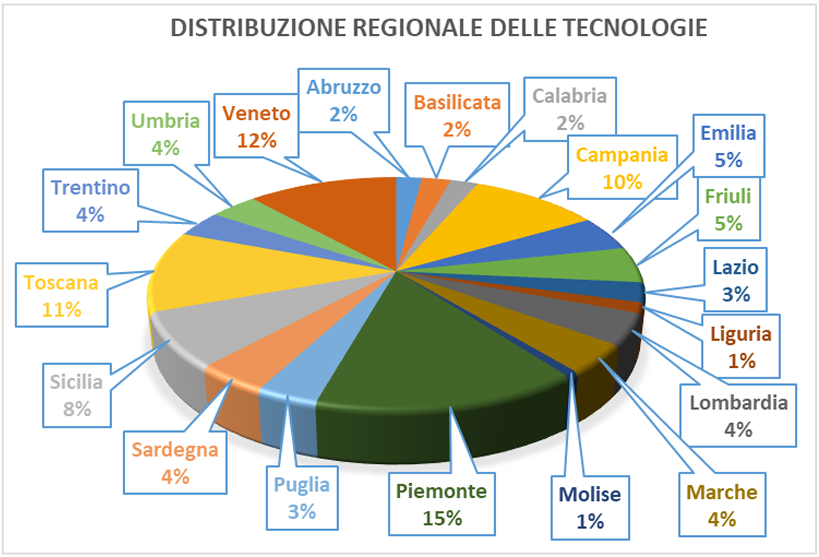
Regional distribution of technologies – Source: Rural Hack – Decanto
These data show the growing interest within the sector for technological innovation, but also the need to clarify and make the concrete benefits of digitalization in the wine industry more visible. Producers need tangible examples and practical demonstrations of the advantages that adopting new technologies can bring in terms of efficiency, quality, and competitiveness. Continuing to invest in innovative projects may be the first step in earning the trust of the true “wine wizards,” but our task is to show that we are here to help, not to complicate things.
In short, between the rows of vines and the cellars, where the fine scent of wine fills the air, there is also room for digital technology to support a future that is becoming sustainable and ready to conquer the world… one sip at a time!
Article by Fabiana Mango