

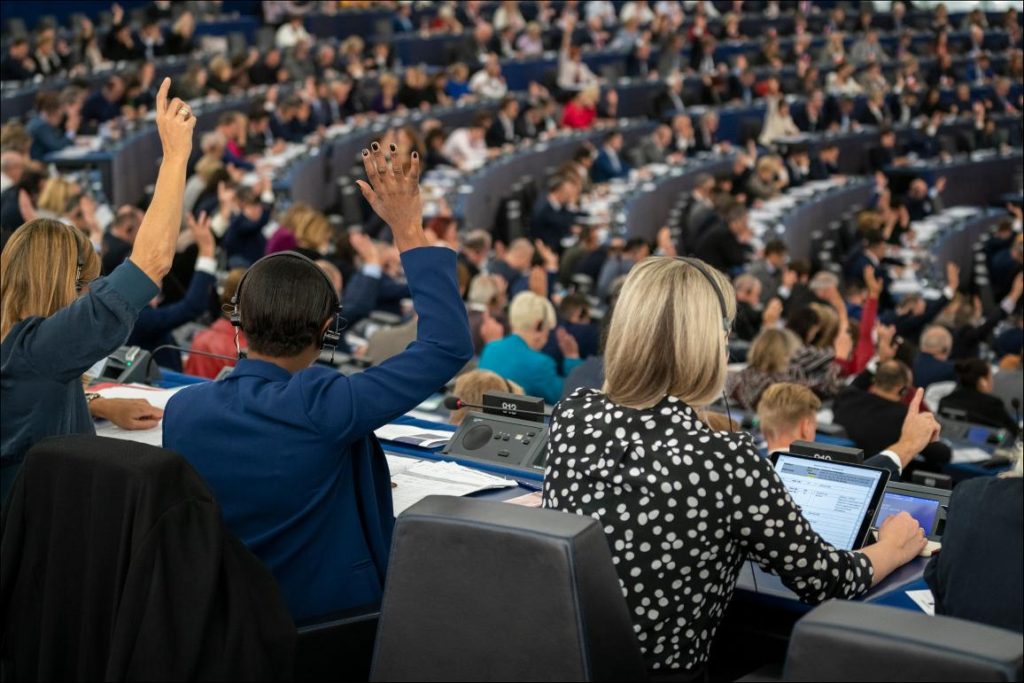
The European Parliament has proposed banning companies that market plant-based preparations or laboratory-produced raw materials from using names that recall meat-based preparations. This is intended, they say, to avoid confusing consumers and to defend the work of livestock farmers. However, the operation is neither simple nor immediate. Nor, perhaps, does it make sense.
Marx and Alice Warned Us
Do you remember Humpty Dumpty? He was an egg in a famous English nursery rhyme who falls from a wall, and there is no way to put the pieces back together. Somehow, however, he must have recovered, as we find him in Lewis Carroll’s second novel, Through the Looking-Glass, and What Alice Found There. Here, Humpty Dumpty, having perfectly recovered his form (literally and figuratively), dialogues with Alice about words:
“When I use a word,” Humpty Dumpty said, in rather a scornful tone, “it means just what I choose it to mean—neither more nor less”. “The question is,” said Alice, “whether you can make words mean so many different things”.
“The question is,” said Alice, “whether you can make words mean so many different things”.
“The question is,” replied Humpty Dumpty, “which is to be master—that’s all”.
Indeed, in the end, that is all there is to it. I like to think that Carroll had read Karl Marx’s The German Ideology, published a few decades earlier, and made “pop” the statement that:
“The individuals who compose the ruling class possess, among other things, consciousness, and therefore think. Insofar as they rule as a class and determine the entire scope of a historical epoch, it is evident that they do so in its full extent, and therefore, among other things, they also rule as thinkers, as producers of ideas that regulate the production and distribution of the ideas of their time. It is therefore evident that their ideas are the dominant ideas of the epoch”.
I cannot say, however, if the French center-right MEP Céline Imart had these authors in mind when, on October 7, she saw her proposed amendment to the CMO (Common Market Organization) win a large majority to ban “meat sounding” terms in plant-based preparations. Imart pointed out that “it is a matter of transparency and clarity towards consumers, as well as recognition of the work of farmers” and added that she does not want to ban plant-based alternatives but only to “ensure that terms have their real meaning”.
Nothing Has Happened Yet
In fact, at the moment, nothing more than what was stated above has occurred. Although many headlines claimed that “Europe has banned” calling soy products “hamburgers” or chickpea products “meatballs,” the truth is that the EU has banned nothing at all yet. The European Parliament does not legislate; it proposes. Now, the CMO amendment proposal will be taken up by the Commission, which will initiate a dialogue with the Parliament and the Council, creating what—using a term Carroll would have liked—is called a Trilogue.
So, keep calm; but in the meantime, let’s try to understand, given that this institutional anxiety for consumer clarity is intermittent at best. Proof of this is the reluctance to use words like “artificial” or “synthetic” on labels to indicate, for example, synthetic flavorings—molecules identical to natural ones but obtained in a lab, often from non-edible raw materials. That would be a good way to avoid confusion. Instead, synthetic flavors are called “nature-identical flavorings,” but on labels they can be listed simply as “flavorings” for brevity. But back to our business.
Old Words for New Products
There are several reasons why the “meat sounding” issue is not easily solved.
One point raised by Stefano Bartezzaghi, semiologist and journalist, is rather unsettling:
““This ‘meat sounding’ thing is a clever catchphrase, but technically it means nothing. You cannot name something new without referring to something known. The word polpetta (meatball) comes from polpa (pulp/flesh). If the argument were that meatballs are only made of meat, then butchers should sue paper mills that use wood pulp!. Language doesn’t work that way; common words are used to name innovations, and no one gets confused. We constantly talk about the web, the mouse, platforms, and networks: the words aren’t new, but the objects falling under their meaning are. Why should plant-based food producers be deprived of a part of their linguistic heritage?”.
The most important reason in legal terms, however, is that there is no primary European regulation that specifically prohibits using butchery terms for other sectors. For milk, for example, a primary rule existed, making it easier in 2017 for the European Court of Justice sentence to ban calling anything “milk” that does not come from a mammal. Thus, we said goodbye to “tofu butter” and “veggie-cheese,” though Italy saved “almond milk” due to rooted traditions.
Was Gaber Right?
In 2020, a similar proposal was rejected by the previous European Parliament, which has since shifted further to the right following the 2024 elections. What does the right have to do with the fight against plant-based ingredients?. Is “minestrone always leftist,” as in the Gaber song?. Let’s not fall into the trap: Gaber was right in another passage of “Right/Left”:
Ideology Ideology
Despite everything, I still believe it’s there
Continuing to assert a thought and the reason behind it
With the excuse of a conflict that doesn’t exist.
If it’s there, who knows where it is; if it’s there, who knows where it is.
Let’s start from there, from the conflict that could legally exist.
The real point is the CMOs (Common Market Organizations), which define European rules and product definitions for each agricultural category. While some categories have clear rules, the situation for meat is still evolving.
This is a market problem, explains Stefano Masini, professor of Food Law:
“Any element of confusion or ambivalence in the information provided to the consumer translates, from a market perspective, into a barrier to trade. The need for harmonization, aimed at standardizing the linguistic rules for the circulation of food products regardless of their qualitative characteristics, has already penalized our country due to our range of traditional products and consumption habits. I am thinking of the designation ‘vinegar,’ which traditionally in Italy is the result of wine fermentation, and which was subjected to a devaluation of its distinctive qualities through a choice of linguistic standardization that also included products derived from the fermentation of apples or pears, with penalizing effects on our producers, albeit in respect of other European traditions. From a legal standpoint, the ruling on dairy products is a firm point, but for meat, it is necessary to proceed with a more complex definition in the absence of a precise one.

Making things even more complex is the fact that technology allows for the production of foods that did not exist until recently. Therefore, as Bartezzaghi noted, they can only be given a comprehensible name by referencing terms that the consumer can understand.
‘I completely disagree with this,‘ Masini points out, ‘because using designations that are familiar within the collective imagination and culture to classify products of a different composition influences consumer behavior and amounts to a deceptive practice, leading to a clear loss of value for traditional products: precisely because technology today allows previously non-existent products to be put on the market, the meat market and the meat industry could face a crisis.”
The Market Doesn’t Want Worries
We have therefore reached the sore point: market considerations and concerns over trade between countries, at least within the European Union. For this reason, individual Member States cannot legislate on the definition of food; only the European Union has the power to do so. This is also why Italian Law 172/2023, ‘Provisions regarding the prohibition of the production and placing on the market of food and feed consisting of, isolated from, or produced from cell cultures or tissues derived from vertebrate animals, as well as the prohibition of the meat designation for processed products containing plant proteins,’ is—let’s just say—of little consequence.
However, the amendment proposed by Imart relies on other elements; the market is apparently the least of their concerns. The issue is supposedly the protection of the breeders’ know-how and clarity of communication to consumers. Bartezzaghi, what are your thoughts?
“It is clear that all this anxiety to regulate words has to do with the market and not with common usage. Common usage cannot be regulated. We continue to order our cappuccino with soy milk, with all due respect to packaging and labels. Just as we continue to call peach or apricot jams ‘marmalade’, and not just the citrus ones. Regulation distances spoken language from written language in an attempt to stem the tide of change. Labeling must aim for correctness towards the consumer, and you can define rules that all producers must follow, but you cannot regulate the way people speak. Perhaps it will change over time, sooner or later, but it takes generations. Like when street or square names change: dual versions survive for decades, and if you want to be sure of being understood when using the new designation, you would do well to mention the old name too, perhaps with a ‘former’ in front of it.”
If we don’t use the words we have, how will we understand each other?
Heraclitus already said it: ‘to speak with understanding, one must draw upon what is common,‘ and Umberto Galimberti’s latest book, Le disavventure della verità (Feltrinelli 2025), reminds us of this. The fact remains, however, that in this specific case, the proposed ban does not seem geared toward helping the consumer choose, and it is unclear how an eggplant cutlet could damage the know-how of cattle farmers.
“If every one of us started acting like a purist, we would be ruined,” Bartezzaghi continues. I am Milanese; for me, no “cotoletta” exists other than veal. I shudder at the thought of a chicken cutlet, let alone eggplant. But as an observer of linguistic habits, I say the exact opposite: There are languages, and then there are ‘sub-languages,’ variants of the common tongue: they differ by region, ethnicity, or even social group. When these groups meet, they must surely find a way to understand one another, mustn’t they? And how can they do so if not by starting from shared concepts and words that make sense to everyone? Here, ‘legality’ does not exist; regulating by exclusion, rather than opening up to new meanings for already familiar words, creates friction between the decisions of those with the authority to regulate and those who actually possess the usage of the words. In speech or informal writing, usage will always prevail”
From word to brand in a heartbeat.
“That much is certain; however, the rules imposed on those producing vegetarian alternatives will create problems for those producers. Furthermore, as noted by Michele Fino—Professor of Fundamentals of European Law at the University of Gastronomic Sciences in Pollenzo (Cn) in a social media post—the EU cannot harm one category of economic operators while favoring another.”
“Bartezzaghi, does preventing a group of producers from using words that belong to common usage mean harming them?
““Well, I’d certainly say so, because it’s as if the market were transforming common words into brands. Sometimes, in everyday use, the opposite happens: words that were originally brands become common nouns for objects in the same category. Think of how we call any adhesive tape ‘Scotch,’ or the English term for a vacuum cleaner, ‘hoover.’ Or even the way—considered a bit vulgar today—we refer to condoms as goldoni, even using it in the singular; this stems from the perfectly normal surname of the man who marketed the first brand of this product, which he invented.
Now, however, the market—or at least the institutions that regulate it—is doing the exact opposite. They are treating common words as if they were brands and, as such, the ‘property’ of someone or a specific category of producers: sausage, meatball, steak, cutlet. How are these supposed to be replaced with words of equal clarity and effectiveness? If you impose taboos by law, you literally end up no longer having the words to say it.”
So, if this proposed ban were to go through—even if it takes at least a couple of years according to procedure—what alternative definitions would even be possible?
“Language also has its limits; we see this all the time. At a certain point, you have to stop and accept the rules of linguistic communication. If you decide to subvert those rules instead, sooner or later you step outside of language itself. This happened with the LGBTQ+ issue: the concern with including as many nuances and categories as possible, without leaving anyone out, overstretched the possibilities of language. As a result, they had to resort to that ‘+’ sign, which is a non-linguistic symbol.”
Qui la preoccupazione sembra esattamente opposta, ovvero quella di escludere, però il tema è il medesimo. Quindi conviene abbandonare l’idea che la lingua faccia il mondo? È un’idea affascinante, ma a giudicare da questa piccola vicissitudine europea sembra che vengono prima le cose e solo dopo le parole.
“Here, the concern seems to be the exact opposite—that is, to exclude—yet the theme remains the same. So, is it time to abandon the idea that language creates the world? It is a fascinating concept, but judging by this minor European ordeal, it seems that things come first, and words only follow.”
But in a democratic system, institutions are supposed to be there to protect the common good; they should be a bit less arrogant than Humpty Dumpty.
“Certainly, and in fact, there is a further risk in trying to force language usage through regulations: that is, giving citizens the feeling that institutions don’t just disregard the common use of language, but the very daily lives of the people connected to it. It makes it seem as though institutions aren’t there to make everyday life easier for them, but rather to protect the specific interests of a certain economic category. They raise clouds of linguistic smoke, knowing full well that we will all continue to call even the tofu ones ‘cutlets,’ yet they go out of their way to ensure that those who produce meat cutlets have more tools—more words—and market advantages, making it perfectly clear, as it happens, who is really in charge.”