

The FoodSystem 5.0 Summer School returns to Sessa Cilento from September 3rd to 5th, 2025. This marks the third stage of a journey that follows the rhythm of the seasons, following two successful events previously held in March and June. Discussions first focused on soil and its regeneration, followed by community olive growing, always utilizing a multidisciplinary approach that combines science, technological innovation, and regenerative practices.
With the third edition, the journey takes root in the Cilento, Vallo di Diano and Alburni National Park, an emblematic location for experimenting with new forms of community and social regeneration.
Active “Restanza”: Beyond the Picturesque Ideal of Small Villages
In recent years, the term restanza has often been associated with a static vision of small villages, reduced to nostalgic postcards or backdrops for quick and superficial tourism. Hence, the concept for the third stage of the FoodSystem 5.0 Seasonal School: Active Restanza.
The Summer School proposes a different perspective: moving beyond stagnation and folklore to promote small villages as spaces for social innovation, capable of hosting “communities of intent.” These are groups of people who consciously choose to share common values and projects, regardless of birth ties or territorial background.
Communities of Intent: A Generative Choice
Scientifically led by Alex Giordano—director of Rural Hack and professor at the University of Naples Federico II—the Summer School invites participants to reflect on how to build fluid, generative, and future-oriented communities.
In this journey, food takes on a central role: it is not merely nourishment, but a universal language and a social technology, capable of bridging the local and the global, tradition and innovation.
Program for September 5th
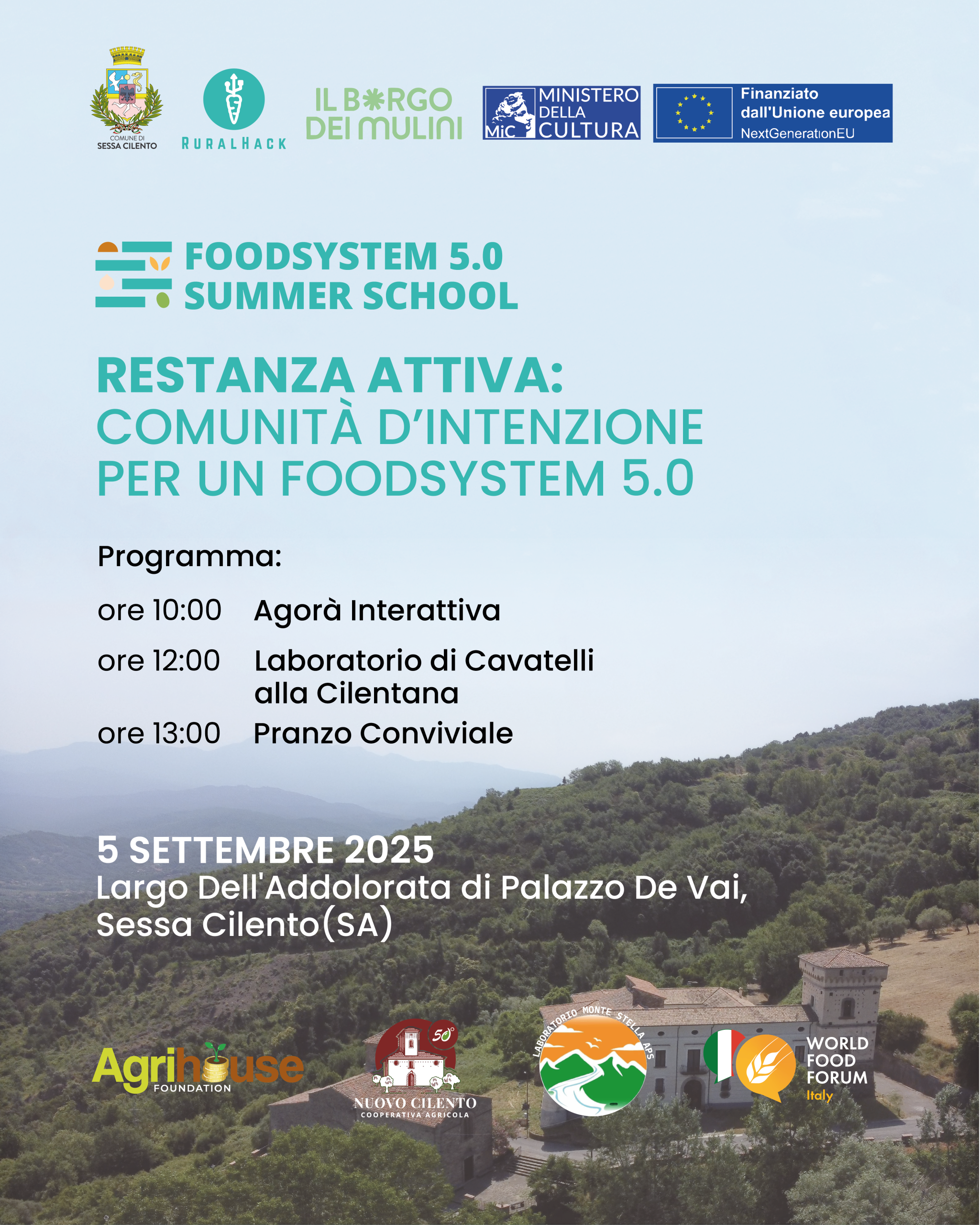
September 5th marks the concluding day of the FoodSystem Summer School 5.0 and is characterized by a strong focus on the role of the Municipality of Sessa Cilento as the promoting entity and local point of reference. The decision to hold the event in the heart of the village underscores the desire to root the educational journey within the local community, transforming the historic center into a space for dialogue and social innovation, thanks to the invaluable contribution of the Laboratorio Montestella APS.
The initiative is not limited to the academic sphere but is open to the entire citizenry, creating an opportunity for collective participation where the knowledge of young scholars and international researchers intertwines with the everyday experiences of the inhabitants. The presence of the Rural Hack alumni network, together with participants from the World Food Forum, strengthens an ecosystem of relationships that extends beyond the borders of the village, connecting Cilento to national and global networks.
The final day of the Summer School thus presents a significant opportunity: for the inhabitants, who experience firsthand a moment of openness and exchange; for the researchers, who test new community models in the field; and for the territory itself, which establishes itself as a laboratory for FoodSystem 5.0 in action.
An ecosystem of partners and collaborations
The Summer School is organized in collaboration with the Salerno Chamber of Commerce, PIDMed, Agrifood Future, Agrihouse Foundation, Hub RETE di Salerno, the Nuovo Cilento Agricultural Cooperative, World Food Forum – Italy Chapter, and Lazy Farm.
The initiative also holds the moral patronage of the Giustino Fortunato University, the Department of Social Sciences at the University of Naples Federico II, and the Institute for Research on Innovation and Services for Development of the CNR.
The Summer School is part of Rural Hack’s cycle of four Seasonal Schools, which is integrated into the “Il Borgo dei Mulini” project by the Municipality of Sessa Cilento, funded by the Ministry of Culture through the PNRR (National Recovery and Resilience Plan) – under the “Attractiveness of Historic Villages” initiative.
The goal is to transform Sessa Cilento into a laboratory for civic participation and an incubator for sustainable innovation, countering depopulation and enhancing historical and natural resources. The village thus becomes a model of active restanza, where tradition and innovation intertwine under the banner of FoodSystem 5.0.